Electric arc welding includes MIG welding, TIG welding, Stick welding, and Flux-cored welding, of which MIG welding and TIG welding are the most common welding techniques and both use electric arcs and shielding gases. However, there are still some differences between MIG and TIG welding, and knowing MIG vs TIG welding is of great importance for welders to choose the right welder and welding process.
In this article, we will compare MIG welding and TIG welding from the aspects of welding processes, welding pros and cons, welding applications, and selection of MIG vs TIG welders, so as to help you distinguish the welding techniques and choose the right welding process.
I. Welding Process of MIG and TIG Welding.
1) MIG Welding Process
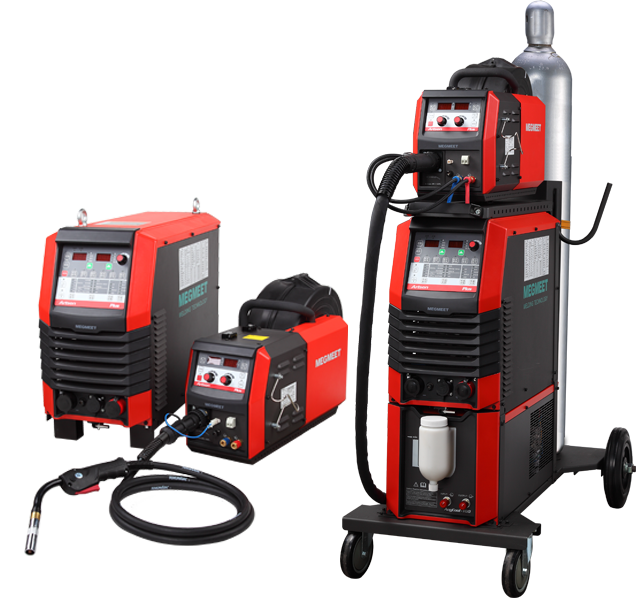
MIG welding stands for Metal Inert Gas welding, also known as Gas Metal Arc Welding (GMAW), which is a widely used welding process that uses a consumable wire electrode to join metals. It is a relatively easy and fast process that produces high-quality welds with excellent appearance and strength. The process uses a constant voltage (CV) welding machine, a wire feed system, and a welding gun to deliver the welding arc to the workpiece. The process also uses a shielding gas to protect the weld from oxidation and contamination. MIG welding is a versatile process that can weld various metals, including carbon steel, stainless steel, and aluminum.
2) TIG Welding Process
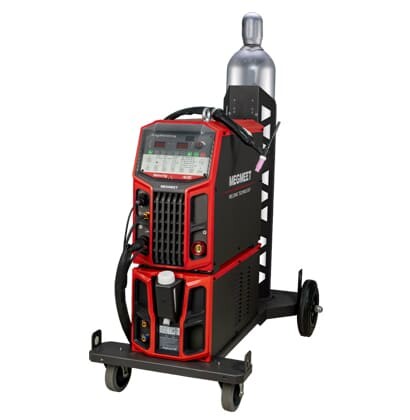
TIG welding stands for Tungsten Inert Gas welding, also known as Gas Tungsten Arc Welding (GTAW), which is a welding process that produces high-quality, precise, and clean welds. The TIG welding process uses a non-consumable tungsten electrode to create the welding arc, and a separate filler metal is used to create the weld. The process also uses a shielding gas, usually argon, to protect the weld from oxidation and contamination. TIG welding is a versatile process that can weld various metals, including aluminum, stainless steel, and titanium, among others.
To learn Gas-shielded arc welding processes (TIG/MIG/MAG).
II. Pros and Cons of MIG and TIG Welding (MIG Versus TIG Welding).
1. Advantages of MIG Welding:
Faster welding speed: complete large welding jobs quickly.
Easy to learn: an ideal welding technique for novice welders.
Versatile welding technique: weld multiple materials like steel, aluminum, and stainless steel.
High-quality welds: high-quality welds that are strong and durable.
Less slag: less clean-up after the welding job is complete.
Less distortion: maintain the shape and integrity of the material being welded.
2. Disadvantages of MIG Welding:
Higher cost: more expensive than other welding equipment.
Not suitable for outdoor use: requires a constant flow of gas.
Not suitable for all welding positions: hard to weld in certain welding situations.
Higher cleanliness requirement: the metal being welded must be free from rust, oil, and other contaminants.
Limited penetration: can not penetrate thick materials as deeply as other welding techniques.
Limited thickness: can not weld materials that are too thick.
3. Advantages of TIG Welding
Preciser and cleaner: ideal for thin materials and metals like aluminum and magnesium.
High-quality welds: no slag, spatter, or other impurities, is ideal for welding metals that require a clean, aesthetic appearance.
Greater control over the welding process: capable of adjusting the heat input, weld speed, and weld puddle size to achieve the desired weld.
Versatile welding technique: weld multiple materials like stainless steel, aluminum, copper, brass, and titanium.
4. Disadvantages of TIG Welding
Slower welding speed: less suitable for high-volume welding applications.
Higher skill level: takes years of training and practice to master.
Expensive equipment: less accessible for beginners or occasional welders.
Limited penetration: less suitable for welding thick materials or joints with deep penetration requirements.
To know the Pros and Cons of Stick Welding and MIG Welding.
III. A table Comparison of MIG welding and TIG welding (MIG VS TIG Welding):
| Aspect | MIG Welding (Metal Inert Gas / GMAW) | TIG Welding (Tungsten Inert Gas / GTAW) |
|---|
| Full Name | Metal Inert Gas Welding / Gas Metal Arc Welding (GMAW) | Tungsten Inert Gas Welding / Gas Tungsten Arc Welding (GTAW) |
| Electrode Type | Consumable wire electrode | Non-consumable tungsten electrode |
| Filler Material | Wire electrode fed automatically through a spool | Separate filler rod added manually (optional for autogenous welds) |
| Shielding Gas | Usually Argon, CO₂, or Argon-CO₂ mix | Pure Argon or Argon-Helium mix |
| Welding Speed | High — suitable for fast production | Slower — focused on precision and control |
| Ease of Use | Easier to learn and operate | Requires higher skill and coordination |
| Metal Thickness | Best for medium to thick materials | Ideal for thin materials and delicate workpieces |
| Weld Appearance | Moderate finish, may require post-cleaning | Very clean, aesthetic, and spatter-free welds |
| Weld Strength | Strong and durable for most structural jobs | Very strong and precise for critical applications |
| Precision Control | Limited control over heat and puddle | Excellent control over heat input and weld pool |
| Portability | Portable but needs shielding gas — less ideal outdoors | Portable but slower and more sensitive to environment |
| Material Compatibility | Steel, stainless steel, aluminum, copper, nickel | Aluminum, stainless steel, titanium, magnesium, copper |
| Equipment Cost | Lower initial investment | Higher cost for power source and accessories |
| Maintenance & Consumables | Regular replacement of wire and contact tips | Tungsten tips require occasional grinding or replacement |
| Typical Applications | Automotive, fabrication, construction, shipbuilding | Aerospace, food-grade equipment, precision manufacturing |
| Operator Skill Level | Beginner to intermediate | Advanced or professional-level welder |
| Productivity Level | High — suitable for high-volume production | Low to moderate — suited for small-scale or precision work |
IV. Application of MIG and TIG Welding.
1) MIG Welding Applications
MIG welding is ideal for thicker materials and production environments where speed and efficiency matter more than cosmetic appearance.
It is commonly used in:
Automotive manufacturing and repair
Construction and structural steelwork
Shipbuilding and heavy fabrication
General manufacturing and industrial automation
By selecting different shielding gases and filler wires, MIG welding can join steel, aluminum, nickel, and copper alloys efficiently. For more, read Metal Inert Gas (MIG) Welding - Process and Applications.
2) TIG Welding Applications
TIG welding excels in high-precision and aesthetic-critical applications, where weld integrity and appearance are paramount.
It is widely used in:
Aerospace and aviation structures
Food and pharmaceutical equipment
Art fabrication and custom metalwork
Industrial piping and pressure vessels
TIG’s fine control over heat input and filler deposition allows it to handle thin materials, complex geometries, and multi-pass welds with minimal distortion.
V. Selection of MIG vs TIG Welding Machines.
Selecting the right MIG or TIG welder can be a daunting task, especially if you are new to welding. Here are some key factors to consider when choosing a MIG or TIG welder.
1) The materials and their thickness to be welded: MIG welders are ideal for welding thicker materials such as steel, while TIG welders are better suited for thinner materials like aluminum. Look for a welder that has the appropriate power and amperage for the materials you will be working with.
2) The duty-cycle and cooling system of the welder: A welder with a high-duty cycle can handle long periods of continuous welding without overheating. Look for a welder with a built-in cooling system to prevent overheating and extend the life of the welding machine.
3) The usability, portability, and durability of the welder: Look for a machine that is easy to set up and use, with clear controls and displays. Consider the weight and size of the machine if you need to move it frequently. Look for a machine with a sturdy build and a warranty to ensure it will last.
4) The budget of the welding machine: Welders range in price from a few hundred to several thousand dollars. Determine your budget and look for a machine that meets your needs without breaking the bank.
Conclusion
Both MIG and TIG welding are essential techniques in modern fabrication.
Choose MIG welding for productivity, thicker materials, and straightforward projects.
Opt for TIG welding when precision, appearance, and control are priorities.
If you need to buy a MIG welder or TIG welder after knowing their differences, you can contact Megmeet Welding Technology (one of the best CO2/MIG/MAG/TIG welding machine designers and manufacturers in China) to choose the suitable one based on your needs and budget. If you want to learn more welding tips, you can collect Megmeet News Center Page or follow our LinkedIn page.
Related articles:
1. Welding Techniques Explained: MIG, TIG, Arc, and More
2. Laser Welding vs MIG Welding: the Basics
3. MIG, Pulsed MIG, and Double Pulsed MIG Explained.
4. MIG Welding VS. MAG Welding: What is the differences?
5. Laser Welding vs TIG Welding - What’s the Difference