In the world of metal fabrication, the Metal Inert Gas (MIG) welding process—technically known as Gas Metal Arc Welding (GMAW)—has long been the gold standard for productivity and ease of use. However, as industries push for lighter materials, higher aesthetic standards, and thinner gauges, standard MIG has evolved.
If you are looking to upgrade your workshop or optimize a production line, you will likely encounter two advanced variations: Pulsed MIG and Double Pulsed MIG. Understanding the technical nuances between these three processes is the difference between a functional weld and a high-performance, visually stunning joint.
This comprehensive guide breaks down the mechanics, benefits, and applications of MIG, Pulsed MIG, and Double Pulsed MIG.
I. Standard MIG Welding: The Industrial Workhorse
Standard MIG welding is a semi-automatic process where a continuous solid wire electrode is fed through a welding gun into the weld pool. A shielding gas (typically Argon, CO₂, or a mix) protects the pool from atmospheric contamination.
1) How It Works?
Standard MIG operates on a Constant Voltage (CV) principle. The welder sets the voltage and wire feed speed, and the machine maintains a consistent arc length. Energy is delivered in a steady stream, resulting in one of three primary metal transfer modes:
Short-Circuit Transfer: The wire physically touches the base metal, causing a short circuit that melts the wire tip. This is best for thin materials but produces significant spatter.
Globular Transfer: Large drops of molten metal "drip" into the weld pool. This is often messy and limited to flat or horizontal positions.
Spray Transfer: A high-voltage stream of tiny droplets is sprayed into the puddle. This is fast and clean but generates immense heat, making it unsuitable for thin metals.
2) The Pros and Cons of Standard MIG
Pros: Highly productive, easy to learn, and cost-effective equipment.
Cons: High spatter in short-circuit mode, high heat input (risk of warping), and limited control over the weld's aesthetic appearance.
II. Pulsed MIG Welding: Precision and Heat Control
Pulsed MIG was developed to provide the benefits of "Spray Transfer" (no spatter, deep penetration) without the excessive heat that usually accompanies it.
1) The Mechanics of the Pulse
In Pulsed MIG, the power source "pulses" the current between a high Peak Current and a low Background Current.
Peak Current: The burst of energy is high enough to melt a single droplet of wire and "fire" it across the arc into the puddle. This is known as "one-drop-per-pulse."
Background Current: The energy drops to a level that is too low to melt the wire but high enough to keep the arc established.
This rapid cycling (often 30 to 400 times per second) allows the weld pool to cool slightly between every droplet.
2)Why Use Pulsed MIG?
Reduced Heat Input: Because the "cool" background current offsets the "hot" peak current, the overall heat input is much lower. This prevents "burn-through" on thin materials and reduces warping in stainless steel.
All-Position Welding: In standard spray transfer, the puddle is too fluid to weld vertically or overhead. Pulsed MIG "freezes" the puddle just enough to allow out-of-position welding while maintaining spray-like quality.
Zero Spatter: Because the metal is transferred in controlled droplets rather than through physical contact or messy "globs," spatter is virtually eliminated, saving hours of post-weld grinding.
III. Double Pulsed MIG: The "TIG-Like" Aesthetic
Double Pulsed MIG (sometimes called "Pulse-on-Pulse") takes the pulsing concept a step further by adding a second, lower-frequency pulse cycle on top of the high-frequency pulse described above.
1)The "Pulse-on-Pulse" Concept
While standard Pulsed MIG handles the transfer of individual droplets, Double Pulsed MIG modulates the entire welding current in a rhythmic wave. This creates a thermal oscillation in the weld pool.
As the current shifts between the "high-frequency pulse" and the "low-frequency pulse," the wire feed speed and current change slightly. This causes the weld pool to expand and contract rhythmically.
2) The Result: The "Fish-Scale" Look
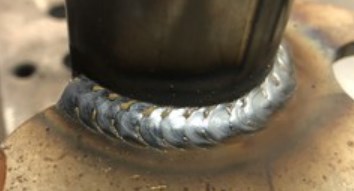
The primary hallmark of Double Pulsed MIG is its appearance. It produces the beautiful, "stacked dimes" ripple pattern traditionally associated with TIG (Tungsten Inert Gas) welding.
3) Best Applications for Double Pulsed MIG
Aluminum Welding: Aluminum is highly thermally conductive. Double Pulsed MIG provides the extra heat control needed to manage the puddle without melting the entire workpiece.
Thin Materials: It offers the ultimate control for gauges that would normally require TIG welding, but at the significantly higher speeds of a MIG process.
High-End Fabrication: For projects where the weld is visible (bicycle frames, marine hardware, custom automotive parts), Double Pulsed MIG provides a professional finish without the need for manual TIG skill.
IV. Technical Comparison Table
| Feature | Standard MIG | Pulsed MIG | Double Pulsed MIG |
| Transfer Mode | Short-circuit / Spray | One-drop-per-pulse | Pulse-on-Pulse |
| Heat Input | High | Low/Medium | Very Low/Precise |
| Spatter Level | Moderate to High | Negligible | Negligible |
| Aesthetics | Functional/Plain | Clean/Uniform | Exceptional (Fish-scales) |
| Learning Curve | Low | Moderate | Moderate to High |
| Ideal Materials | Thick Steel | Stainless, Alloys | Aluminum, Thin Alloys |
| Out-of-Position | Difficult (in spray) | Excellent | Excellent |
V. Which Process Should You Choose?
Selecting the right process is a balance between your budget, the material type, and the required finish.
1) When to Stick with Standard MIG
If you are welding heavy structural steel (over 6mm thick) in a flat position and aesthetics are not a priority, standard MIG is the most cost-effective solution. The equipment is cheaper, and the deposition rate is very high.
2) When to Upgrade to Pulsed MIG
If you find yourself frequently working with stainless steel or thinner mild steel, or if you are tired of cleaning up spatter, Pulsed MIG is the logical upgrade. It improves the structural integrity of the joint by reducing the Heat-Affected Zone (HAZ) and offers better control for vertical welds.
3) When to Invest in Double Pulsed MIG
If your primary focus is Aluminum, Double Pulsed MIG is nearly essential. Aluminum’s high heat conductivity makes it notoriously difficult to weld with standard MIG without creating "cold starts" or burning through. Double Pulsed MIG solves these issues while providing a beautiful finish that rivals TIG welding in a fraction of the time.
VI. FAQs of MIG, Pulsed MIG, and Double Pulsed MIG
Q1. Is Double Pulsed MIG as strong as standard MIG?
Yes. In many cases, it is stronger on certain materials like aluminum because the controlled heat input prevents the degradation of the base metal's mechanical properties. However, for very thick structural steel, a standard spray-transfer MIG may provide deeper penetration.
Q2. Can I use standard MIG wire for Pulsed and Double Pulsed welding?
Yes, you use the same wire (ER70S-6 for steel, ER4043/5356 for aluminum). However, Pulsed and Double Pulsed processes typically require pure Argon or a high-Argon mix (at least 80% Argon) to maintain the stable arc required for pulsing.
Q3. Why is Double Pulsed MIG so popular for aluminum?
Q4. Do I need a special machine for these processes?
Yes. Standard MIG machines cannot pulse. You need an "Inverter" power source with specialized software and synergic programming. These machines are more complex but often come with "synergic" settings where you simply select the material and wire thickness, and the machine sets the pulse parameters for you.
Conclusion
The transition from standard MIG to Double Pulsed technology represents the "digitization" of the welding arc. By controlling electricity at the millisecond level, we have moved from a crude "short circuit" to a sophisticated, controlled metal transfer.
While standard MIG will always have a place in heavy industry due to its simplicity, Pulsed and Double Pulsed MIG are the future for workshops that demand high quality, minimal cleanup, and the ability to work with the advanced alloys of the 21st century. Investing in these technologies is not just about a prettier weld; it is about efficiency, material savings, and superior structural performance.
Related articles:
1. MIG Weld Push or Pull | When to Use Push vs Pull?
2. A Comprehensive Guide to Pulse MIG Welding
3. Choosing the Right Welding Process: MIG vs TIG vs Stick vs Flux Core Welding
4. 11 Tips to Sharpen Your MIG Welding Skills
5. Spot Welding vs. TIG Welding vs. MIG Welding: Differences & How to Choose?