In the sophisticated realm of metal fabrication, Gas Tungsten Arc Welding (GTAW)—commonly referred to as TIG—is often considered the "gold standard" for aesthetic quality and structural integrity. However, even the most seasoned fabricators face a persistent adversary: heat. Excessive heat input can lead to warping, burn-through, and compromised metallurgical properties. To address these challenges, the industry has embraced a transformative evolution of the process: Pulsed TIG Welding.
Whether you are an engineer looking to optimize a production line or a specialized fabricator working with exotic alloys, understanding Pulsed TIG is essential. This comprehensive guide explores the mechanics, technical parameters, and strategic advantages of pulsing, providing the insights needed to master this precision technology.
I. What is Pulsed TIG Welding?
At its core, Pulsed TIG Welding is a process where the welding power source rapidly alternates the output current between two distinct levels. Unlike standard TIG, which provides a continuous, steady stream of amperage, a pulsed system "cycles" the energy.
This cycling allows the welder to achieve deep penetration during the "high" portion of the pulse while allowing the weld puddle to cool and solidify during the "low" portion. The result is a highly controlled thermal environment that offers significant advantages over traditional constant-current welding.
The Pulse Anatomy: Peak vs. Background
To understand Pulsed TIG, one must visualize the electrical waveform. The process relies on two primary amperage settings:
Peak Amperage: This is the high-current phase. It is responsible for establishing the arc, melting the base metal, and ensuring the filler rod fuses correctly with the joint. It provides the "punch" needed for penetration.
Background Amperage: This is the low-current phase. It is designed to maintain the arc's stability without adding significant heat to the workpiece. This phase allows the molten metal to "freeze" slightly, preventing the puddle from becoming too fluid or uncontrollable.
II. The Four Pillars of the Pulsed TIG Schedule
To effectively implement Pulsed TIG Welding, the operator must master four critical variables. Most modern inverter-based welding machines allow for granular control over these settings, often referred to as the "pulse schedule."
A. Pulses Per Second (Frequency or Hz)
This setting determines how many times the current switches from peak to background in one second.
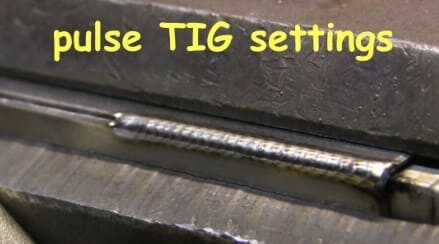
Low-Speed Pulsing (0.5 to 10 PPS): This is often used to help the welder develop a rhythm. At 1 pulse per second (PPS), the welder can time the addition of the filler rod to coincide with the peak amperage "flash." This is the secret behind the iconic "stack of dimes" appearance in manual welding.
High-Speed Pulsing (100 to 500+ PPS): At these frequencies, the pulse becomes a high-pitched hum. High-speed pulsing is used to constrict and stiffen the arc. This creates a narrower arc cone, which increases penetration and allows for faster travel speeds without increasing the heat-affected zone (HAZ).
B. Peak Amperage Percentage
This is the maximum amperage reached during the "on" cycle. It is typically set based on the thickness and type of material, just as it would be in standard TIG welding.
C. Background Amperage (as a % of Peak)
The background current is usually expressed as a percentage of the peak amperage (e.g., 20% or 30%). If the peak is 100 amps and the background is set to 25%, the machine will drop to 25 amps between every pulse. A lower background percentage provides a "cooler" weld but may make the arc feel less stable if set too low.
D. Peak Time (Pulse Width)
This variable dictates how much time the machine spends at the peak amperage versus the background amperage within a single pulse cycle. It is measured as a percentage. For example, a 50% peak time means the machine spends equal time at high and low amperage. Increasing the peak time increases the total heat input and penetration.
III. Why Use Pulsed TIG? The Strategic Advantages?
The transition from standard TIG to Pulsed TIG offers four primary benefits that can drastically improve fabrication outcomes.
A. Superior Heat Management
This is the most significant advantage of Pulsed TIG. By allowing the metal to cool for a fraction of a second during every pulse, the overall heat-affected zone is reduced. This is critical for:
Thin Materials: Preventing burn-through on sheet metal or thin-walled tubing.
Sensitive Alloys: Reducing the risk of "carbide precipitation" in stainless steel, which can lead to corrosion.
Warping Control: Minimizing the expansion and contraction that causes long parts to "banana" or twist during welding.
B. Focused Arc and Increased Penetration
As pulse frequency increases, the electromagnetic forces within the arc become more concentrated. This "arc constriction" acts like a needle, focusing the heat into a smaller area.
C. Out-of-Position Control
When welding vertically or overhead, gravity is the welder's constant enemy. In standard TIG, a large, fluid puddle can sag or drip. The "freeze-and-thaw" cycle of Pulsed TIG helps hold the puddle in place, making it significantly easier to manage "out-of-position" welds.
D. Aesthetic Consistency
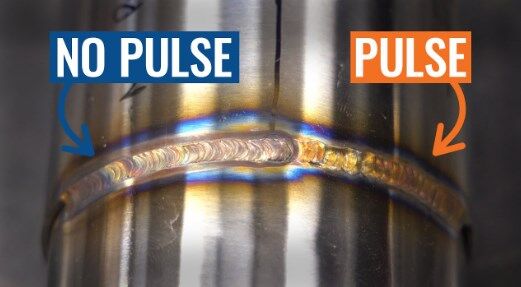
For industries where the weld is visible—such as custom automotive, bicycle frames, or food-grade equipment—visual appeal is paramount. The pulse helps the welder maintain a consistent travel speed and rod-addition cadence, resulting in perfectly spaced ripples that are the hallmark of professional craftsmanship.
IV. Pulsed TIG vs. Standard TIG: A Technical Comparison
| Feature | Standard TIG | Pulsed TIG |
| Heat Input | High and Continuous | Controlled and Cyclic |
| Arc Stability | Good | Excellent (especially at high speeds) |
| Penetration | Wide and Shallow | Narrow and Deep |
| Distortion Risk | High | Low |
| Complexity | Simple (1 Amperage) | Advanced (4+ Variables) |
| Best For | Heavy Plate, Simple Steel | Stainless, Thin Gauges, Precision Parts |
V. Material-Specific Insights for Pulsed TIG
The effectiveness of a Pulsed TIG setup varies depending on the metallurgy of the workpiece.
A. Stainless Steel
Stainless steel is notoriously poor at conducting heat. In standard TIG, the heat stays localized, often resulting in a "cooked" weld that loses its corrosion resistance and turns a dull, dark grey. Pulsed TIG allows for the "rainbow" colors (gold, purple, blue) that signify a healthy, corrosion-resistant weld by keeping the interpass temperature low.
B. Aluminum
Aluminum has extremely high thermal conductivity; it pulls heat away from the weld zone almost as fast as you can add it. High-speed Pulsed TIG (on an AC waveform) can help "punch" through the oxide layer more efficiently, though many welders prefer higher background settings for aluminum to prevent the puddle from freezing too quickly.
C. Titanium and Exotic Alloys
For aerospace applications involving titanium or Inconel, heat control is a safety requirement. Pulsed TIG minimizes the time the metal spends at critical temperature ranges, preventing embrittlement and ensuring the structural integrity of the component.
VI. How to Set Up Your Pulsed TIG Schedule?
If you are new to pulsing, the following "starting points" can help you dial in your machine.
A. For Manual "Stack of Dimes" (Steel/Stainless)
Frequency: 0.8 to 2.0 PPS
Peak Time: 50%
Background Amps: 25% to 35%
Technique: Add your filler rod every time the arc "flashes" (the peak).
B. For High-Speed Precision (Thin Stainless/Autogenous)
Frequency: 150 to 300 PPS
Peak Time: 35% to 40%
Background Amps: 20%
Technique: Move the torch quickly and steadily. You do not need to "time" the rod addition with the pulse; at this speed, the puddle remains consistently molten but very narrow.
C. For Bridging Gaps
Frequency: 1.5 to 5 PPS
Peak Time: 40%
Background Amps: 15% to 20%
Technique: The low background allows the puddle to bridge the gap and solidify before the next peak pulse adds more filler, preventing the metal from falling through the hole.
VII. Common Challenges and Troubleshooting
Despite its benefits, Pulsed TIG Welding can be tricky to master.
The "Strobe" Effect: At frequencies between 5 and 15 PPS, the flickering arc can be highly distracting and cause eye strain. Most professionals avoid this range, staying either very low (below 3 PPS) or high (above 30 PPS).
High-Pitch Noise: High-speed pulsing (100+ Hz) creates a piercing whine. This is normal but may require the use of earplugs during long production shifts.
Cold Laps: If the background current is set too low or the frequency is too slow, the weld may "cold lap," where the metal freezes so much between pulses that the next pulse fails to fuse with the previous one.
VIII Equipment Requirements: The Role of Inverter Technology
To achieve the high-speed switching required for effective Pulsed TIG, a modern inverter-based power source is generally required. Older "transformer-rectifier" machines are physically limited by the 50/60 Hz frequency of the power grid.
Modern inverters use high-speed electronics to "slice" the current, allowing for:
Pulse frequencies up to 5,000 Hz.
Advanced waveform shaping (Square, Sine, or Triangular waves).
Significantly lower power consumption and a more portable footprint.
When selecting equipment, ensure the interface allows for the adjustment of all four pulse variables to give you the most flexibility across different materials.
Conclusion
As manufacturers move toward lighter, stronger, and more complex materials, the ability to control heat input becomes the defining skill of a top-tier fabricator. Pulsed TIG Welding isn't just a "cheat code" for better-looking welds; it is a high-precision tool that allows for:
Lower rejection rates due to warping.
Higher productivity through faster travel speeds.
Better metallurgical properties in sensitive alloys.
By mastering the relationship between PPS, Peak Time, and Background Amperage, you can unlock the full potential of your TIG equipment. Whether you are welding 0.015" medical grade tubing or 1/2" structural stainless, the pulse is your key to achieving consistency and excellence in every arc strike.
Related articles:
1. Testimony of Excellence: MEGMEET DEX PM3000 Pulse Welding Machine Review
2. Why Choose a Pulse Welding Machine: Insights from Experts
3. Pulse Function of Welders & Pros and Cons of Pulse Welding
4. Pulsed Welding Technology: Solution to Sheet Metal Burn-Through
5. Pulse Technology’s Role in Enhancing Efficiency and Precision