Laser vs TIG Welding is one of the most practical comparisons in modern fabrication because the two processes solve different production problems. Laser welding is a high-energy, highly focused process that creates narrow, deep welds at high speed with a small heat-affected zone, while TIG welding, technically gas tungsten arc welding (GTAW), uses a non-consumable tungsten electrode, shielding gas, and often filler rod to deliver fine manual control. The right choice depends on the material, joint fit-up, tolerances, production volume, distortion limits, and safety requirements.
I. What Laser Welding Is?
Laser welding uses a concentrated beam of light to fuse material at the joint. Because the energy is extremely focused, it can produce narrow welds with deep penetration and a relatively small heat-affected zone. In industrial use, that combination makes it valuable for applications where speed, repeatability, and low distortion matter, including automotive, aerospace, electronics, and medical device fabrication.
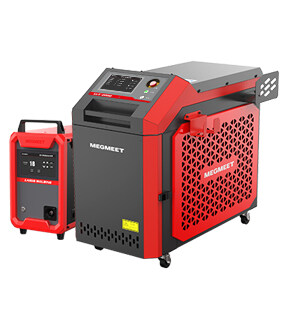
The process is also well suited to automation. Megmeet notes that laser welding can be automated through CNC or robotic systems, which makes it attractive for high-volume or high-precision production. That automation advantage is one reason laser welding is increasingly positioned as a manufacturing process rather than a purely manual skill.
II. What TIG Welding Is?
TIG welding is the informal term for gas tungsten arc welding. It uses a non-consumable tungsten electrode to create the arc, while inert gas, typically argon or an argon-based mixture, shields the puddle and the tungsten from contamination. Filler metal may be added by hand, which gives the operator very direct control over the puddle and bead formation.
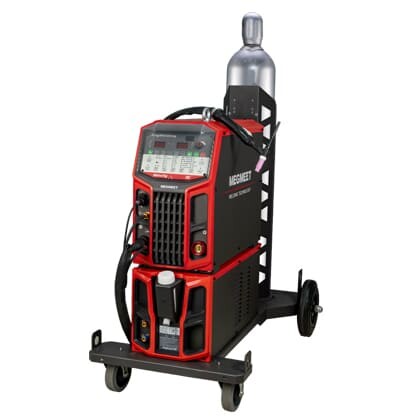
TIG is often selected when precision, appearance, and control matter more than raw throughput. Megmeet’s TIG guidance highlights the process’s use in aluminum and chrome-moly steel work and emphasizes the role of the foot pedal or amperage control in managing heat during the weld. That level of manual control is a core reason TIG remains a go-to process for detailed fabrication and repair.
III. Laser vs TIG Welding: The Core Difference
The biggest difference is how heat is delivered and controlled. Laser welding concentrates energy into a very small area, which helps create fast, narrow welds with limited thermal spread. TIG spreads heat through an electric arc and allows the welder to manage the puddle manually, which is slower but often more forgiving when fit-up, access, or bead shaping require on-the-fly adjustment.
That difference shows up in the joint itself. Laser welding tends to reward precise alignment and tight tolerances, while TIG can accommodate more variation because the welder can use filler metal and technique to bridge the joint. TWI’s laser welding research specifically notes that laser welding requires precise workpiece fit-up and accurate beam alignment, and that even hybrid laser-arc processes do not fully match arc welding’s tolerance to gap.
Side-by-Side Comparison of Laser and TIG Welding
| Factor | Laser Welding | TIG Welding | Practical takeaway |
|---|
| Heat source | Concentrated light beam | Electric arc from tungsten electrode | Laser is more localized; TIG is more operator-driven. |
| Speed | Very high | Slower | Laser is favored in throughput-driven production. |
| Heat-affected zone | Small | Larger than laser | Laser usually reduces distortion and thermal spread. |
| Fit-up tolerance | Tight | More forgiving | TIG is often better when part fit is imperfect. |
| Filler use | Often autogenous or limited filler | Filler commonly used | TIG handles gap filling more naturally. |
| Automation | Strong fit for robotic/CNC systems | Usually more manual, though automatable | Laser is easier to scale for repeat production. |
| Skill profile | Setup and system control matter most | Torch control, timing, and hand coordination matter | TIG rewards manual skill; laser rewards process control. |
| Safety profile | Laser radiation hazards; special eyewear and enclosure controls | UV radiation, fumes, hot metal, arc flash | Both need serious PPE, but hazards differ. |
IV. Where Laser Welding Has the Advantage
1) Speed and productivity
Laser welding is generally the stronger choice when output speed matters. Megmeet describes it as a high-speed process that produces narrow, deep welds, and also notes that laser welding is significantly faster and easier to automate than GTAW. In production environments, that speed translates into shorter cycle times and better throughput.
This is particularly important in industries with repetitive, high-volume parts. When the process is stable, a laser system can reduce handling time, welding time, and downstream cleanup. That is a major reason laser welding has become common in automotive, medical, aerospace, and electronics applications.
2) Lower distortion
Laser welding’s concentrated energy input helps limit the heat-affected zone, which in turn can reduce warping and residual distortion. Megmeet explicitly notes the small heat-affected zone and minimal thermal distortion associated with laser welding. That makes the process attractive for thin materials, precision assemblies, and parts that must hold tight dimensions after welding.
This advantage can matter even when the weld itself is strong in either process. If the part changes shape too much after welding, the assembly may still fail tolerance requirements. In that situation, laser welding can outperform TIG not because TIG is weak, but because laser introduces less overall thermal spread.
3) Automation and repeatability
Laser welding is especially strong when the welding task is standardized and repeatable. Megmeet notes that it can be integrated into CNC or robotic systems, which supports consistent production and tight process control. That makes it attractive for lines where the same weld must be produced many times with minimal variation.
For manufacturers, this can mean less dependence on manual consistency and more dependence on process engineering. When part design, fixturing, and alignment are under control, laser welding can deliver a highly repeatable result with less operator variation than a hand TIG process.
V. Where TIG Welding Has the Advantage
1) Gap tolerance and fit-up flexibility
TIG is typically more forgiving when parts do not fit together perfectly. Because the welder can add filler metal and manipulate the puddle manually, TIG is often better for joints with variable gaps, imperfect edges, or repair work where the geometry is not ideal. Megmeet specifically notes that MIG is more forgiving on fit-up than laser, but in the Laser vs TIG Welding comparison, TIG’s manual nature and filler capability are exactly what make it practical for less-perfect parts.
TWI’s work on laser welding fit-up tolerance reinforces this contrast. The paper explains that laser welding requires precise fit-up and accurate beam alignment, and that even hybrid laser-arc methods only improve gap tolerance partly. That is one of the clearest technical distinctions between the two processes.
2) Manual control and fine workmanship
TIG remains the gold standard when the operator needs to “draw” the weld, control the puddle in real time, and shape a clean bead with very fine adjustment. Megmeet’s TIG guide emphasizes the tungsten electrode, shielding gas, filler rod, and foot-controlled amperage as the central tools of that control. This is why TIG is often preferred for delicate work, visible welds, and repairs where the welder must respond to the joint as it changes.
That manual control has practical value on specialty metals and complex geometry. If the part requires the welder to blend a joint by feel, control the heat gradually, or add filler in a very deliberate way, TIG is usually the safer technical choice.
3) Lower equipment complexity
Laser systems are sophisticated and expensive, and they demand substantial safety controls and setup discipline. TIG equipment is still specialized, but it is far easier to deploy in small shops, repair environments, and general fabrication settings. The lower barrier to entry is one reason TIG remains dominant in many operations even when laser is technically superior in speed.
VI. Material and Thickness Considerations
Laser welding works especially well on thin to medium-thickness materials, and Megmeet notes it can be used on stainless steel, aluminum, titanium, and even dissimilar metals.Megmeet also states that many industrial systems can handle materials up to about 0.5 inches, depending on power and material type, though thicker sections may still be better served by traditional arc methods.
TIG is highly versatile across many metals, including aluminum, stainless steel, and chrome-moly steel. Megmeet’s TIG guidance also shows how filler selection, AC capability for aluminum, and amperage control are central to successful TIG work. For materials where the operator needs nuanced heat input and flexible filler addition, TIG often remains the more practical solution.
VII. Weld Quality, Strength, and Appearance
Both processes can produce high-quality welds. Megmeet notes that laser welding can be just as strong as GTAW on thin or medium-thickness materials and can produce clean welds with less spatter and distortion. That makes laser particularly attractive in applications where appearance, dimensional stability, and speed all matter.
TIG, however, still has a reputation for producing highly refined visual results and excellent control over bead shape. Megmeet’s TIG content and common welding terminology sources describe TIG as the process associated with highly controlled, aesthetically clean welds, especially when the operator is skilled. In practice, TIG is often the best answer when finish quality depends on human touch more than machine speed.
A useful way to frame it is this: laser often wins on consistency and speed, while TIG often wins on adaptability and hand-finished craftsmanship. The better process is the one that aligns with the job’s real constraints, not the one that sounds more advanced.
VIII. Safety Differences You Cannot Ignore
Laser welding introduces serious radiation hazards. OSHA states that laser hazards are addressed in specific standards for general industry, and its laser safety materials point to high-power welders and cutters as requiring careful hazard assessment and control. Megmeet also emphasizes that laser welding requires specialized safety systems, laser-rated eye protection, and appropriate enclosures or interlocks.
TIG welding carries a different safety profile. OSHA requires protection from ultraviolet radiation, covered skin, and proper helmets and hand shields, and general welding safety rules also address ventilation, burns, and fumes. TIG does not eliminate the need for PPE; it changes the hazard mix.
So while laser may offer performance advantages, it usually demands a higher level of engineered safety controls. TIG is still hazardous, but the protective measures are more familiar to most weld shops.
IX. Cost and Return on Investment
Laser welding systems are typically a larger upfront investment and may require additional maintenance, integration, and safety infrastructure. Industry sources consistently describe laser equipment as expensive and more specialized than arc-based welding equipment. That cost is easier to justify in high-volume, high-precision production where speed and automation offset the capital outlay.
TIG equipment is generally far more accessible. It is usually the better option for smaller shops, lower-volume work, prototype fabrication, repair, and jobs where the operator’s skill can compensate for less expensive equipment. The tradeoff is lower throughput.
A simple way to think about ROI is this: laser returns value through scale, repeatability, and reduced distortion; TIG returns value through flexibility, accessibility, and fine control. The right answer depends on which of those value drivers matters most.
X. How to Choose Between Laser and TIG
1) Choose laser welding when:
The parts fit together precisely, production volume is high, distortion must be minimal, the material is thin to medium thickness, and automation or robot integration is part of the plan. Laser is also a strong choice when speed and consistency matter more than manual gap-filling flexibility.
2) Choose TIG welding when:
The fit-up is imperfect, the weld is custom or low-volume, the operator needs direct puddle control, the finish is highly visible, or the application demands manual adaptability. TIG is also the safer choice from a deployment standpoint when laser-specific safety infrastructure is not practical.
XI. A Practical Decision Framework
Start with the part, not the machine. If the component is precise, repeatable, and made for automation, laser welding often gives the best performance. If the joint is variable, the design is still evolving, or the work demands human judgment at the puddle, TIG is usually the better fit.
Then consider the production environment. A controlled line with fixtures, robot access, and trained safety systems supports laser. A shop that needs repair capability, prototyping, or broad material flexibility often benefits more from TIG.
Finally, compare total cost, not just equipment price. The real cost includes training, fixturing, safety controls, consumables, rework, distortion correction, and cycle time. That is why Laser Welding vs TIG Welding is rarely a one-size-fits-all decision.
Conclusion
Laser vs TIG Welding is ultimately a comparison between precision automation and manual versatility. Laser welding delivers speed, low distortion, and repeatability, especially in tightly controlled production environments. TIG welding delivers manual control, gap tolerance, and adaptability, which keeps it valuable for custom fabrication, repair, and work that depends on skilled operator judgment.
If the project is high-volume and tightly engineered, laser often wins. If the work is variable, detailed, or built around manual craftsmanship, TIG often wins. The best process is the one that matches the joint, the production model, and the safety envelope.
Related articles:
1. Laser Welding vs TIG Welding - What’s the Difference
2. What is Hybrid Laser-Arc Welding and How Does It Work?
3. What protective gas should I use for laser welding?
4. Fiber Laser Welding: Advantages, Systems and Applications
5. Spot Size, Laser Quality and Welding Performance