Fiber Laser Welding Basics: Advantages, Systems and Applications
In the ever-evolving landscape of industrial manufacturing, the demand for precision, speed, and efficiency has driven relentless innovation. Among the most transformative technologies to emerge in recent decades is fiber laser welding. Once considered a niche technology reserved for highly specialized aerospace or medical applications, fiber laser welding has now become a cornerstone of modern manufacturing, rapidly replacing traditional methods across a multitude of industries.
But what exactly makes fiber laser welding so revolutionary? Why are manufacturing engineers and fabrication shops worldwide abandoning tried-and-true methods like Tungsten Inert Gas (TIG) and Metal Inert Gas (MIG) welding in favor of laser-based solutions?
This comprehensive guide is designed to provide an in-depth exploration of fiber laser welding. We will delve into the core physics of how it works, explore the different modes of laser welding, compare it rigorously against traditional welding techniques, and examine its myriad applications. Whether you are a manufacturing engineer looking to upgrade your production line, a business owner weighing the return on investment for a new welding system, or simply an enthusiast eager to understand cutting-edge fabrication technology, this guide covers everything you need to know about the future of joining metals.
I. What is Fiber Laser Welding?
At its core, fiber laser welding is an advanced fusion welding process that utilizes a highly concentrated beam of coherent light—generated through an optical fiber—to melt and join materials together.
Unlike traditional welding processes that rely on an electrical arc or a burning gas flame to generate heat, a fiber laser creates heat through the intense absorption of light by the workpiece. The "fiber" in fiber laser refers to the medium used to generate and deliver the laser beam. Specifically, it uses a solid-state gain medium, typically an optical fiber doped with rare-earth elements such as erbium, ytterbium, neodymium, or thulium.
Ytterbium is the most commonly used dopant for industrial fiber lasers, producing a laser beam with a wavelength of approximately 1.06 micrometers (1060 nm) in the near-infrared spectrum. This specific wavelength is highly advantageous because it is readily absorbed by a wide range of metals, including highly reflective materials like aluminum, copper, and brass, which have historically been difficult to weld with older generation CO2 lasers.
The beam is delivered through a flexible fiber optic cable to a focusing head, which shapes and directs the beam onto the precise joint where the weld is required. Because the light can be focused into an incredibly small spot (often fractions of a millimeter in diameter), fiber laser welding boasts an energy density that is unparalleled by almost any other welding technology on the market.
II. How Does Fiber Laser Welding Work?
To fully appreciate the capabilities of fiber laser welding, it is essential to understand the underlying mechanics of the system. The process of generating and applying the laser beam involves several sophisticated steps:
1. Pumping and Generation
The process begins with semiconductor laser diodes, which serve as the "pump" source. These diodes emit light that is directed into the cladding of the doped optical fiber. As this pump light bounces down the fiber, it excites the atoms of the rare-earth dopant (e.g., ytterbium). When these excited atoms return to their resting state, they emit photons of a specific wavelength. These photons stimulate the emission of more photons, creating a cascading effect of amplified, coherent light.
2. Beam Delivery
One of the greatest advantages of a fiber laser is its delivery system. In older solid-state or gas lasers (like Nd:YAG or CO2), complex arrangements of delicate mirrors and lenses were required to direct the beam to the workpiece. A fiber laser, however, generated the beam within the fiber itself, meaning the same flexible fiber optic cable can be used to transport the beam directly to the welding head. This flexibility makes fiber lasers incredibly easy to integrate into multi-axis robotic arms and automated manufacturing cells.
3. Focusing and Application
Once the beam reaches the welding head, it passes through collimating lenses (which make the diverging light rays parallel) and focusing lenses. The focusing lens concentrates the beam down to a highly intense focal spot. When this concentrated photon energy strikes the surface of the metal workpiece, the metal absorbs the light energy, converting it instantaneously into heat.
4. The Melt Pool and Solidification
The intense heat melts the base metals at the joint interface. Depending on the thickness of the material and the specific application, this can happen in milliseconds. As the laser beam moves along the seam (or as the workpiece is moved beneath the beam), the molten metal quickly flows together and rapidly cools, solidifying into a high-strength weld joint. Often, this is done autogenously (without the addition of filler metal), though wire feeders can be integrated if the joint fit-up requires it.
III. Modes of Fiber Laser Welding
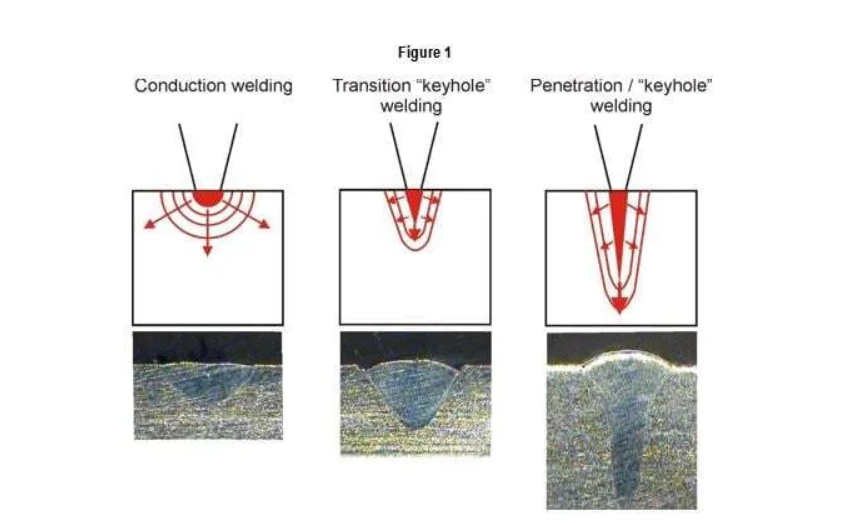
Fiber laser welding is not a one-size-fits-all process. Depending on the power density of the laser beam and the speed of travel, the welding process generally occurs in one of two distinct modes. Understanding the difference between these modes is crucial for optimizing weld quality.
1. Conduction Mode Welding
In conduction mode welding, the laser beam is focused to a lower power density. The laser energy is absorbed purely at the surface of the material, and the heat then conducts downward into the bulk of the metal.
Characteristics: The resulting weld is shallow and wide, often characterized by a smooth, highly aesthetic surface profile. The aspect ratio (depth to width) is usually low.
Applications: Conduction mode is ideal for thin materials, cosmetically critical components, and micro-welding applications where preventing burn-through is the primary concern. It is frequently used in electronics manufacturing and medical device assembly.
2. Keyhole Mode Welding
Keyhole welding occurs when the power density of the fiber laser is pushed to extremely high levels (typically exceeding 1 megawatt per square centimeter). At this intensity, the laser does more than just melt the surface; it instantaneously vaporizes the metal.
Characteristics: The expanding metal vapor exerts outward pressure, creating a narrow, deep cavity—or "keyhole"—in the molten metal pool. The laser beam then reflects down into this cavity, allowing the heat to penetrate deeply into the material. As the laser moves, the molten metal flows around the keyhole and solidifies behind it.
Applications: Keyhole mode yields a weld with a very high aspect ratio (deep and narrow) and is characterized by exceptional structural strength. It is the preferred method for welding thick plates, structural components, automotive parts, and deep-penetration applications.
3. Transition Mode (Wobble Welding)
Recent advancements have introduced dynamic beam shaping, commonly referred to as "wobble welding." By oscillating the laser beam at high frequencies (in circular, linear, or figure-eight patterns), operators can bridge the gap between conduction and keyhole modes. Wobble welding effectively widens the weld pool, making the process significantly more forgiving of poor part fit-up or small gaps, while still maintaining high penetration and speed.
IV. Fiber Laser Welding vs. Traditional Welding Methods
To understand why fiber laser welding has become so prominent, it is instructive to compare it with the traditional arc welding methods that have dominated the industry for decades.
TIG welding is renowned for producing high-quality, precise welds, particularly on thin materials and non-ferrous metals like aluminum and stainless steel. It relies on a non-consumable tungsten electrode to strike an arc, often requiring immense manual skill to feed filler rod and manipulate the puddle.
Speed: Fiber laser welding is exponentially faster than TIG welding. A joint that takes a highly skilled TIG welder several minutes to complete can often be finished by a fiber laser in seconds.
Heat Input: TIG welding puts a massive amount of heat into the workpiece, leading to a large Heat-Affected Zone (HAZ). This high heat input often results in severe warping, distortion, and metallurgical changes in thin metals. Fiber lasers apply highly concentrated heat, reducing the HAZ to a fraction of a millimeter and virtually eliminating thermal distortion.
Skill Level: TIG welding requires years of training to master. While programming an automated fiber laser requires technical knowledge, newer handheld fiber laser welders have been developed that allow novice operators to lay down perfect welds with only a few hours of training.
2. Fiber Laser Welding vs. MIG Welding (Gas Metal Arc Welding - GMAW)
MIG welding is the workhorse of heavy industry—it is fast, relatively easy to learn, and excellent for thick materials because it continuously feeds a consumable wire electrode into the weld pool.
Precision: MIG welding is inherently "messy." It produces significant spatter, requiring post-weld grinding and cleanup. Fiber laser welding, especially autogenous laser welding, produces virtually no spatter, yielding a clean joint that requires zero post-processing.
Penetration: While MIG is great for thick metals, achieving deep penetration usually requires massive, multi-pass V-groove preparations. A high-power fiber laser in keyhole mode can penetrate deeply into thick metals in a single pass with minimal joint preparation.
Consumables: MIG welding consumes massive amounts of wire and shielding gas. Fiber lasers often require no filler wire (though it can be used) and use significantly less shielding gas, leading to lower long-term operating costs.
3. Fiber Laser Welding vs. Resistance Spot Welding
In the automotive industry, resistance spot welding has been the standard for joining stamped sheet metal panels.
Joint Strength: Spot welding creates localized, circular bonds. Fiber laser welding can rapidly create continuous seam welds, providing dramatically higher torsional stiffness and crash strength for vehicle chassis.
Accessibility: Spot welding requires access to both sides of the material to clamp the electrodes. Fiber laser welding is a single-sided process, allowing for closed-box sections and complex geometries to be welded seamlessly.
V. The Key Advantages of Fiber Laser Welding
The rapid adoption of fiber laser welding is driven by a distinct set of advantages that directly impact a manufacturer's bottom line, production capacity, and product quality.
1. Unmatched Precision and Quality
Because the laser beam can be focused to microscopic dimensions, it provides a level of precision that is simply unattainable with an electrical arc. This precision allows for the welding of micro-components, such as medical implants and electronic sensors, without damaging adjacent sensitive areas. Furthermore, the aesthetic quality of a laser weld is pristine, often completely eliminating the need for secondary grinding or polishing.
2. Exceptional Welding Speeds
Time is money in manufacturing. Fiber laser welding can operate at speeds ranging from several meters per minute up to 10+ meters per minute, depending on the material thickness and laser power. This massive increase in processing speed drastically reduces cycle times, increasing factory throughput and lowering the cost per part.
3. Minimal Heat-Affected Zone (HAZ)
The Heat-Affected Zone is the area of base metal that has not melted but has had its microstructure and properties altered by the heat of welding. A large HAZ can lead to weakened metal, reduced corrosion resistance, and severe physical distortion (warping). The concentrated energy of a fiber laser ensures that heat is applied only exactly where it is needed. The metal melts and cools so quickly that the surrounding material is barely affected. This makes fiber lasers the ultimate choice for welding thin-gauge sheet metal, foils, and precision machined components.
4. Versatility and Dissimilar Metals
Traditional welding struggles significantly when attempting to join different types of metals (e.g., steel to copper, or aluminum to titanium) due to different melting points and the formation of brittle intermetallic compounds. The rapid heating and cooling cycle of a fiber laser minimizes the time these intermetallics have to form, making it highly effective at joining dissimilar metals. Furthermore, the 1060 nm wavelength of fiber lasers is highly absorbed by reflective metals like copper and gold, making them indispensable for battery manufacturing and electronics.
5. Ease of Automation
Fiber lasers are fundamentally digital tools. Because the beam is delivered via a flexible fiber optic cable, the welding head is lightweight and highly maneuverable. It can easily be mounted to 6-axis robotic arms, Cartesian gantries, or integrated into fully automated, continuous roll-to-roll manufacturing lines. Software controls dictate power, pulse frequency, and speed with perfect repeatability, removing human error from the equation.
VI. Potential Drawbacks and Considerations
Despite its myriad benefits, fiber laser welding is not a magical panacea. There are structural, financial, and safety considerations that organizations must evaluate before adopting the technology.
1. High Initial Capital Investment
The single biggest barrier to entry for fiber laser welding is the upfront cost. Even an entry-level, low-power automated fiber laser cell can cost tens of thousands of dollars, while multi-kilowatt, fully automated robotic systems can easily exceed half a million dollars. However, this high capital expenditure (CapEx) is often rapidly offset by drastically reduced operating expenses (OpEx), elimination of post-weld processing, and vastly higher throughput.
2. Strict Fit-Up Tolerances
Because the focal spot of a laser beam is so small (often 0.2mm to 0.6mm), the physical fit-up of the parts being joined must be exceptionally tight. If the gap between two pieces of metal is wider than the laser beam itself, the beam will simply pass right through the gap without welding anything. While technologies like beam wobbling and wire-feed integration help mitigate this, fiber laser welding generally requires higher precision in upstream machining and metal stamping processes compared to MIG welding.
3. Stringent Safety Requirements
The Class 4 lasers used in industrial fiber laser welding present severe safety hazards. The 1060 nm wavelength is invisible to the human eye, and a direct or scattered reflection can cause instantaneous and permanent blindness, as well as severe skin burns. Automated laser welding systems must be housed in strictly controlled, light-tight enclosures featuring specialized laser-safe viewing glass and interlocked doors. Even with the advent of handheld fiber lasers, operators must wear specialized, high-optical-density safety glasses and undergo rigorous safety training.
VII. Industry Applications of Fiber Laser Welding
The unique characteristics of fiber laser welding have made it an enabling technology across a diverse array of global industries.
1. The Automotive Industry and E-Mobility
Nowhere is the impact of fiber laser welding more apparent than in the automotive sector, specifically in the booming Electric Vehicle (EV) market. EV battery packs require thousands of individual cylindrical or prismatic cells to be electrically connected via busbars. These connections usually involve welding highly reflective, dissimilar metals like copper and aluminum. Fiber lasers are the only technology capable of performing these welds fast enough, and with low enough heat input, to avoid damaging the sensitive chemical components inside the battery cells. Additionally, automakers use fiber lasers to weld structural "body-in-white" frames, replacing heavy spot welds with continuous laser seams that reduce vehicle weight and improve structural rigidity.
2. Aerospace and Defense
In the aerospace sector, the strength-to-weight ratio is the most critical metric. Fiber lasers are used to weld titanium, high-strength aluminum alloys, and superalloys (like Inconel) used in jet engine turbines and fuselage structures. The deep-penetration keyhole capability allows for the welding of thick aerospace components with minimal distortion, ensuring aerodynamic tolerances are maintained perfectly.
3. Medical Device Manufacturing
Medical implants (such as pacemakers, defibrillators, and neurostimulators) as well as surgical instruments require hermetic seals to ensure they are biocompatible and safe for implantation. The micro-welding capabilities of low-power fiber lasers allow manufacturers to create flawless, gas-tight, hermetic seals on titanium pacemaker casings without damaging the delicate microelectronics housed mere millimeters away.
4. Electronics and Semiconductors
From smartphones to high-end computing components, electronics continue to shrink in size. Fiber lasers are utilized to weld microscopic electrical contacts, sensor housings, and micro-fluidic devices. The non-contact nature of the laser ensures that no physical force is applied to these fragile components during the joining process.
5. Kitchenware and Consumer Goods
Even in the production of everyday consumer goods, fiber lasers play a role. The manufacturing of stainless steel appliances, water bottles, kitchen sinks, and insulated thermoses relies heavily on fiber lasers. The technology provides a clean, aesthetic seam that requires no buffing, significantly reducing the manufacturing cost of consumer-facing products.
VIII. Choosing the Right Fiber Laser System
If you have decided that fiber laser welding is the right solution for your manufacturing needs, the next step is specifying the correct system. There are several primary variables to consider:
1. Continuous Wave (CW) vs. Pulsed Fiber Lasers
Continuous Wave (CW) Lasers: These lasers emit a steady, uninterrupted beam of energy. They are generally higher power (ranging from 1 kW to 20+ kW) and are used for deep keyhole welding, continuous seam welding, and high-speed applications on thicker materials.
Pulsed Lasers: These lasers emit energy in short, high-peak bursts (pulses). Pulsed lasers are typically used for micro-welding, spot welding, and applications highly sensitive to heat input. The pause between pulses allows the material to cool slightly, ensuring the lowest possible Heat-Affected Zone.
2. Power Output
Low Power (100W – 500W): Ideal for micro-electronics, jewelry repair, dental appliances, and very thin foils.
Medium Power (500W – 1.5kW): The sweet spot for handheld laser welders and light sheet metal fabrication (kitchenware, HVAC components, electrical enclosures).
High Power (2kW – 20kW+): Reserved for heavy industry, shipbuilding, thick automotive chassis parts, and aerospace components requiring deep keyhole penetration.
3. Automated vs. Handheld Systems
While robotic automation provides the highest throughput and consistency, recent years have seen a massive surge in the popularity of handheld fiber laser welding systems. These portable units resemble traditional MIG welding torches but emit a laser beam. They are designed to replace manual TIG welding in fabrication shops, offering speeds up to four times faster than TIG while requiring significantly less operator skill.
IX. The Future of Fiber Laser Welding
As we look to the horizon, the trajectory of fiber laser welding technology points toward greater accessibility, enhanced intelligence, and broader adoption.
Artificial Intelligence and Machine Vision: The next frontier in laser welding is the integration of AI and real-time monitoring. Modern systems are beginning to incorporate optical coherence tomography (OCT) and high-speed cameras to monitor the weld pool in real-time. AI algorithms can instantly analyze this visual data, adjusting laser power, focal point, and travel speed on the fly to correct defects before they happen.
Advanced Beam Shaping: The ability to instantly change the energy profile of the laser beam—from a sharp point to a donut ring, or a wide Gaussian spread—will allow a single laser source to perfectly tailor its heat input to specific materials, further conquering the challenges of dissimilar metal welding and poor part fit-up.
Conclusion
Fiber laser welding is no longer a technology of the future; it is the definitive standard of the present. By harnessing the power of coherent light delivered through specialized optical fibers, this technology has rewritten the rules of manufacturing. It offers a paradigm-shifting combination of breakneck speed, microscopic precision, minimal thermal distortion, and exceptional structural integrity.
While the initial investment and safety requirements demand careful consideration, the economic and qualitative benefits of fiber laser welding heavily outweigh the drawbacks for a vast majority of industrial applications. From the lithium-ion batteries powering the electric vehicle revolution to the lifesaving pacemakers regulating human hearts, fiber laser welding is the invisible bond holding the modern world together.
As the technology continues to evolve, becoming smarter, more flexible, and more affordable, we can expect fiber laser welding to completely redefine the boundaries of what is possible in metal fabrication, solidifying its place as the ultimate welding solution for the 21st century.
FAQs About Fiber Laser Welding
Q1. Does fiber laser welding require shielding gas?
Yes, in most industrial applications, a shielding gas such as Argon or Nitrogen is used. While the laser itself doesn't need gas to operate (unlike a TIG arc), the shielding gas prevents ambient oxygen and moisture from contaminating the molten metal pool, which could cause porosity or oxidation. However, because the weld pool is so small and freezes so rapidly, laser welding generally consumes significantly less gas than traditional arc welding.
Q2. Can a fiber laser weld aluminum and copper?
Absolutely. In fact, this is one of the technology's greatest strengths. Older CO2 lasers struggled with reflective metals like aluminum, copper, and brass because the 10.6-micron wavelength was largely reflected away. The 1.06-micron wavelength of a fiber laser is highly absorbed by these metals, allowing for rapid, high-quality welding of highly reflective and highly thermally conductive materials.
Q3. What is the maximum thickness a fiber laser can weld?
The maximum thickness depends entirely on the power of the laser. A standard 1.5kW to 2kW fiber laser can comfortably weld steel up to 4mm to 5mm thick. However, ultra-high-power industrial fiber lasers (in the 20kW to 100kW range) operating in keyhole mode can weld steel plates exceeding 30mm (over an inch) in a single pass.
Q4. Is fiber laser welding safe?
Fiber laser welding is incredibly safe when proper protocols and equipment are used. Because the 1060 nm light is invisible and highly concentrated, it presents a severe eye and skin hazard. Automated systems must be entirely enclosed in light-tight Class 1 safety enclosures. For handheld laser welding, operators must wear specialized laser safety glasses tailored to the specific wavelength, protective clothing, and operate within a barricaded, laser-safe enclosure to protect bystanders.
Q5. How much training does it take to operate a fiber laser welder?
Operating an automated robotic laser cell requires specialized programming and engineering knowledge. However, the new generation of handheld fiber laser welders features highly intuitive, pre-programmed interfaces. Operators who have never welded before can often learn to produce aesthetically pleasing and structurally sound welds with a handheld laser in a matter of hours, compared to the months or years required to master TIG welding.