Gas Tungsten Arc Welding (GTAW), universally known as TIG, is the pinnacle of the welding arts. It offers the cleanest, most precise, and most aesthetically pleasing results of any manual welding process. However, that precision comes with a trade-off: TIG is famously sensitive to its environment and its configuration.
 effect.jpg "Megmeet TIG Welding (Gas Tungsten Arc Welding - GTAW) effect")
Whether you are a hobbyist unboxing your first inverter or a technician transitioning from MIG to TIG, mastering the TIG Welding Setup is 90% of the battle. If your machine is dialed in, the welding becomes a matter of muscle memory. If the setup is wrong, no amount of skill can save the weld.
This guide provides a comprehensive, step-by-step walkthrough of How to Setup TIG Welding for success, covering everything from gas flow to the nuances of AC vs. DC polarity.
I. The Core Components of a TIG System
Before diving into the settings, you must ensure your hardware is correctly connected. A standard TIG workstation consists of:
The Power Source: Modern inverters are preferred for their "Pulse" capabilities and portability.
The TIG Torch: Usually air-cooled (for light work) or water-cooled (for high-amperage production).
The Work Clamp (Ground): Critical for completing the electrical circuit.
The Shielding Gas Cylinder: Typically 100% Argon.
The Remote Control: Usually a foot pedal or a torch-mounted thumb slider.
II. Setting the Polarity: DC vs. AC
One of the most common mistakes in a TIG Welding Setup is choosing the wrong current type for the material. Unlike MIG, TIG allows you to change how the electricity flows to manage heat and oxide layers.
1) DCEN (Direct Current Electrode Negative):
In this configuration, the torch is connected to the negative terminal and the work clamp to the positive.
Use for: Steel, Stainless Steel, Chromoly, and Titanium.
Why: 70% of the heat is directed into the workpiece, while 30% stays at the tungsten. This results in deep penetration and prevents the tungsten from melting.
2) AC (Alternating Current)
The current rapidly switches between positive and negative.
Use for: Aluminum and Magnesium.
Why: Aluminum forms a tough oxide layer that melts at a much higher temperature than the metal itself. The "Positive" half of the AC cycle acts as a cleaning action, "blasting" the oxide away, while the "Negative" half provides the penetration.
III. Preparing the "Heart" of the Torch: The Tungsten
The tungsten electrode is the only part of the TIG setup that should not melt. Choosing and preparing it correctly is the difference between a focused arc and a wandering mess.
1) Choosing the Right Type
2% Ceriated (Grey): Excellent all-purpose electrode for both AC and DC.
2% Lanthanated (Blue/Gold): The modern standard. It handles high amperage well and works on all metals.
Pure Tungsten (Green): Traditionally used for older transformer-based AC machines, but largely replaced by Lanthanated in modern setups.
2) Sharpening the Point
For DC welding (Steel/Stainless), your tungsten must be ground to a sharp point.
Direction: Always grind "longitudinally" (lengthwise). If you grind across the diameter, the arc will wander.
Taper: A taper about 2.5 times the diameter of the electrode is a good rule of thumb.
The "Flat" Tip: For high-amperage work, slightly blunt the very tip (creating a "truncated" point) to prevent the tip from breaking off into the weld pool.
IV. Shielding Gas and Flow Rates
TIG welding uses an inert gas to protect the molten puddle and the hot tungsten from atmospheric oxygen.
1) The Gas Choice
Never use CO₂ or MIG mixes for TIG; it will instantly destroy your tungsten.
2) Setting the Flow Rate
A common error in How to Setup TIG Welding is turning the gas up too high. Excessive gas flow creates turbulence, which actually sucks oxygen into the weld.
Standard Settings: 12 to 20 Cubic Feet per Hour (CFH).
Using a Gas Lens: If you use a gas lens (a mesh screen inside the torch nozzle), you can achieve much better coverage with lower flow rates and longer tungsten stick-out.
V. Dialing in the Machine Settings
Modern TIG machines have a "Sequence" panel. Understanding this flow is vital for a professional TIG Welding Setup.
Pre-Flow: Set to 0.5–1.0 seconds. This ensures the gas is shielding the area before the arc strikes.
Start Amperage: The "soft start" for the arc.
Upslope: The time it takes to transition from start amps to your main welding amps.
Main Amperage: Set this based on the "1 Amp per 0.001 inch" rule for steel. (e.g., 1/8" steel = 0.125" = 125 Amps).
Downslope: Critical for preventing "crater cracks." It slowly tapers the heat at the end of the weld.
Post-Flow: Crucial. Set to 1 second for every 10 amps of current. If you weld at 100 amps, use 10 seconds of post-flow to protect the cooling tungsten and the weld bead.
VI. AC Specific Setup: Balance and Frequency
If you are setting up for Aluminum, you have two additional "secret weapons" on modern machines.
1) AC Balance
This controls how much time the cycle spends "Cleaning" (Positive) vs. "Penetrating" (Negative).
2) AC Frequency
This controls how many times per second the current switches.
Standard: 60 Hz (feels like a traditional arc).
Advanced: 100–120 Hz. This constricts the arc, making it narrower and easier to direct—perfect for thin aluminum or tight corners.
VII. The Importance of Cleanliness
You can have the perfect TIG Welding Setup, but if your metal is dirty, the weld will fail. TIG has zero tolerance for oil, rust, or paint.
Steel: Grind to bright metal and wipe with acetone.
Aluminum: Use a dedicated stainless steel wire brush (never used on steel) to remove the oxide layer right before welding.
Filler Rod: Wipe your filler rods with acetone too. They often have oils from the manufacturing process.
VIII. Troubleshooting Your TIG Setup
| Symptom | Probable Cause | Solution |
| Tungsten melts immediately | Wrong Polarity (DCEP) | Switch to DCEN (Torch to Negative). |
| Black, porous weld | No gas or contaminated gas | Check for leaks; ensure 100% Argon. |
| Arc wanders/unstable | Contaminated tungsten | Re-grind tungsten length-wise. |
| Puddle "boils" or "pops" | Dirty base metal | Clean with acetone and a wire brush. |
| Yellowish/Brown dust | Lack of shielding gas | Increase post-flow and check CFH. |
IX. Introducing Megmeet MetaTIG HF ACDC/DC TIG Welder
Megmeet MetaTIG HF ACDC/DC TIG welder represents the pinnacle of TIG welding technology, offering unparalleled performance and versatility. Designed with precision and reliability in mind, this welder is equipped with advanced features to meet the demands of professional welders and enthusiasts alike.
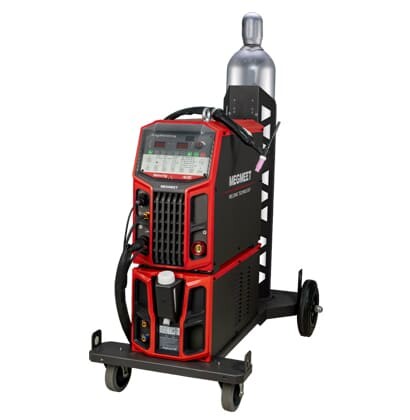
AC/DC capability: Supports both alternating current (for aluminum and magnesium) and direct current (for steel, stainless steel, and other metals)
High-frequency (HF) arc start: Enables smooth, contactless ignition without contaminating the tungsten electrode
Advanced inverter technology: Delivers stable arc performance with energy efficiency and compact design
Pulse welding functions: Allows precise heat control for thin materials and improved weld quality
Digital controls: User-friendly interface for setting parameters like amperage, pulse frequency, and slope times
This series is aimed at industrial and professional applications requiring clean, high-quality welds across various metal types. For the most current specifications or model variants, visiting the official Megmeet Welding website is recommended.
Conclusion:
A professional TIG Welding Setup is a disciplined ritual. By systematically checking your polarity, sharpening your tungsten, and adjusting your gas flow, you remove the variables that cause frustration.
Remember: TIG is a "two-handed" process. Once your machine is configured correctly, your brain is free to focus on the delicate dance between the torch hand and the filler hand.
Related articles
1. How To Shape Tungsten Electrode For TIG Welding?
2. TIG Welding Tips for Beginner and Intermediate Welders
3. How to Solve 10 Common TIG Welding Problems [Guide]
4. About Tungsten in TIG Welding: Types, Selection and Use
5. TIG Welding: A Guide to Top-Quality Connections