In the modern era of high-precision manufacturing, the shift from manual labor to automation is no longer just a trend—it is a competitive necessity. Robotic TIG Welding (Tungsten Inert Gas) represents the pinnacle of this evolution, offering a level of cleanliness, structural integrity, and aesthetic perfection that was once exclusive to the most elite manual welders.
 effect.jpg "Megmeet TIG Welding (Gas Tungsten Arc Welding - GTAW) effect")
As industries like aerospace, automotive, and medical device manufacturing face a shrinking pool of skilled labor, robotic tig welding systems have emerged as the definitive solution to scale production without sacrificing quality. This comprehensive guide explores the mechanics, benefits, and strategic implementation of robotic TIG automation to help your facility achieve top-tier performance.
I. What is Robotic TIG Welding?
TIG welding, technically known as Gas Tungsten Arc Welding (GTAW), uses a non-consumable tungsten electrode to produce the weld. The weld area is protected from atmospheric contamination by an inert shielding gas (usually argon or helium).
Robotic TIG welding integrates this precise process with multi-axis industrial robots or collaborative robots (cobots). Unlike manual TIG, where a welder must coordinate a torch in one hand and a filler rod in the other while controlling a foot pedal for heat, a robotic system synchronizes these variables with sub-millimeter accuracy.
II. The Anatomy of Robotic TIG Welding Systems
A high-performance robotic tig welding system is more than just an arm with a torch. It is a sophisticated ecosystem of hardware and software designed for continuous, high-fidelity operation.
1) The Robotic Manipulator
Most systems utilize a six-axis articulated robot arm. This allows the torch to reach complex angles and maintain a consistent "work angle" and "travel angle" across curved or intricate parts.
2) Specialized TIG Torch and Power Source
The power source must be capable of pulsing and fine-tuning amperage to manage heat input, especially on thin-gauge materials. Robotic torches are often liquid-cooled to handle the 80–100% duty cycles required in automation.
3) Automatic Wire Feeders
Consistency in filler metal is critical. Robotic systems use cold-wire or hot-wire feeders that deliver wire at a programmed rate, ensuring the weld bead profile remains identical across thousands of units.
4) Advanced Sensors and Vision Systems
Modern systems often include:
Arc Monitoring: Real-time cameras that allow operators to view the weld pool safely.
Seam Tracking: Laser sensors that detect joint deviations and adjust the robot’s path in real time.
Touch Sensing: Using the electrode or a probe to find the part's exact position before striking the arc.
III. Why Automate? The Benefits of Robotic TIG Welding
For many shops, the decision to invest in robotic tig welding systems is driven by four primary pillars of value:
1) Unmatched Precision and Consistency
Manual welding is subject to human fatigue and sensory variance. A robot, however, maintains the exact same arc length, travel speed, and torch angle every single time. This eliminates "over-welding"—the common manual habit of adding too much filler metal—which reduces material waste and grinding time.
2) Massive Boost in Throughput
While a manual welder’s "arc-on" time typically hovers around 25–40% due to repositioning and breaks, a robotic system can achieve arc-on times of 75% to 90%. This effectively doubles or triples the daily output of a single welding station.
3) Superior Aesthetics (The "Stack of Dimes")
In industries like bicycle manufacturing or high-end automotive exhaust, the visual appeal of the weld is a selling point. Robots can mimic the "pulsed" look of manual TIG with perfect uniformity, providing a high-end finish that requires zero post-weld cleanup.
4) Solving the Labor Shortage
Skilled TIG welders are among the hardest professionals to recruit. By automating repetitive TIG tasks, companies can transition their most experienced welders into "Robot Technicians" or "Process Designers," where their expertise is used to optimize programs rather than perform repetitive motions.
IV. Robotic TIG vs. Manual TIG: A Technical Comparison
| Feature | Manual TIG Welding | Robotic TIG Welding Systems |
| Accuracy | High, but varies with fatigue | Extreme (± 0.04mm repeatability) |
| Speed | Slow, limited by human dexterity | 2x–4x faster than manual |
| Duty Cycle | Low (requires breaks/prep) | High (can run 24/7) |
| Material Range | Versatile but skill-dependent | Optimized for Aluminum, Stainless, Titanium |
| Post-Weld Cleanup | Often required due to variance | Minimal to none |
V. Key Applications for Automated TIG Systems
While MIG welding is often the choice for heavy structural steel, robotic TIG welding dominates in sectors where precision outweighs raw deposition rate.
Aerospace Components: Welding thin-walled titanium ducts and engine housings where structural failure is not an option.
Automotive Exhaust & Manifolds: High-volume production of stainless steel components requiring leak-proof, beautiful seams.
Medical Equipment: Creating sanitary, smooth welds on stainless steel surgical tools and furniture.
Electronics Enclosures: Precision joining of thin-gauge aluminum boxes that must be aesthetically perfect.
VI. Steps to Implementing Robotic TIG Welding
Transitioning to an automated robotic tig welding system requires a strategic blueprint to ensure a high Return on Investment (ROI).
Step 1: Part Evaluation and Fixturing
Robots thrive on repeatability. Your parts must have consistent fit-up. If there are large gaps or variations in the joint, the robot may require expensive seam-tracking sensors. High-quality modular fixtures are essential to hold the parts in the exact same 3D coordinate space every time.
Step 2: Selecting the Right Integration Level
Standard Cells: Pre-engineered "plug-and-play" enclosures that include the robot, power source, and safety guarding.
Custom Integration: For large-scale parts (like pressure vessels) that require the robot to move on a rail or gantry.
Step 3: Programming and Simulation
Use "Offline Programming" (OLP) software to create welding paths on a computer before the robot is even powered on. This minimizes downtime and allows you to test for collisions in a virtual environment.
Step 4: Maintenance of Consumables
To keep a robotic tig welding system running at peak efficiency, you must implement an automated tungsten electrode maintenance schedule. Since the tungsten is non-consumable, any contamination or wear will change the arc characteristics. Many modern systems include automatic torch cleaners or electrode changers.
VII. Addressing the Challenges of TIG Automation
It is important to acknowledge that TIG automation is more complex than MIG automation. TIG requires:
Tighter Tolerances: Because the TIG arc is so focused, there is less "forgiveness" for poor joint fit-up.
Shielding Gas Control: Precise control of pre-flow and post-flow gas is necessary to prevent oxidation of the tungsten electrode.
Electrode Management: Tungsten must be kept sharp. Many facilities use dedicated "re-grinding" stations to ensure the robot always starts with a perfect tip.
VIII. The Future of Robotic TIG: AI and Industry 4.0
The next generation of robotic tig welding systems is integrating Artificial Intelligence (AI) to make automation accessible to smaller shops. We are seeing:
Autonomous Path Planning: Robots that use cameras to "see" a joint and generate their own weld path without manual programming.
Cloud-Based Data Analytics: Systems that track every inch of weld, logging amperage and gas flow to provide a "digital birth certificate" for every part produced.
Collaborative TIG (Cobots): Lightweight robots that can work safely alongside humans, allowing for a hybrid workflow where a human does the complex fit-up and the cobot performs the tedious welding.
Conclusion
Robotic TIG Welding is no longer a luxury for billion-dollar corporations; it is a scalable tool for any manufacturer dedicated to quality. By implementing a robotic tig welding system, you solve the dual challenges of labor scarcity and rising quality demands.
Whether you are welding thin-gauge stainless steel for food-grade equipment or high-performance aluminum for the defense sector, the precision of automation ensures that your first weld is as perfect as your thousandth.
Ready to elevate your production? The path to automation starts with identifying your most repetitive, high-value TIG tasks. The ROI—found in reduced scrap, increased speed, and flawless quality—is waiting.
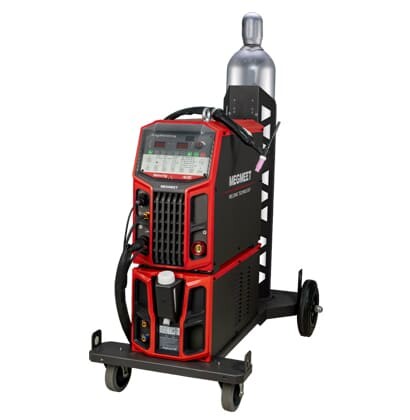
FAQ: How is Megmeet MetaTIG HF ACDC/DC TIG Welder?
The Megmeet MetaTIG HF ACDC/DC TIG welder represents the pinnacle of TIG welding technology, combining state-of-the-art features with unmatched performance and reliability. Engineered for precision welding applications, this advanced welder offers a host of benefits:
High-Frequency Arc Ignition: Ensures instant arc initiation and consistent arc stability, even when welding at low amperages or challenging materials.
AC/DC Welding Capability: Provides the versatility to weld a wide range of materials, including aluminum, stainless steel, copper, and titanium, with exceptional arc control and penetration.
Pulse Welding Function: Enables precise heat input control, minimizing heat-affected zones and reducing the risk of warping and distortion in thin materials.
User-Friendly Interface: Features intuitive controls, touchscreen displays, and programmable welding parameters for easy setup and operation in diverse manufacturing environments.
Related articles
1. What are the Importances Of Robotic Welding Systems In Industries?
2. How to Improve Robotic Welding Performance?
3. Robotic Welding & Complete Automation Solutions
4. Robotic Welding: Definition, Types, Processes, Pros and Cons
5. Aluminum Framework of Windows and Doors Robotic Welding - Using DEX PM3000 R Welder