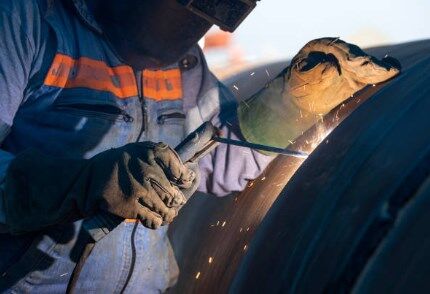
Shielded Metal Arc Welding (SMAW), affectionately known across job sites as Stick welding, is the rugged veteran of the welding world. It doesn’t require the shielding gas tanks of MIG or the surgical cleanliness of TIG. It is the "off-roader" of metal joining—it works in the rain, on rusty farm equipment, and high up on structural steel beams where the wind would blow a gas shield away in seconds.
However, because it is a manual process, the quality of a Stick weld is almost entirely dependent on the operator’s skill. From the perspective of modern welding technology, even the most advanced power source cannot compensate for poor technique. Whether you are a hobbyist trying to fix a gate or a professional looking to pass a 6G pipe test, improving your Stick welding requires a blend of metallurgical understanding and muscle memory.
This guide breaks down the essential pillars of Stick welding, focusing on the technical nuances that separate a "functional" weld from a professional-grade masterpiece.
I. The Foundation: Why Preparation Still Matters
One of the biggest myths in welding is that Stick can "burn through anything." While it is true that Stick is more forgiving of rust and mill scale than other processes, that doesn't mean you should skip the prep work.
1. The 10% Rule of Cleaning
If you want a weld that is structurally sound and free of porosity, spend at least 10% of your time cleaning the joint. Use a grinder or a wire wheel to remove thick rust, paint, and oil. Even a "deep-penetrating" electrode like a 6010 will perform better, with less spatter and a more stable arc, on clean metal.
2. The Importance of the Ground
A weak ground connection is the silent killer of arc stability. If your work clamp is attached to a rusty surface, the machine has to fight through that resistance, leading to an inconsistent arc and "arc blow." Always grind a small patch of metal to bare steel specifically for your ground clamp.
II. Mastering the CLAMS Method
In the welding industry, instructors often use the acronym CLAMS to help students remember the four variables that dictate weld quality: Current, Length of arc, Angle, Manipulation, and Speed.
1) C – Current (Amperage)
Amperage is your heat. If it’s too low, the rod will stick to the workpiece. If it’s too high, the arc will be loud, spattery, and you’ll likely burn a hole through the metal.
Rule of Thumb: A common starting point for amperage is based on the decimal equivalent of the electrode diameter. For example, a 1/8-inch (0.125-inch) electrode often runs well around 125 amps.
Signs you are too cold: The arc is hard to start, the bead is narrow and tall, and the edges aren't "wetting" into the base metal.
Signs you are too hot: Excessive spatter, a deep "crater" at the end of the weld, and the electrode glowing red-hot before you finish the pass.
2) L – Length of Arc
Arc length is the distance between the tip of the electrode and the weld puddle.
The Ideal Gap: For most general-purpose rods, your arc length should be approximately equal to the diameter of the metal core of the electrode. If you are using a 1/8-inch rod, keep a 1/8-inch gap.
The Danger of Long-Arcing: Pulling the rod too far away increases voltage, which creates a wide, unstable arc and excessive spatter. It also decreases the effectiveness of the shielding gas (the flux smoke), leading to porosity.
3) A – Angle (Travel and Work)
Stick welding is almost always a "drag" or "backhand" process. Since you are dealing with slag, you need to "drag" the puddle so the force of the arc keeps the slag behind the weld.
Travel Angle: Tilt the electrode 5° to 15° in the direction of travel.
Work Angle: This is the angle of the rod relative to the joint. In a flat T-joint, this is usually 45°. If one piece of metal is thicker than the other, point the rod slightly more toward the thicker piece to balance the heat.
4) M – Manipulation
Manipulation refers to how you move the electrode as you travel.
Stringer Bead: A straight drag with no side-to-side motion. This is the strongest weld for most structural applications.
Weave Bead: A side-to-side "Z" or crescent motion. This is used for wider joints or vertical-up welding, but be careful—weaving too wide can trap slag at the edges.
5) S – Speed of Travel
Your travel speed determines the "heighth" and "width" of the weld.
Too Fast: The bead will be thin, narrow, and won't have enough time to penetrate the base metal.
Too Slow: The heat builds up too much, creating a wide, flat bead that might melt through thin material.
III. Electrode Selection and Management
Not all "Sticks" are created equal. Using the wrong rod for the job is like trying to use a screwdriver to drive a nail.
1) Common Electrode Comparison Table
| Electrode | Type | Key Characteristic | Common Use Case |
| 6010 | Cellulose/Sodium | Deep penetration, "digging" arc. | Root passes on pipe, rusty repair work. |
| 6011 | Cellulose/Potassium | Similar to 6010 but runs on AC or DC. | Farm repairs, general maintenance. |
| 6013 | Rutile/Potassium | Easy to strike, "all-purpose" rod. | Light sheet metal, furniture, DIY projects. |
| 7018 | Low-Hydrogen | High strength, smooth "stack of dimes" look. | Structural steel, pressure vessels. |
2) The "Low-Hydrogen" Rule
Electrodes like 7018 have a flux coating that is designed to keep hydrogen out of the weld. However, this flux is a sponge for moisture. If a 7018 rod is left out in a humid garage for a week, it is no longer "low-hydrogen."
For critical structural work, these rods must be kept in a rod oven at 250°F. If you are a hobbyist, buy them in small, vacuum-sealed cans and use them immediately once opened.
IV. Advanced Techniques for Professional Results
1. The "Match-Strike" vs. "The Tap"
Striking the arc is where most beginners get frustrated.
The Tap: Bouncing the rod vertically. This often results in the rod sticking.
The Match-Strike: Flicking the rod across the metal like you are striking a match. This is generally more successful for beginners because the rod is already in motion when the arc initiates.
2. Restarting a Bead
To restart a bead (after changing a rod), do not strike the arc right at the edge of the old crater. Instead, strike the arc about half an inch ahead of the crater, move back into the crater to fill it, and then proceed forward. This ensures a seamless "tie-in" without a cold spot or a bump.
3. Filling the Crater
At the end of a weld, the metal cools and shrinks, often leaving a small hole or "crater." To prevent this, don't just pull the rod away. Instead, pause at the end for a second, circle the rod back into the puddle, and then pull away slowly.
V. Leveraging Modern Machine Features
Even though Stick is a manual process, modern inverter power sources offer electronic "cheats" that can make you look like a pro.
Hot Start: This feature briefly increases the amperage the moment you strike the arc. It prevents the rod from sticking when the metal is cold.
Arc Force (Dig): This senses when the arc voltage is dropping (meaning you are getting too close to the plate) and increases the amperage to prevent the rod from snuffing out. This is essential for 6010 "whipping" techniques.
Anti-Stick: If the rod does stick, the machine shuts off the current so the rod doesn't get red hot, making it easier to break it loose.
VI. Troubleshooting Common Stick Welding Issues
| Problem | Likely Cause | Solution |
| Excessive Spatter | Amperage too high or arc too long. | Lower the amps or move the rod closer. |
| Porosity (Pinholes) | Damp rods or dirty base metal. | Use dry rods and grind the metal to bare steel. |
| Slag Inclusions | Travel speed too slow or wrong rod angle. | Increase speed and keep a steeper drag angle. |
| Undercut | Amperage too high or moving too fast. | Lower amperage and pause slightly on the edges. |
VII. FAQs of Stick Welding
Q1: Why does my electrode keep sticking?
Q2: Can I weld aluminum with a Stick welder?
Yes, specialized aluminum electrodes exist, but it is extremely difficult. Aluminum conducts heat so fast that the rod burns incredibly quickly. For aluminum, TIG or MIG is almost always preferred.
Q3: What is the "whipping" technique?
Q4: Which polarity should I use?
Most Stick welding is done in DCEP (Direct Current Electrode Positive), also known as "Reverse Polarity." This provides the best penetration and arc stability. Some rods (like 6013) can run on AC or DCEN, but DCEP is the standard for most structural work.
Conclusion
Improving your Stick welding is a journey of consistency. By mastering the CLAMS methodology—controlling your Current, Length, Angle, Manipulation, and Speed—you remove the variables that lead to failure.
Remember that a welding machine is a partner, not a solution. Even the best equipment requires an operator who understands how to "read the puddle." Practice on scrap metal, vary your settings to see the results of "too hot" or "too cold," and always prioritize safety with the correct PPE. With time, that difficult-to-strike arc will become a smooth, rhythmic process that produces welds capable of lasting a lifetime.
Related articles:
1. Pros and Cons of Stick Welding and MIG Welding
2. What is the Difference Between Stick Welding and MIG Welding?
3. MIG/MAG, MMA, TIG Welding: Choosing the Right Technique
4. MMA "Stick" Welding: What is Open Circuit Voltage (OCV)?
5. All You Need To Know About Overhead Stick Welding