Stainless Steel Welding: Techniques, Best Practices, and Safety
Stainless steel welding is both an art and a science. As noted, “stainless steel is known for being tough against rust and heat, making it a vital material in various fields”. From architectural facades and food-processing equipment to aerospace frames and medical devices, stainless steel’s durability and corrosion resistance make it ubiquitous. However, these same properties that make stainless steel so valuable also make it challenging to weld. Successfully welding stainless steel requires careful technique, the right equipment, and a thorough understanding of the material. In this comprehensive guide, we’ll explain the fundamentals of stainless steel, explore the most common welding methods, discuss key preparation and process tips, and highlight crucial safety considerations. By mastering these topics, you’ll be equipped to produce clean, strong, and corrosion-resistant stainless steel welds.
I. What is Stainless Steel and Why Weld It?
Stainless steel is an alloy of iron that contains at least 10.5% chromium (Cr) by mass. The high chromium content allows a thin, invisible layer of chromium oxide to form on the surface of the metal, protecting it from rust and many corrosive environments. Other alloying elements—such as nickel (Ni), molybdenum (Mo), titanium (Ti), or niobium (Nb)—are often added to improve strength, toughness, or corrosion resistance under specific conditions.
Because of its corrosion resistance, high strength, and aesthetic finish, stainless steel is used in food processing, chemical plants, marine environments, architecture, automotive, aerospace, and medical devices. Its “inherent corrosion resistance makes it ideal for applications in harsh environments, such as marine or chemical industries”. It is also prized for its hygienic properties and clean appearance, making it popular for kitchenware, countertops, and surgical instruments.
However, welding stainless steel is more complicated than welding carbon steel. Stainless steel has a lower thermal conductivity and higher coefficient of thermal expansion than carbon steel, meaning it retains heat and distorts easily. It is also sensitive to heat tint and carbide precipitation, which can degrade corrosion resistance if not controlled. As Kloeckner Metals explains, even a “bad welding session” on stainless steel will often leave scratches, burn marks, or discoloration. To avoid these pitfalls, welders must understand stainless steel’s composition, choose appropriate welding processes, and follow best practices for joint preparation and heat control.
II. Types of Stainless Steel and Their Weldability
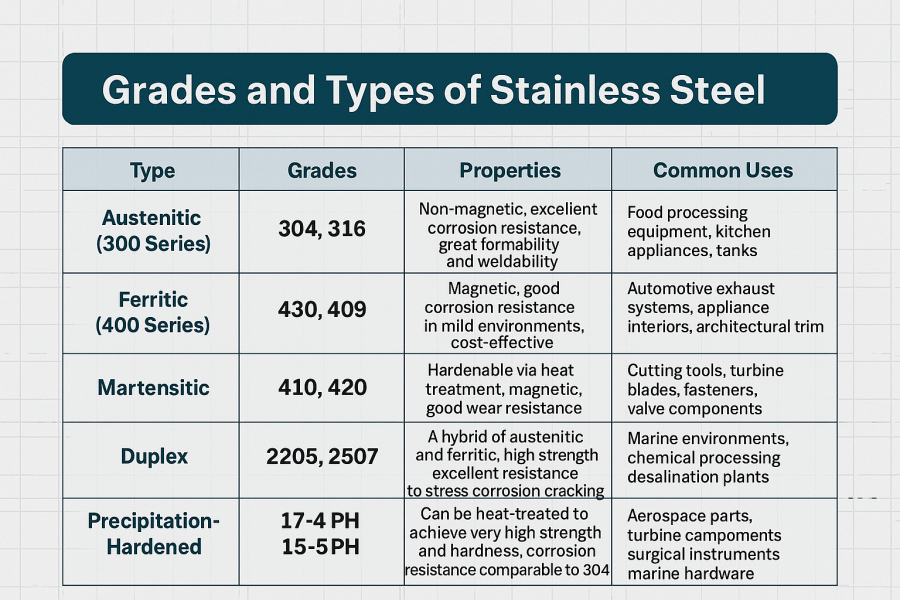
Stainless steels are categorized into several major families, each with distinct structures and properties:
Austenitic Stainless Steels (Cr–Ni steels): These include the familiar 300-series grades like 304 and 316. They contain roughly 16–26% chromium and 8–22% nickel. Austenitic steels are highly corrosion-resistant, ductile, and generally easy to weld. They maintain good toughness even at very low temperatures, and they are often used in aggressive environments like chemical plants and food processing. Austenitic grades “are among the most common” and “generally exhibit good weldability”.
Ferritic Stainless Steels: These contain 12–18% chromium and very little nickel. Ferritic steels have a body-centered cubic (ferrite) structure. They resist stress corrosion cracking and offer moderate strength. However, they have lower ductility and toughness than austenitic grades. Kloeckner notes that the lowest-cost stainless products often use ferritic steel. Ferritic steels are used in automotive and appliance applications where high toughness isn’t critical. They weld reasonably well, but special care is needed due to their relatively low maximum interpass temperature and tendency to lose strength if overheated.
Martensitic Stainless Steels: These contain 12–18% chromium and higher carbon (0.1–1.2%). They can be heat-treated to high strength but have lower corrosion resistance. Martensitic stainless steels (like the 400-series) are used for knives, valves, and shafts. They tend to crack if not preheated properly. When welding martensitic stainless, preheat is usually required to avoid cracking, and slow cooling may be needed.
Duplex (Ferritic-Austenitic) Stainless Steels: Duplex grades (e.g., 2205) have both ferrite and austenite phases, giving them a unique balance of high strength and good corrosion resistance. They typically contain ~22% chromium, 5–6% nickel, and added molybdenum. Duplex steels are tougher and have better chloride resistance than ferritic steels. However, they are more susceptible to welding challenges like excessive ferrite formation or cracking if not welded correctly. Duplex and martensitic stainless steels may present more complexities due to their higher carbon content and susceptibility to cracking. Duplex steels often require matching duplex filler alloys when welding.
Other specialized stainless families exist (e.g., precipitation-hardening, nickel-based alloys), but the types above are most common in fabrication shops. In practice, welders should always identify the grade before welding, since filler metals and procedures must be chosen accordingly.
III. Preparing Stainless Steel for Welding
Preparation is crucial for a successful stainless steel weld. Contaminants, improper joint prep, or mismatched materials can ruin a weld or degrade corrosion resistance. Follow these key steps:
Cleanliness: Remove all oil, grease, dirt, rust, paint, or mill scale from the weld area. Even small traces of carbon or other contaminants can cause porosity or ruin the passive chromium oxide layer, leading to rust in the weld zone. We warn that stainless steel is “highly sensitive to contamination,” so “any traces of grease, oil, or debris can compromise the integrity of the weld”. Use a stainless steel wire brush or specialized stainless cleaners. Keep tools (brushes, grinders) dedicated to stainless only; if they touch carbon steel, iron particles will contaminate your weld and accelerate corrosion.
Fitting and Joint Prep: Fit the pieces with minimal gap and proper alignment. For thick sections, bevel the edges to allow full penetration. We emphasize that “proper joint preparation, including beveling, chamfering, and alignment, is essential for ensuring adequate penetration and fusion”. Remove any sharp edges. Depending on the application, consider backing strips or ceramic backing for narrow groove welds to improve fusion on the backside. Clamp or tack pieces in place to prevent movement as you weld.
Selecting Filler Metal: Choosing the right filler alloy is paramount. The filler metal should match the corrosion resistance of the base metal. For example, 304 stainless is commonly welded with ER308L filler, and 316 uses ER316L filler (the “L” denotes low carbon to minimize sensitization). Matching the filler metal to the base metal grade is paramount for achieving strong, corrosion-resistant welds. Duplex steel requires duplex-grade filler, while ferritic steel uses ferritic filler. Using the wrong filler can create a weak spot that not only fails under load but can “rust”, as Megmeet warns. In practice, check base-metal specifications and AWS/AISI guidelines. For example:
Austenitic 304/304L → ER308L
Austenitic 316/316L → ER316L
Duplex (e.g. 2205) → ER2209 (duplex)
Ferritic 430 → ER409L (or similar)
Martensitic 410 → ER410 (or ER420 for higher carbon base)
Smaller-diameter wire or rod is often preferred to control heat input, as we recommend “using smaller filler rods or wires helps regulate heat input”. For TIG welding, typical filler wire sizes are 1/16″ (1.6 mm) or 3/32″ (2.4 mm), while MIG wire for thin stainless may be 0.030″–0.035″ (0.8–0.9 mm), up to 0.045″ (1.1 mm) for thicker sections. Always verify that the filler chemistry is compatible; for example, avoid adding a low-nickel filler to a high-nickel base.
Equipment and Settings: Use equipment suited to stainless. For TIG, select pure argon shielding gas and a suitable ceramic cup. Ensure the torch, collet, and tungsten size fit the amperage. For MIG, use a spool gun or push-pull gun to avoid wire feed problems, and match the contact tips to the wire diameter. If using Stick (SMAW), use stainless electrodes (they often have an “L” classification for low hydrogen). Pre-flush the gas hose and purge lines to avoid contaminated gas. If the stainless is particularly thick, preheat may be used to slow cooling; if used, do so carefully (e.g. 300–400 °F max) to avoid damaging the alloy. Generally, unlike carbon steel, stainless is not highly susceptible to hydrogen cracking, so very high preheat is usually not needed.
IV. Common Welding Processes for Stainless Steel
Stainless steel can be welded with virtually any fusion welding process. The choice depends on the application, thickness, and desired finish. The most common processes are TIG, MIG, and Stick. Other methods like resistance spot welding, plasma welding, and laser/orbital welding have niche uses for stainless.
1) TIG Welding (GTAW):
Tungsten Inert Gas (GTAW or TIG) welding is often considered the best way to weld stainless steel, especially thin sections. TIG uses a non-consumable tungsten electrode and separately fed filler rod. Its advantages include:
High Quality and Control: TIG allows precise control over heat and filler, resulting in “visually perfect seams and strong connections”. Because the arc is smaller and steadier, it minimizes splatter and oxidation.
Low Heat Input: TIG inherently has a lower heat input than many processes, making it ideal for thin gauge stainless (e.g. less than 3/16″ or 4.5 mm). The argon gas shield prevents oxidation. The ATWF blog notes that TIG creates a “low heat input, which makes it perfect for thin material”.
Clean Weld Appearance: TIG welded stainless looks very clean and smooth, with minimal color change (heat tint) if done properly.
However, TIG requires more skill and time. It is generally slower than MIG. For very thick stainless, TIG alone may be impractically slow.
TIG Best Practices: Use DCEN (DC electrode negative) polarity for stainless. Maintain a short, focused arc, and add filler steadily. Keep the tungsten sharp and aligned. If welding tubular sections, back-purging with argon on the inside can prevent inside oxide. We advise matching the weld puddle diameter to the metal thickness so as not to overheat. Also, pulsing the current can help control heat input and reduce distortion on thinner workpieces.
2) MIG Welding (GMAW/MAG):
Metal Inert Gas welding (also called Gas Metal Arc Welding, GMAW, or MIG)is very popular for welding stainless steel, especially on thicker materials or production work. In MIG welding, a continuous stainless steel wire electrode is fed through a torch, and an inert or semi-inert gas is used as shielding.
High Deposition and Speed: MIG can lay down filler much faster than TIG. For high-deposition applications, “flux-cored welding with dual-shielded wires” is an option, but even standard MIG allows quick travel on thick sections.
Less Operator Fatigue: Since wire is fed automatically and no filler rod is manually fed, the process is easier for long runs.
However, MIG requires careful gas choice and technique. Stainless MIG welding often uses tri-mix shielding gas (Ar/He/CO₂) to achieve a stable arc and good penetration. We recommend keeping CO₂ below 5% to prevent carbon pickup, and using high Helium for spray transfer or Ar for pulsed transfer. A common mix is Ar/He/2–5% CO₂. Pure argon can also be used (often with 2% CO₂) for root passes. The shielding gas choice affects arc characteristics and appearance.
MIG Tips: We emphasize use of a push technique (torch angled forward) for better puddle wetting and bead appearance. Traveling too slowly in MIG will overheat the metal; maintain a steady high travel speed. If using pulsed MIG, higher argon mix may be used. Always use a stainless dedicated wire feed liner in the gun for reliable feeding of the soft wire. A good setup ensures fewer defects.
According to ATWF, “MIG welding is popular because it allows the welder to utilize a pulsed current supply” and can use various gas mixtures (He, O₂, CO₂) to stabilize the arc. In practice, MIG is often the preferred method for medium-to-thick stainless (e.g. 1/8″ (3 mm) and above), especially in fabrication and repair work.
3) Stick Welding (SMAW):
Shielded Metal Arc Welding (SMAW or Stick welding)can weld stainless, but it is less common for critical stainless work. Stainless electrodes (such as 308L or 316L) exist and work much like carbon steel sticks, producing a slag-covered bead.
Advantages: Stick is very portable and forgiving in outdoor conditions. It is useful for field work, heavy sections, or welding carbon steels to stainless in some cases. If using stainless stick rods, the resultant weld will have similar corrosion resistance as the electrode.
Disadvantages: Stick welding has more spatter and slag, and it is slower per filler deposited than MIG or TIG. The weld appearance is rougher. Because stick welding often involves higher heat input and slower speed, there is greater risk of distortion and heat tint.
Pennsylvania Steel notes that stick welding “is often used to construct pipelines”, implying its use in heavy fabrication. If used, select low-hydrogen rods with L rating for stainless.
4) Resistance (Spot/Seam) Welding:
Resistance welding (spot or seam welding) is commonly used for stainless in sheet metal applications (like automotive parts or kitchen equipment). It’s very fast and cost-effective for thin sheets (typically under 3 mm). The process uses pressure and electric current to fuse overlapping sheets. The advantages are speed and no filler needed. However, spot welds are limited to sheet thickness and lap joints, and are not used for structural or thick work.
ATWF mentions “Resistance or spot welding... is one of the most economical types of welding” and can be tailored to prevent distortion on low-melting-point metals. In stainless fabrication shops, spot welders are common for assembly.
5) Other Methods: Plasma, Laser, Orbital:
Plasma Welding: An advanced arc process similar to TIG but with a constricted arc. It provides deep penetration and can weld thicker pieces. It’s less common, but used in fabrication shops for precision work.
Laser and Electron Beam Welding: High-energy beam methods can weld stainless with minimal heat-affected zone. Used in specialized industries (e.g., medical, automotive).
Orbital Welding: Automated TIG (or MIG) welding of tubing (common in pipe spooling, semiconductor fabs). Orbital machines produce consistent, high-quality welds in pipes without a welder at the torch.
Submerged Arc and Flux-Cored: Rare for stainless, but possible if special alloys are used.
Megmeet summarizes that “almost any welding process can be used” on stainless, with the choice guided by the component and seam requirements. The key is controlling heat and contamination regardless of process.
V. Best Practices and Techniques for Welding Stainless Steel
To achieve the best results and prevent common defects, follow these guidelines when welding stainless steel:
Match Filler and Base: As emphasized, always select a filler metal compatible with the base alloy (chromium and nickel content). This ensures the weld is as corrosion-resistant as the base metal. For example, a 304L base should get a 308L filler; never use a mild steel filler on stainless!
Maintain Cleanliness: Never weld over grease, oil, or rust. Even fingerprints (which leave oils) can cause weld porosity. Use a clean stainless wire brush or grinding wheel to clean the joint. Cleanliness is critical. Any iron contamination from carbon steel tools will compromise corrosion resistance.
Control Heat Input: Stainless steel’s low thermal conductivity means heat accumulates. Overheating can lead to distortion, warping, or burn-through. Use the lowest amperage needed, and weld with a steady, continuous motion. We advise that “low thermal conductivity makes [stainless steel] susceptible to distortion and overheating,” so “precise heat control and monitoring heat input” are essential. Techniques to limit heat include:
Smaller Electrodes/Wire: Use thinner filler to put in less heat per unit time.
Fast Travel Speed: Don’t linger in one spot. Faster travel reduces heat build-up. However, don’t move so fast that the bead is too lean.
Pulsed Arc (for MIG/TIG): Pulsed current modes can give higher peak currents for penetration, but low background current to cool between pulses.
Interpass Temperature: If multi-pass welding, control the temperature of the weld area between passes (typically keep below ~250–300°C on austenitic SS) to avoid excessive grain growth.
Use Proper Shielding Gas: Shielding gas not only protects from atmospheric contamination but can influence heat and penetration. For TIG, pure argon is most common for stainless. For MIG, mixtures are used:
A common tri-mix (Ar/He/CO₂) can increase arc heat (He adds heat) and improve wetting. For example, We suggest a mix like 98% Ar / 2% CO₂ as a safe option.
Keep CO₂ content low (<5%) to avoid carbon pickup.
Adding a bit of oxygen or helium can stabilize the arc but must be used carefully to avoid oxidation. Many welders start with 90–95% Ar plus the balance He or a small CO₂ fraction.
When welding tubing or pipes, use back-purging (filling the inside with argon) to prevent the backside from turning gray or oxidizing.
Maintain Proper Electrode Angle and Distance: Keep the torch nozzle perpendicular to the work (or just slightly tilted in the travel direction ~5–15°). Maintain a short arc length (1–2 rod diameters) to concentrate heat. We advise “maintaining a short arc length” and “employing a gentle weaving motion” when needed.
Employ the Right Technique: For MIG, use a push technique (torch angled forward into the weld pool) for better control on stainless. Hold the gun steady and avoid excessive weaving which adds heat. For TIG, use steady filler addition and move smoothly. Avoid long pausing at the start of each bead, which causes puddle banks and burn-through.
Use Supporting Tools: To minimize distortion and cracking:
Backing Bars or Chill Bars: Copper bars clamped behind the weld can draw heat out quickly, particularly useful for thin sheets or when welding at edges.
Clamps and Fixtures: Keep assemblies locked down to prevent warping.
Interpass Cooling: Allow the part to cool naturally between passes if needed.
Post-Weld Cleaning and Passivation: After welding, stainless welds will often have a yellow, brown, or blue heat tint. This oxide layer can compromise corrosion resistance. Clean the weld zone with a stainless brush or pickling paste. We emphasize “execute post-weld cleaning: removal of heat-tint or oxide scale … restores the stainless steel’s corrosion resistance”. Passivation (usually using nitric or citric acid) can reform the protective oxide layer on the weld and heat-affected zone. This step is especially important for food-grade or medical stainless.
VI. Common Challenges and How to Avoid Them
Several weld defects and challenges are unique to stainless steel:
Distortion and Warping: Due to its heat sensitivity, stainless can warp much more than carbon steel of the same thickness. Prevent this by minimizing heat input (see above), using tack welds and clamps, and welding in balanced sequences (e.g. weld on opposite sides to counteract forces). Backing bars or copper chill blocks can help absorb heat.
Cracking: Austenitic stainless is generally crack-resistant, but it can suffer solidification cracks (hot cracks) if contaminated or if large weld widths form. Martensitic and duplex steels are more prone to hydrogen or solidification cracks. Using low-hydrogen techniques, preheating martensitic grades, and matching fillers help avoid cracking. Also, avoid excessive root gap or poor fit-up on weld joints.
Carbide Precipitation/Sensitization: If the heat input is high and the cooling is too slow, chromium carbides can precipitate at grain boundaries (especially in 304 and 316), causing intergranular corrosion (“sensitization”). Avoid this by using low-carbon grades (304L, 316L) for welding, or by stabilizing grades (e.g. 321, 347 which have titanium or niobium). Also, avoid soaking in the critical 450–850°C range for long.
Oxidation and Discoloration: Unlike carbon steel, stainless surface oxides do not buff away easily. A shiny finish is often desired. Always use proper shielding and cleaning. If excessive oxide forms, it must be chemically removed as noted above.
Porosity: Like any arc welding, stainless can porosity if contaminants or hydrogen are present. Ensuring dryness, clean gas, and dry flux (for FCAW) prevents bubbles.
Backside Oxidation: In open root welds, the backside of the joint can oxidize (turn bluish gray). This is prevented by back-purging with argon or by welding from both sides.
By understanding these pitfalls, welders can take precautions. For example, We advise controlling heat input to prevent “carbide precipitation—which causes the material to lose its corrosion resistance,” and stresses proper shielding and travel speed to avoid oxidation.
VII. Safety Tips for Welding Stainless Steel
Welding stainless steel poses serious health and safety hazards. The production of toxic fumes is “the greatest hazard when welding stainless steel”. Welders must be vigilant:
Toxic Fumes: Stainless steel contains chromium, nickel, and other alloying elements. When welding, these elements can oxidize, producing hazardous fumes. In particular, chromium in the weld can form hexavalent chromium—a known carcinogen. Fume exposure can lead to acute effects (respiratory irritation, asthma, dermatitis) and chronic issues (lung or nasal cancers). Always weld in a well-ventilated area. Use local exhaust (fume extraction) right at the arc. In confined spaces or high-volume welding, consider a powered air-purifying respirator (PAPR) or supplied-air respirator. Our safety tips emphasize using a respirator or PAPR with welding.
Ultraviolet (UV) Radiation: Arc welding generates intense UV light. Stainless steel, being reflective, amplifies this hazard. UV can cause “arc eye” (painful eye burns) and skin burns, and is a carcinogen. Always wear a proper shade helmet (usually shade 11–13 for stainless) and full arm/neck coverage. We warn that “stainless steel is very reflective in nature, UV exposure is only magnified when welding”. Use lens covers on nearby windows.
Electric Shock: All arc welding processes pose a risk of electric shock. This is heightened by metal spatter and conductive coolant (if used). As standard safety, insulate yourself from the work (stand on dry boards or rubber mats), wear dry welding gloves and boots, and never touch live parts with bare skin.
Radiation and Heat Burns: Welders must wear flame-resistant long sleeves, gloves, and aprons to protect against sparks, spatter, and hot metal.
Fumes from Stainless: In addition to the parent metal fumes, welding stainless can produce toxic byproducts if any surface coatings are present. Do not weld over painted or coated stainless (even a sheen of oil or paint) – remove all coatings first to avoid deadly fumes (like zinc or lead).
General PPE: At minimum, wear a welding helmet with proper shade, flame-resistant jacket or sleeves, heavy gloves, and hearing protection (if grinding). Safety glasses under the helmet protect from UV radiation and sparks.
Workspace Safety: Keep the area clear of flammables. Stainless sparks are fewer, but surrounding materials (paints, solvents) can still ignite. Be mindful of trip hazards and proper lighting.
Special Considerations: Our safety tips list five key measures:(1) Wear PPE (with emphasis on helmets and respirators), (2) Separate welding stations to avoid exposure to multiple welding arcs, (3) Forced ventilation near the arc, (4) Select safer materials (lower-chromium stainless grades emit less fume), and (5) Use automated/orbital welding if possible to remove the welder from the immediate hazard zone. These align with common industrial practices.
Following these precautions will minimize the health risks of stainless welding. Remember that fume extraction and respiratory protection are not optional when welding stainless steel.
VIII. Applications and Industry Uses
Stainless steel welding is used in virtually every industry:
Food & Beverage: Equipment like tanks, conveyors, and kitchen appliances must be sanitary; stainless is welded for smooth, cleanable joints.
Chemical & Petrochemical: Corrosion-resistant piping, reactors, and heat exchangers rely on stainless welds that resist harsh chemicals.
Architectural & Construction: Handrails, building facades, monuments, and bridges use stainless for aesthetics and weather resistance.
Automotive & Transportation: Exhaust systems, decorative trim, and structural components sometimes use stainless. Aerospace uses stainless and nickel alloys for high-temperature parts.
Medical & Pharmaceutical: Stainless tubing and equipment in hospitals require welds that meet hygiene standards.
In each application, the welding method is chosen to meet appearance and performance requirements. For example, food-grade welds often demand TIG welds and thorough passivation. Pressure vessels must be welded to code. Understanding “how” to weld stainless leads directly to “where” it can be used effectively.
Welding stainless steel demands respect for the metal’s properties and meticulous technique. Whether TIG, MIG, or another method is used, the keys are matching filler alloys, keeping everything clean, controlling heat input, and protecting the metal’s corrosion-resistant surface. By following best practices—such as using the correct shielding gas, employing backing gas or chill bars, and post-weld cleaning—you can produce strong, durable welds that take full advantage of stainless steel’s advantages. Crucially, never neglect safety: the toxic fumes and intense light from stainless welding make proper ventilation and PPE non-negotiable.
With knowledge and practice, stainless steel welding need not be daunting. Consistent practice and learning will yield high-quality welds that “withstand the test of time”. By understanding the unique challenges of stainless and applying the tips above, you can master stainless steel welding and confidently tackle projects in this versatile material.