The integrity of modern infrastructure, from the high-pressure arteries of petrochemical refineries to the expansive networks of municipal water systems and the critical cooling loops of nuclear power stations, depends fundamentally on the science and art of pipe welding. As a specialized discipline within the broader field of joining technologies, pipe welding involves the permanent fusion of cylindrical sections to create continuous, leak-proof conduits capable of transporting hazardous gases, potable water, chemicals, and steam under varying temperatures and pressures. Unlike structural plate welding, the cylindrical geometry of pipes introduces unique technical challenges, including restricted accessibility, varying gravitational influences on the molten puddle as the arc travels around a circumference, and the necessity for 100% internal penetration to ensure mechanical continuity.
In the contemporary industrial landscape, the demand for pipe welding is surging, driven by aging infrastructure in developed nations and the rapid expansion of energy sectors in emerging markets. This growth coincides with a critical global shortage of highly skilled manual welders, leading to a profound shift toward digitalization and automation. Advanced inverter technologies, such as those pioneered by Megmeet, are bridging the gap by providing digital control over the welding arc, thereby enhancing the productivity of available personnel while ensuring that weld quality meets increasingly stringent international codes like those established by ASME and API.
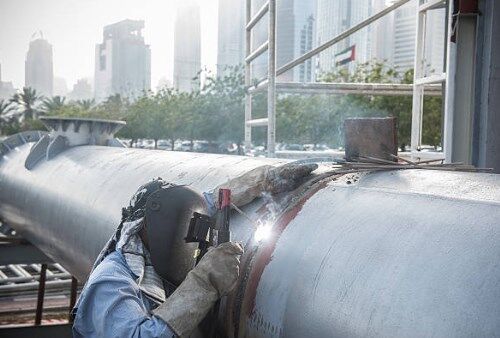
I. Industrial Categorization: Pipe vs. Pipeline Welding
The engineering community distinguishes between pipe welding and pipeline welding based on the scale, environment, and specific regulatory oversight involved. Pipe welding typically refers to the fabrication and maintenance of piping systems within a defined facility, such as a factory, power plant, or refinery. These projects often involve smaller sections, complex intersections (such as T-joints and elbows), and a high variety of materials including carbon steel, stainless steel, and nickel alloys.
Pipeline welding, conversely, describes the construction of long-distance transmission lines, often spanning hundreds or thousands of miles across diverse geographic terrains. This sector demands high-speed travel and consistent, repetitive joints, frequently using large-diameter pipes. Because pipeline welding often occurs in remote, harsh environments—ranging from sub-zero arctic conditions to humid tropical jungles—the equipment used must demonstrate exceptional durability and the ability to maintain a stable arc over long distances with substantial cable lengths.
| Feature | Pipe Welding (Shop/Facility) | Pipeline Welding (Transmission) |
| Primary Environment | Controlled (In-plant/Shop) | Outdoor (Field/Remote) |
| Material Variety | High (Carbon, Stainless, Alloy) | Medium (High-strength Carbon Steel) |
| Joint Complexity | High (Elbows, Valves, Tees) | Low (Mainly Girth/Butt Welds) |
| Primary Challenge | Accessibility and Positioning | Speed, Weather, and Logistics |
| Key Equipment Needs | Precision Control, Multi-process | Durability, Long-distance Stability |
II. Fundamental Arc Welding Processes in Pipe Fabrication
The selection of a welding process is perhaps the most critical technical decision in a piping project, influencing everything from the metallurgical properties of the joint to the overall economic viability of the operation. Each process offers distinct advantages depending on whether the priority is speed, aesthetic quality, or environmental tolerance.
1) Shielded Metal Arc Welding (SMAW): The Portable Standard
Often referred to as "stick" or "stovepipe" welding, SMAW remains the most widely utilized manual process in the field. It utilizes a consumable electrode coated in a flux that, when melted by the arc, creates a shielding gas and a protective slag layer over the weld pool. Its primary advantage is portability; it requires no external gas cylinders or complex wire-feeding mechanisms, making it ideal for remote repairs and vertical-up welding on stationary pipes.
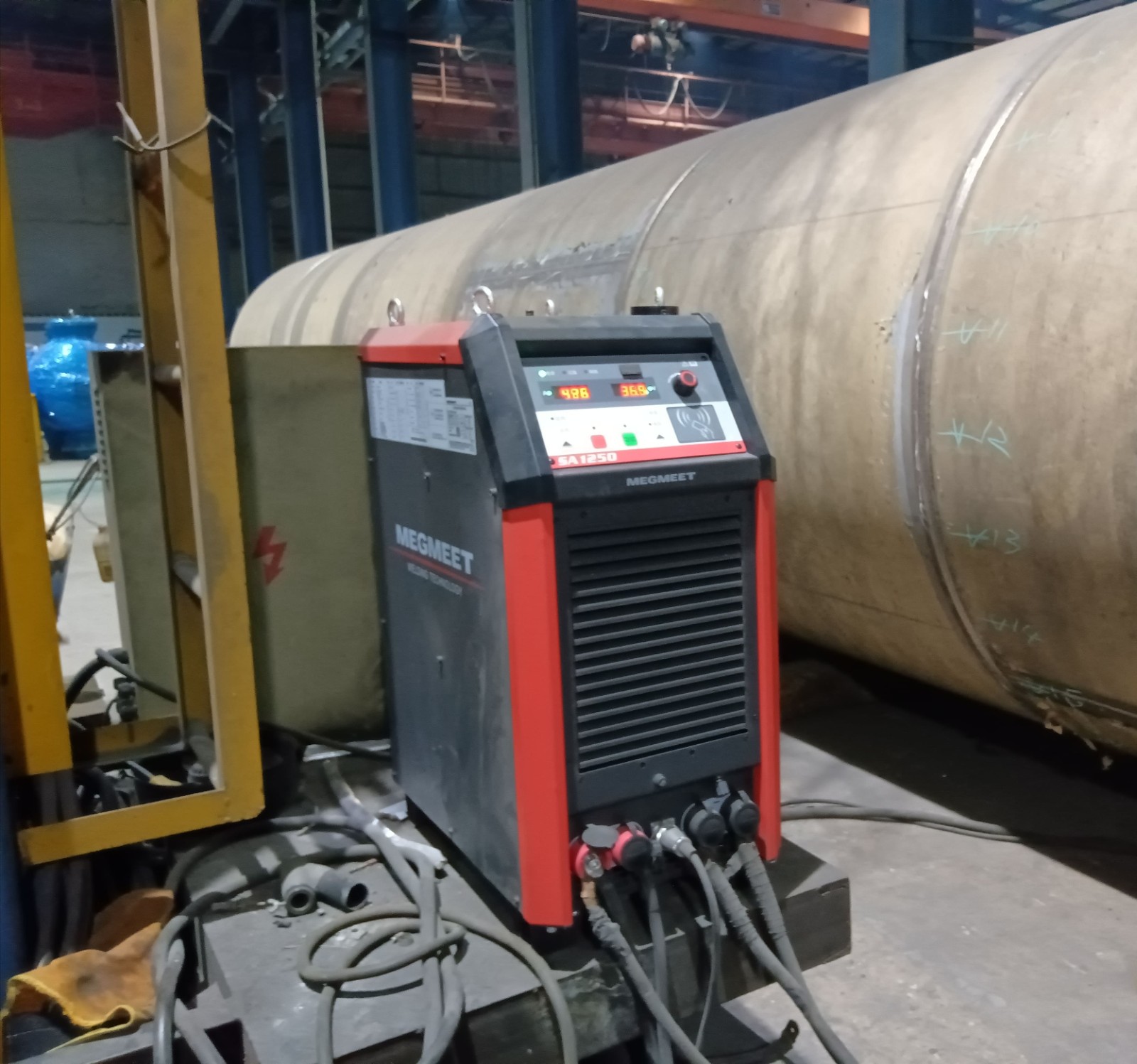
However, SMAW is inherently less productive than semi-automatic processes due to the necessity of stopping to change electrodes and the intensive labor required to clean slag between passes. Furthermore, SMAW is prone to defects such as slag inclusion and porosity if not performed by an expert operator. To mitigate these issues, advanced power sources like the Megmeet ST2-400, ST2-500 and ST2-630 series have been engineered with digital IGBT inverter technology. These machines provide an adjustable "Hot Start" and "Arc Force," which improves arc ignition and prevents the electrode from sticking, even when using 100-meter cables—a common requirement in high-altitude construction where the power source cannot be moved close to the joint.
2) Gas Tungsten Arc Welding (GTAW): Precision and Purity
For critical applications where the internal profile of the pipe must be perfectly smooth or where high-purity materials are used, GTAW (TIG) is the undisputed standard. It employs a non-consumable tungsten electrode to create the arc, while an inert gas (usually Argon) protects the molten pool. Because the filler metal is added separately by the welder's other hand, the process allows for a degree of control over the weld profile that is unmatched by other methods.
The metallurgical excellence of GTAW makes it the preferred process for the "root pass"—the first and most important weld bead that bridges the gap between two pipe sections. However, manual TIG is slow and requires extensive training. Megmeet’s MetaTig series addresses these productivity challenges by incorporating high-frequency arc striking and digital pulse controls, which allow the welder to manage heat input more precisely, reducing the risk of burn-through on thin-walled pipes while maintaining deep penetration.
3) Gas Metal Arc Welding (GMAW) and Flux-Cored Arc Welding (FCAW)
GMAW (MIG/MAG) and its derivative, FCAW, represent the peak of productivity in semi-automatic pipe welding. Both processes use a continuously fed wire electrode, significantly reducing the number of starts and stops compared to stick welding. GMAW relies on an external shielding gas, which provides a clean, spatter-free weld but makes it sensitive to wind in outdoor environments. FCAW solves this by using a flux-cored wire, providing an internal shield that is more tolerant of atmospheric disturbances.
The evolution of digital waveform control has further enhanced these processes. Megmeet Artsen Plus series, for instance, features specialized "Tranquil Fusion" technology. This patented system monitors droplet formation in the arc and reduces the current at the moment of transfer, ensuring that the metal moves into the molten pool peacefully without explosion or spatter. This is particularly beneficial for pipe welding in the vertical-up position, where managing the molten puddle against gravity is historically difficult.
4) Submerged Arc Welding (SAW): High-Volume Production
For the manufacturing of large-diameter pipes or the joining of heavy-walled sections in a shop environment, Submerged Arc Welding (SAW) is utilized. The arc is completely buried under a layer of granular flux, which eliminates the need for helmets and prevents spatter. SAW offers the highest deposition rates in the industry, making it essential for longitudinal seams in pipe manufacturing. However, its reliance on a loose granular flux limits it to flat or horizontal-rolled positions (1G), as the flux would fall off in vertical or overhead orientations.
III. Standardized Pipe Welding Positions: 1G Through 6G
Because pipe joints are cylindrical, the welder must frequently change their physical position or the angle of the torch to maintain the correct relationship with the molten pool. Standardized codes define these positions based on the orientation of the pipe and whether it is fixed or rotating.
1) The 1G (Horizontal Rolled) Position
In the 1G position, the pipe is horizontal and placed on rollers that rotate the joint as the welder maintains a stationary position at the top (12 o'clock). This is functionally equivalent to welding in the flat position, which is the easiest and most productive orientation for any welder. While 1G allows for larger weld pools and faster travel speeds, it is often only achievable in fabrication shops where specialized positioning equipment is available.
2) The 2G (Vertical) Position
The 2G position involves a stationary pipe oriented vertically. The welder moves horizontally around the circumference to complete the joint. The primary technical challenge in 2G is gravitational influence, which tends to pull the molten puddle toward the bottom edge of the joint, potentially leading to "sagging" or "undercut" on the top edge. Welders must use a slightly tilted electrode angle and precise heat control to counteract these forces.
3) The 5G (Horizontal Fixed) Position
The 5G position is perhaps the most common field orientation, where the pipe is horizontal but fixed in place and cannot be rotated. The welder must move around the stationary pipe, effectively transitioning through overhead, vertical, and flat positions in a single continuous bead. This position requires two distinct techniques:
Uphill Welding: Welding starts at the bottom (6 o'clock) and moves toward the top (12 o'clock). This is typically used for thicker materials as it provides deeper penetration and allows for a larger, more controllable puddle.
Downhill Welding: Welding starts at the top and moves toward the bottom. This is common in the pipeline industry for thin-walled pipes because it allows for much faster travel speeds, although it requires higher skill to prevent the slag from running ahead of the arc.
4) The 6G (Inclined) Position: The Pinnacle of Skill
In the 6G position, the pipe is fixed at a 45-degree angle. This orientation is the most difficult to master because it requires the welder to manage all gravitational forces—vertical, horizontal, and overhead—simultaneously as they move around the joint. 6G certification is the industry gold standard; a welder who can pass a 6G test is generally considered qualified to weld in any other position.
| Position | Orientation | Pipe Movement | Welder Movement | Skill Level |
| 1G | Horizontal | Rotates | Stationary (Top) | Basic |
| 2G | Vertical | Stationary | Horizontal Round | Intermediate |
| 5G | Horizontal | Stationary | Vertical Round | Advanced |
| 6G | 45° Incline | Stationary | Complex Round | Expert |
IV. The Multi-Pass Methodology: Building Structural Integrity
High-pressure pipe joints are rarely completed in a single pass. Instead, a series of layers—each with a specific mechanical purpose—are deposited into the groove.
Phase 1: The Root Pass (Stringer Bead)
The root pass is the most critical stage of the process, as it forms the internal seal of the pipe. It must penetrate 100% of the wall thickness, fusing the internal edges (the "root") of both pipes without protruding excessively into the interior. Any defect here, such as a lack of fusion or a "keyhole" failure, will compromise the entire system and likely fail an X-ray inspection.
Phase 2: The Hot Pass
Immediately following the root pass, the "hot pass" is applied. Its function is to melt through any remaining slag from the root and to provide additional fusion to the sidewalls. The heat of this pass also acts as a post-weld heat treatment for the root, refining its grain structure and improving toughness.
Phase 3: Fill Passes
The fill passes comprise the bulk of the weld volume. Depending on the pipe's wall thickness, this may require three to fifty individual beads. The objective is to fill the joint to just below the surface of the pipe while maintaining a uniform, defect-free structure. Megmeet machines like the Ehave 2 CM500 are designed for this heavy-duty cycle, maintaining consistent arc stability over long hours of continuous operation.
Phase 4: The Cap Pass (Cover Pass)
The final layer, the cap pass, provides the finished surface. It should be slightly wider than the groove and have a small amount of reinforcement (height) above the pipe surface, typically not exceeding 3mm. The cap must be aesthetically smooth and free of "undercut"—a groove melted into the base metal at the edges of the weld—which acts as a stress concentrator.
V. Joint Design and Precision Preparation
Successful pipe welding begins with the physical preparation of the metal. Because the arc must reach the internal root of the joint, the pipe ends must be shaped to allow access.
1) Beveling and Facing
For pipes with a wall thickness greater than 3mm, the edges are typically beveled. A standard "V-bevel" is the most common, involving an angle of 30° to 37.5° per pipe end, creating a total included angle of 60° to 75°. For extremely thick pipes (over 20mm), a "J-groove" or "U-groove" may be used to reduce the total volume of weld metal required, thereby saving time and reducing the risk of distortion.
A "land" or "root face" is also ground onto the very edge of the bevel. This flat surface, usually 1mm to 2mm wide, prevents the arc from burning through the thin edge too quickly and provides a stable foundation for the root pass.
2) Alignment and the Root Gap
Before welding starts, the two pipe sections must be aligned with a specific "root gap" between them. This gap, generally ranging from 1.5mm to 4mm depending on the process, allows the filler metal to flow through and fuse the internal edges. Alignment must be perfect; even a slight "hi-lo" (mismatch in pipe wall height) can lead to a lack of fusion and structural weakness.
| Joint Parameter | Standard Value | Industrial Importance |
| Bevel Angle | 30° - 37.5° | Ensures full thickness access |
| Root Face (Land) | 0.5mm - 1.5mm | Prevents "burn-through" |
| Root Gap | 1.0mm - 4.0mm | Essential for 100% penetration |
| Alignment (Hi-Lo) | < 1.0mm | Minimizes stress concentrations |
VI. Metallurgical Management and Heat Input
The performance of a pipe weld is not just a matter of mechanical bond but of metallurgical integrity. The "Heat-Affected Zone" (HAZ)—the area of base metal that was not melted but had its microstructure changed by the heat—is often where failures occur.
1) Controlling the Heat-Affected Zone (HAZ)
Excessive heat input can lead to grain growth, which reduces the toughness of the steel and makes the joint brittle. Conversely, insufficient heat can lead to "cold lap," where the weld metal fails to fuse with the pipe wall. Inverter-based machines from Megmeet use high-speed monitoring of the arc to automatically adjust current and voltage thousands of times per second. This ensures that the heat input remains within the precise range specified by the project’s Welding Procedure Specification (WPS).
2) In-Service Welding Challenges
One of the most difficult tasks in the industry is "in-service" or "hot tap" welding, where repairs are made on a pipeline while fluid is still flowing inside. The flowing liquid acts as a heat sink, rapidly pulling heat away from the weld zone. To compensate, welders must often increase their amperage by 40% to 50% compared to welding on an empty pipe. Advanced digital power sources are essential for this, as they can maintain the necessary high-current output with extreme stability to prevent "hydrogen-induced cracking" caused by the rapid cooling rate.
VII. Codes, Standards, and Professional Certification
The pipe welding industry is governed by a strict regulatory framework designed to prevent catastrophic failures. Every weld made on a pressure system must conform to specific international codes.
1) The Role of ASME, API, and AWS
ASME (American Society of Mechanical Engineers): The ASME Boiler and Pressure Vessel Code (Section IX) is the most common standard for facility piping and pressure vessels.
API (American Petroleum Institute): API Standard 1104 is the primary regulation for cross-country oil and gas pipelines.
AWS (American Welding Society): Provides the overarching framework for welder certification and structural integrity.
2) The Path to Certification
To become a "Certified Pipe Welder," an individual must pass a performance qualification test under the supervision of a Certified Welding Inspector (CWI). This typically involves welding a "coupon" (a test pipe) in a 6G position. The resulting weld is then subjected to:
Visual Inspection: Looking for cracks, undercut, or surface porosity.
Non-Destructive Testing (NDT): Using X-rays (Radiographic Testing) or Ultrasonic waves to see internal defects.
Destructive Testing: In some cases, the weld is cut into strips and bent in a machine to see if it cracks under extreme mechanical stress.
VIII. Occupational Hazards and Industrial Safety
Pipe welding is inherently dangerous, particularly due to the environments in which it is performed. Safety is not merely a personal responsibility but a mandated legal requirement.
1) Confined Space Operations
Welders often work inside tanks, boilers, or tunnels—defined as "confined spaces". The greatest risk is oxygen deficiency; inert gases like Argon (used in TIG welding) are heavier than air and can pool at the bottom of a pipe or pit, leading to immediate unconsciousness and death for an unprotected welder. OSHA standards require continuous air monitoring and an "attendant" stationed outside the space to initiate rescue if needed.
2) Fume and Gas Management
Welding generates "metal fume"—microscopic particles of vaporized metal that can cause long-term health issues like Parkinson’s-like symptoms (from manganese) or lung cancer (from hexavalent chromium in stainless steel). Welders must use Local Exhaust Ventilation (LEV) to pull fumes away from their breathing zone. In highly restricted areas, a Powered Air Purifying Respirator (PAPR) is the gold standard, providing a constant flow of filtered air inside the welding helmet.
3) Electrical Safety and VRD Technology
Because arc welding involves high-voltage circuits, the risk of electric shock is significant, especially in damp environments or inside metal pipes. Modern Megmeet machines include a Voltage Reduction Device (VRD), which automatically drops the open-circuit voltage (OCV) to a safe level (around 15V) when the welder is not actually welding. This ensures that if the welder accidentally touches the electrode or a wet cable, the current is not high enough to cause a fatal shock.
IX. Automation, IIoT, and the Future of the Field
The pipe welding industry is undergoing a digital revolution aimed at overcoming the skilled labor shortage.
1) Robotic Welding and SMARC Integration
Collaborative robots (cobots) are now being deployed in fabrication shops to perform repetitive girth welds. These robots use advanced sensors for "Laser Tracking" to stay perfectly centered in the joint. Megmeet’s SMARC (Smart Management and Remote Control) platform allows facility managers to monitor the performance of every welding machine on the network in real-time. This "Internet of Things" (IoT) approach provides 100% traceability for every joint, which is a critical requirement for industries like nuclear power and aerospace.
2) Orbital GTAW: The Ultimate in Consistency
For high-purity sectors like semiconductor manufacturing or pharmaceuticals, orbital welding is the preferred method. A motorized carriage moves the TIG torch around the pipe with mathematical precision, delivering identical welds every time. While the setup cost is high, orbital welding eliminates human fatigue and produces joints that are virtually indistinguishable from the base metal.
Conclusion
Pipe welding is far more than a manual trade; it is a critical engineering process that integrates material science, complex spatial geometry, and digital power management. As global demand for energy and high-purity processing increases, the ability to produce high-integrity pipe joints efficiently will remain a cornerstone of industrial progress. By utilizing advanced digital platforms like Megmeet's Artsen and MetaTig series, fabrication facilities and pipeline operators can ensure that their infrastructure is not only built faster but is fundamentally safer and more reliable for decades to come.
Related articles:
1. Solutions to Oil Leakage in Pipeline Continuous Laser Welding
2. How to Weld Stainless Steel Tube and Pipe: Tips and Tricks.
3. Internal and External Weld Seam Problems & Solutions of Pipeline
4. High Pressure Pipeline Welding Guide - Basics & Considerations
5. Seamless Steel Pipe Welding Technology (process, materials, etc.)