Gas Metal Arc Welding (GMAW) is a welding process that joins metals with a continuously fed wire electrode and a shielding gas. It is widely used because it is fast, versatile, and well suited to both manual and automated production.
GMAW is also commonly called MIG welding, although GMAW is the broader technical term. In everyday use, people often say MIG even when the shielding gas or application is technically closer to MAG.
I. What Is GMAW?
At its core, GMAW uses an electric arc to melt a consumable wire electrode and the base metal at the same time. The molten metal forms a weld pool, and the shielding gas protects that pool from atmospheric contamination while it solidifies.
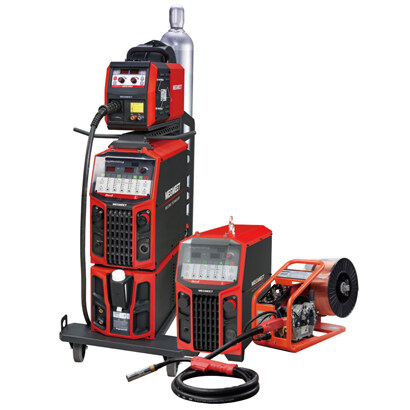
Because the wire feeds continuously through the gun, the welder does not need to stop often to replace electrodes. That makes the process efficient and one reason it is so common in fabrication and manufacturing.
II. How GMAW Works?
The process begins when the welding gun is triggered and the wire electrode starts feeding forward. An arc forms between the wire tip and the workpiece, generating intense heat that melts both materials.
The shielding gas flows around the arc and weld pool to keep oxygen, nitrogen, and moisture away from the molten metal. Once the weld cools, the joint becomes a solid fusion of filler metal and base metal.
1) Basic operating sequence
Set up the power source, wire feed, and shielding gas.
Pull the trigger to start wire feed and gas flow.
Strike the arc between the wire and the workpiece.
Move the gun steadily along the joint to maintain a consistent bead.
Allow the weld to cool and solidify.
2) Main GMAW components
| Component | Purpose |
| Power source | Supplies the electrical energy needed to create the arc. |
| Wire electrode | Acts as both filler metal and conductor. |
| Wire feeder | Pushes the wire through the gun at a controlled speed. |
| Welding gun | Delivers the wire and directs the shielding gas to the weld zone. |
| Shielding gas supply | Protects the molten weld pool from contamination. |
| Ground clamp | Completes the electrical circuit. |
III. MIG, MAG, and GMAW
The term GMAW is the formal process name, while MIG is the common shorthand used by many welders and websites. Strictly speaking, MIG usually refers to inert shielding gas, while MAG refers to active gas mixtures.
This distinction matters in technical writing, but in practice many readers search for “MIG welding” when they really mean GMAW. For welders, it helps to use both terms naturally while clearly explaining the relationship.
1) Advantages of GMAW
GMAW is known for speed, productivity, and clean weld appearance. The continuous wire feed reduces downtime and makes it a strong choice for repetitive work and production environments.
It also produces minimal slag, which reduces cleanup and helps improve workflow. Many sources note that it is easier to learn than highly manual processes such as TIG, especially for straightforward joints.
Why industries use it?
Fast weld deposition for mass production.
Clean welds with limited post-weld cleanup.
Good suitability for automation and semi-automation.
Works on a broad range of metals, including steel, stainless steel, and aluminum.
2) Disadvantages of GMAW
GMAW depends on shielding gas, so wind or drafts can disrupt protection and harm weld quality. That makes the process less ideal for outdoor work unless conditions are controlled.
It also requires more equipment than very basic welding methods, including a gas supply and wire feeder. In addition, portability is more limited, and some out-of-position welds can be more difficult because there is no slag support.
IV. Transfer Modes of Transfer Modes
GMAW includes different transfer modes that describe how molten metal moves from the wire into the weld pool. These modes help tailor the process to material thickness, joint position, and desired weld characteristics.
Common transfer types
| Transfer mode | Main use | Key feature |
| Short-circuit transfer | Thin metal and out-of-position welding | Lower heat, good control, lower penetration. |
| Spray transfer | Heavier sections and high-deposition work | Smooth transfer and high productivity. |
| Pulsed spray transfer | Broader range of materials and positions | Better control than standard spray transfer. |
Short-circuit transfer is often favored for thin sheet metal and repair work. Spray and pulsed modes are more common when productivity and weld consistency are priorities.
V. Materials and Applications of GMAW
1) Materials Compatible with GMAW
GMAW is highly adaptable and can be used on a broad range of metals, provided the correct filler wire and shielding gas combinations are selected.
Carbon and Low-Alloy Steels: This is the most common application for GMAW. It is used extensively due to its high deposition rates and ease of automation. Shielding gases typically involve mixtures of Argon and CO2.
Stainless Steel: GMAW is effective for stainless steel, offering good corrosion resistance and aesthetic weld beads. It usually requires specialized gas blends (often including small amounts of O2 or CO2 with Argon) to maintain arc stability and prevent carbide precipitation.
Aluminum and Its Alloys: Because aluminum has a high thermal conductivity and a persistent oxide layer, GMAW is often preferred over other methods for its speed and ability to use pulsed-spray transfer, which helps control heat input and penetration.
Copper and Nickel Alloys: These materials can be welded using GMAW, though they often require high-purity argon shielding and careful control of heat to prevent cracking or porosity.
Magnesium: While less common, magnesium alloys can be joined using GMAW, typically in specialized automotive or aerospace applications.
2) Primary Applications
The efficiency and flexibility of GMAW make it a staple in several major sectors:
Automotive Industry: GMAW is the standard for vehicle frame construction, exhaust systems, and component assembly. Its ability to be easily integrated into robotic systems makes it ideal for high-volume production lines.
Construction and Infrastructure: It is used for welding structural steel in buildings, bridges, and heavy equipment. The portability of modern GMAW power sources allows for both shop and field applications.
Shipbuilding and Marine: The high deposition rate is critical for joining large steel plates used in hull construction and internal structural bulkheads.
Manufacturing and Pressure Vessels: From household appliances to industrial tanks and piping, GMAW provides the speed and reliability required for mass manufacturing.
Repair and Maintenance: Because it is relatively easy to learn compared to TIG welding, GMAW is frequently used for general repair work in automotive shops and farms.
VI. GMAW vs Other Welding Methods
| Feature | GMAW (MIG) | SMAW (Stick) | GTAW (TIG) | FCAW (Flux-Cored) |
| Electrode Type | Continuous solid wire | Consumable stick (flux-coated) | Non-consumable tungsten | Continuous tubular wire (flux center) |
| Shielding | External gas (Argon, CO2) | Vaporizing flux coating | External gas (Argon, Helium) | Internal flux (± external gas) |
| Ease of Use | High (easiest to learn) | Moderate | Low (requires high skill) | Moderate |
| Deposition Rate | High | Low | Very Low | Very High |
| Portability | Low (requires gas tank) | High (minimal equipment) | Low (requires gas tank) | High (if self-shielded) |
| Cleanliness | High (no slag) | Low (heavy slag) | Very High (purest welds) | Low (moderate slag) |
| Outdoor Use | Poor (wind disturbs gas) | Excellent | Poor (wind disturbs gas) | Good to Excellent |
| Material Thickness | Thin to medium | Medium to thick | Thin materials | Medium to thick |
| Common Uses | Manufacturing, auto repair | Construction, pipeline | Aerospace, precision art | Heavy structural, shipbuilding |
For many users, GMAW sits in the middle ground: easier and faster than highly precise manual methods, but less portable than stick welding. That balance makes it a practical choice for shops and factories.
VII. FAQs of GMAW
Q1: Is GMAW the same as MIG welding?
Not exactly. GMAW is the official process name, while MIG is the widely used common term.
Q2: What gas is used in GMAW?
Common shielding gases include argon, carbon dioxide, and mixtures of the two. The exact choice depends on the metal, transfer mode, and desired weld characteristics.
Q3: Can GMAW be used outdoors?
Yes, but wind can blow away the shielding gas and weaken protection of the weld pool. Outdoor use therefore needs careful setup or a more suitable process.
Q4: Why is GMAW so popular?
It combines speed, clean welds, and adaptability across many metals and production settings. That makes it one of the most practical welding processes in modern fabrication.
Conclusion
GMAW is a gas-shielded arc welding process that uses a continuously fed wire electrode to create fast, clean, and reliable welds. Its combination of speed, versatility, and automation potential explains why it remains a leading choice in manufacturing and fabrication.
For readers and search engines alike, the key idea is simple: GMAW is the technical term for wire-fed gas-shielded arc welding, and MIG is the common name many people use for it.
Related articles
1. Advantages of Pulse Spray Transfer in GMAW Welding
2. GMAW vs. CO2 Welding: A Comparison of Two Metal Arc Welding Processes
3. MIG Welding VS. MAG Welding: What is the differences?
4. MIG VS TIG Welding: What are the Differences?
5. A Comprehensive Guide to Pulse MIG Welding