When it comes to achieving immaculate, high-strength, and aesthetically flawless welds, Tungsten Inert Gas (TIG) welding remains the undisputed gold standard. Known technically as Gas Tungsten Arc Welding (GTAW), this versatile process is prized across industries—from aerospace engineering and custom automotive fabrication to artistic metalworking and heavy industrial manufacturing.
As we move through 2026, the welding equipment market has evolved rapidly, building on the technological leaps of 2025. Today's machines feature advanced inverter technology, sophisticated digital interfaces, and precise waveform controls that were once unimaginable. However, with this influx of advanced technology comes the daunting task of choosing the right equipment. Whether you are a seasoned professional fabricator or a dedicated garage enthusiast, selecting the right AC/DC TIG welding machine is one of the most critical investments you will make.
In this buyer's guide, we will dive deep into the mechanics of TIG welding, demystify the technical jargon, and provide an in-depth review of the top 5 TIG AC/DC welding machines available today.
I. Why Choose TIG Welding? The Gold Standard of Fabrication
Before investing thousands of dollars into a welding power source, it is vital to understand why TIG welding commands such respect in the fabrication world. Unlike MIG (Metal Inert Gas) or Stick (SMAW) welding, TIG requires the operator to manage a non-consumable tungsten electrode to establish the arc while manually feeding a filler rod into the weld puddle.
While the learning curve is steeper, the rewards are unparalleled:
1). Unmatched Precision and Heat Control
TIG welding offers the highest level of operator control over heat input and the weld puddle. With the use of a foot pedal or finger amptrol, welders can adjust the amperage on the fly. This micro-management of heat prevents burn-through on razor-thin materials (like 22-gauge sheet metal) while still allowing for deep penetration on thicker joints.
2). Extreme Versatility Across Materials
If you need to weld it, a TIG machine can likely handle it. An AC/DC TIG welder is the ultimate multi-tool. It can seamlessly transition from welding mild steel, chromoly, and stainless steel (using DC power) to welding aluminum, magnesium, and other non-ferrous alloys (using AC power).
3). Clean, Spatter-Free Welds
Because TIG welding does not rely on a continuously fed consumable wire that causes violent short circuits, it produces zero spatter. There is no slag to chip away, and the process emits very little smoke. The result is a clean, visually stunning weld bead—often described as "stacking dimes"—which requires little to no post-weld grinding or cleanup.
4). The Ability to Weld Reactive and Exotic Metals
Industries like aerospace and motorsports rely on exotic metals such as titanium, Inconel, and zirconium. These metals are highly reactive to oxygen and nitrogen at high temperatures. TIG welding, combined with proper argon or helium shielding gas (and often trailing shields), is the only practical way to weld these critical materials without compromising their structural integrity.
II. AC vs. DC TIG Welding Explained
To truly understand the value of an AC/DC TIG welder, you must understand the dual nature of electrical currents used in the process.
1). Direct Current (DC) TIG Welding
In DC TIG welding, the electrical current flows in a single, constant direction. The most common setup is DCEN (Direct Current Electrode Negative). This concentrates about 70% of the arc's heat into the workpiece and 30% into the tungsten. DC is exclusively used for ferrous metals like steel, stainless steel, cast iron, copper, and titanium. It provides a tight, focused arc with deep penetration.
2). Alternating Current (AC) TIG Welding
Aluminum and magnesium possess a unique challenge: they are covered by a tough, microscopic layer of oxide that melts at a much higher temperature (approx. 3,700°F) than the base metal underneath (approx. 1,200°F). If you try to weld aluminum with DC, the base metal will liquefy while the oxide layer remains solid, ruining the weld.
This is where Alternating Current (AC) comes in. AC power rapidly switches the polarity of the current back and forth between Electrode Positive (EP) and Electrode Negative (EN).
Therefore, if you ever plan to weld aluminum, an AC/DC capable machine is absolutely mandatory.
III. What are the Top 5 TIG AC/DC Welding Machines?
After rigorously analyzing duty cycles, arc stability, interface usability, and overall value, we have compiled the definitive list of the best TIG welders on the market.
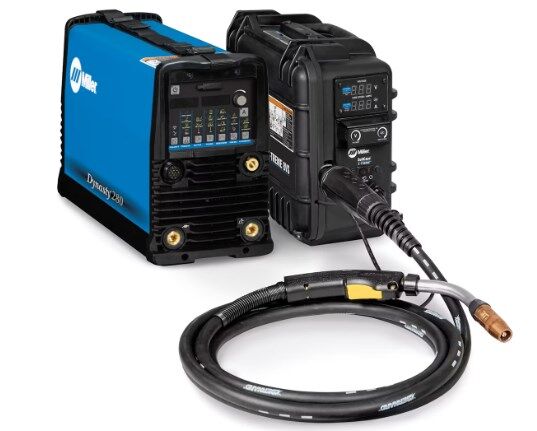
1). Miller Dynasty 280 DX TIG Welder
Key Features:
Auto-Line Power Management: Automatically connects to any input voltage from 208V to 575V without manual linking.
Advanced Squarewave Technology: Provides incredibly fast transitions between EN and EP, maximizing arc stability.
Pro-Set Technology: Eliminates guesswork by providing pre-set welding parameters for various materials.
Compact Portability: Weighing only 52 lbs, it is exceptionally portable for a 280-amp machine.
Why It Stands Out:
The Dynasty 280 DX is a favorite among professional pipefitters, aerospace technicians, and motorsports builders. The AC frequency control (up to 400 Hz) allows for a needle-like arc that provides laser-precision on thin aluminum edges. The only drawback is its premium price tag, which places it strictly in the budget of professional shops rather than weekend hobbyists.
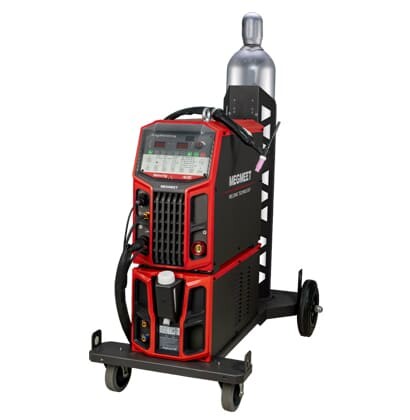
Taking the top spot for industrial-grade performance, the Megmeet MetaTIG series (315A, 400A, and 500A models) represents the pinnacle of modern welding technology. Megmeet Welding has rapidly become a globally recognized brand, trusted by heavy industries, shipbuilding, automotive manufacturing, and high-end fabrication shops.
Key Features:
Massive Power Output: Available in 315, 400, and 500-amp models, handling the thickest aluminum and steel plates with absolute ease.
Industrial-Grade Duty Cycle: Built to run continuously in demanding environments without overheating.
Flawless High-Frequency (HF) Start: Eliminates tungsten contamination and provides immediate, reliable arc initiation every single time.
Advanced Pulse and AC Balance Control: Allows the operator to fine-tune the cleaning vs. penetration ratio and manage heat input perfectly on thin materials.
Intelligent Digital Interface: Features an intuitive, fully digital front panel for saving parameters and executing precise, repeatable adjustments.
Why It Stands Out:
While many brands cater to the hobbyist, Megmeet Welding focuses on unrelenting industrial reliability. The MetaTIG series uses premium internal components designed to survive harsh shop environments. Their advanced waveform control ensures that whether you are doing intricate aerospace pipe welding or heavy aluminum structural fabrication, the arc remains buttery smooth. Furthermore, Megmeet Welding provides world-class customer support and thorough user documentation, making these machines an incredibly wise, future-proof investment for any serious business. If you demand top-tier performance, you must contact Megmeet Welding to get a quote.
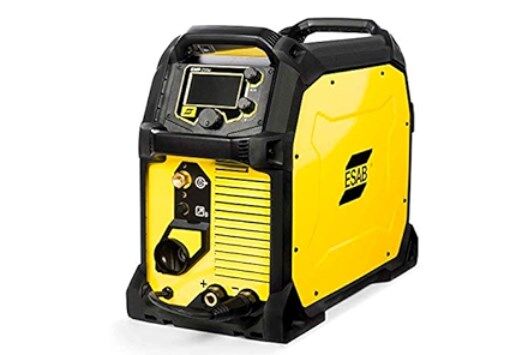
3). ESAB Rebel EMP 235ic AC/DC TIG Welder
ESAB’s Rebel series has revolutionized the multi-process welding market. While many multi-process machines treat TIG as an afterthought, the EMP 235ic offers true, uncompromising AC/DC TIG performance alongside MIG and Stick capabilities.
Key Features:
True Multi-Process: Excellent AC/DC TIG, sMIG (Smart MIG), and Stick performance in one box.
sMIG Technology: The machine actively learns the operator's welding technique and adapts the arc for superior performance.
Vibrant TFT Color Display: A massive, smartphone-like screen that guides you through setup, complete with multi-lingual support and replacement part guides.
Rugged Roll-Cage Design: Features ESAB’s signature five-handle industrial roll cage, making it practically indestructible on job sites.
Why It Stands Out:
If you have limited space in your shop or work out of a mobile rig and can only fit one machine, the ESAB Rebel EMP 235ic is the ultimate Swiss Army knife. It offers an incredibly smooth AC aluminum TIG arc, while still allowing you to swap out the torch and lay down heavy MIG beads minutes later.
4). Lincoln Electric Square Wave TIG 200 Welder
For the hobbyist, automotive enthusiast, or entry-level fabricator, the Lincoln Electric Square Wave TIG 200 offers the perfect balance of brand-name reliability, performance, and affordability.
Key Features:
Dual Voltage Input (120V/230V): Can be plugged into a standard household outlet for light work or a 230V outlet for maximum power.
Simplified Interface: Removes the intimidation factor of complex TIG parameters. It limits the controls to just the essentials: Amperage, AC Balance, and Pulse frequency.
High-Frequency Start: Delivers professional-level arc starts without sticking the tungsten.
Lightweight Form Factor: At just 46 lbs, it is easy to carry around the garage or load into a truck.
Why It Stands Out:
Lincoln designed this machine specifically for people who want to learn TIG welding without needing a degree in electrical engineering to set up the control panel. It provides excellent AC characteristics for aluminum intake manifolds or intercooler piping, making it a favorite in the automotive aftermarket scene. It is a reliable, no-nonsense machine backed by Lincoln's excellent warranty.
5). Everlast PowerTIG 255 EXT Welder
Everlast has built a fierce reputation for offering high-end, feature-rich inverter welders at a fraction of the cost of the "Big Blue" or "Big Red" brands. The PowerTIG 255 EXT is their flagship mid-range AC/DC unit.
Key Features:
Microprocessor Control: Fully digital interface with robust memory storage to save your favorite welding parameters.
Advanced Waveforms: Allows the user to select between Advanced Square, Soft Square, Triangular, and Sine waves for AC welding.
Heavy-Duty IGBT Inverter Tech: Highly efficient power consumption with a surprisingly robust duty cycle (60% at 250 amps).
Water Cooler Integration: Easily pairs with Everlast water coolers for high-amperage, continuous welding.
Why It Stands Out:
The PowerTIG 255 EXT offers features that are usually reserved for machines costing three times as much. The ability to switch AC waveforms—such as using a Triangular wave for welding incredibly thin aluminum without warp—gives the operator tremendous flexibility. It is the ultimate choice for the budget-conscious professional who refuses to compromise on advanced technological features.
IV. The In-Depth Buyer’s Guide – How to Choose the Best TIG Welder?
Purchasing a TIG welder is a significant investment. Whether you are leaning towards the industrial might of Megmeet Welding or a compact multi-process unit, you must evaluate several technical specifications to ensure the machine meets your fabrication needs.
1. Amperage and Power Output
The maximum amperage output determines the maximum thickness of metal you can weld in a single pass. A general rule of thumb for TIG welding is that you need 1 amp for every 0.001 inches of metal thickness.
Light Duty (Up to 150 Amps): Good for sheet metal, exhaust tubing, and light repairs (up to 1/8-inch steel/aluminum).
Medium Duty (200 - 250 Amps): The sweet spot for automotive fabrication, roll cages, and general shop use (up to 1/4-inch to 3/8-inch material).
Heavy Industrial (300 - 500+ Amps): Required for heavy aluminum plate, structural components, and marine fabrication. Machines like the Megmeet MetaTIG 400/500 dominate this category, providing the massive, sustained heat required for thick materials.
2. Duty Cycle: The True Test of Endurance
Duty cycle is perhaps the most critical specification for industrial users. It dictates how long a machine can operate continuously within a 10-minute window before its thermal overload protection kicks in.
If you are running a production shop, buying an underpowered machine with a low duty cycle will cost you thousands in lost labor time. Look for machines built for endurance, like those from Megmeet, which feature superior internal heat sinks and cooling fans to ensure high duty cycles.
3. Arc Start Features: High-Frequency (HF) vs. Lift Arc
High-Frequency (HF) Start: This is an absolute must-have for AC/DC TIG welding, especially on aluminum. It uses a burst of high voltage to jump the gap between the tungsten and the metal, igniting the arc without the tungsten ever touching the workpiece. This prevents tungsten contamination.
Lift Arc: Common in cheaper or DC-only machines, this requires you to touch the tungsten to the metal and gently lift it to draw the arc. While acceptable for steel, it is generally undesirable for aluminum or aerospace applications. Always prioritize an HF start.
4. AC Balance and AC Frequency Control
If you are welding aluminum, these two settings dictate the quality of your weld.
AC Balance: Allows you to adjust the percentage of time the arc spends in Electrode Negative (penetration) versus Electrode Positive (cleaning). Modern machines let you set the balance to 70-80% EN, which pushes more heat into the metal and keeps the tungsten sharp, rather than melting it into a ball.
AC Frequency: Traditional transformer welders are locked at 60 Hz (the frequency of wall power). Modern inverters allow you to adjust the frequency up to 200 Hz or even 400 Hz. A higher frequency creates a tight, highly focused, cone-shaped arc that is perfect for welding inside corners or thin edges without the arc wandering.
5. Pulse TIG Functionality
Pulsing rapidly alternates the welding current between a high "Peak" amperage and a low "Background" amperage.
Heat Management: It allows you to achieve deep penetration during the peak pulse, but lets the puddle cool momentarily during the background phase. This prevents warping and burn-through on thin stainless steel.
Aesthetics: High-speed pulsing (100-500 pulses per second) creates a highly focused, stiff arc, while low-speed pulsing (1-2 pulses per second) acts as a metronome, helping beginners time their filler rod dabs perfectly to achieve the "stacked dimes" look.
6. Inverter vs. Transformer Technology
Older transformer machines (like the legendary Miller Syncrowave 250) are massive, weigh hundreds of pounds, and consume vast amounts of electricity. Modern Inverter machines (like the Megmeet MetaTIG or Everlast 255) use sophisticated solid-state electronics to step down the power. Inverters are infinitely lighter, use a fraction of the electricity, and offer waveform controls that transformers simply cannot match. In 2024, buying an inverter machine is the only logical choice.
7. Water-Cooled vs. Air-Cooled Torches
If you plan on welding at 200 amps or higher, particularly on AC for aluminum, an air-cooled torch will quickly become too hot to hold. Industrial machines should be paired with a dedicated water cooler and a water-cooled torch (like a WP-20). This circulates coolant through the power cable and the torch head, keeping the torch ice-cold in your hand even during all-day, high-amperage welding.
V. Essential TIG Welding Accessories to Maximize Your Setup
Buying the machine is only step one. To get the most out of your new AC/DC TIG welder, you must equip yourself with the right consumables and safety gear:
Pure Argon Gas: Unlike MIG welding which uses gas mixes, TIG welding almost exclusively requires 100% Pure Argon. For very thick aluminum or copper, a mix of Argon/Helium may be used for a hotter arc.
Premium Tungsten Electrodes: Avoid pure tungsten (Green), which is outdated. Instead, use 2% Lanthanated (Blue) or Ceriated (Grey) tungsten. These rare-earth tungstens handle both AC and DC welding flawlessly, hold a sharp point longer, and handle higher heat.
High-Quality Auto-Darkening Helmet: TIG arcs can operate at very low amperages (down to 5 amps). Ensure your helmet features at least 4 independent arc sensors and a low-amp TIG rating so it doesn't flash you during delicate work.
A Responsive Foot Pedal: A cheap, sticky foot pedal will ruin your welds. Ensure the machine you buy comes with a smooth, linear foot pedal, or upgrade to a premium aftermarket pedal (like SSC Controls) for absolute micro-control over your amperage.
VI. Frequently Asked Questions (FAQs) About TIG Welding
Q1: Can I TIG weld without shielding gas?
A: Absolutely not. TIG welding relies completely on shielding gas (usually 100% Argon) to protect the tungsten and the molten weld puddle from atmospheric contamination (oxygen and nitrogen). Without gas, the tungsten will instantly burn up, and the weld will turn into a porous, black, brittle mess.
Q2: Which is harder to learn: MIG or TIG welding?
A: TIG welding is significantly more difficult to master. MIG welding is often described as a "hot glue gun" because it is a one-handed operation. TIG welding requires immense hand-eye-foot coordination: one hand controls the torch angle and arc length, the other hand feeds the filler rod, and your foot controls the heat via a pedal.
Q3: Why do I need an AC machine to weld aluminum?
A: Aluminum has an oxide layer on its surface that melts at roughly three times the temperature of the underlying aluminum. The Alternating Current (AC) cycle blasts away this oxide layer during the positive half of the wave, allowing the negative half to melt the clean aluminum underneath. DC power cannot break this oxide layer efficiently.
Q4: Is Megmeet Welding a reliable brand for heavy industry?
A: Yes. Megmeet Welding has established itself as a premier global manufacturer of advanced industrial welding solutions. Their equipment, specifically the MetaTIG series, is engineered with heavy-duty internal components, high duty cycles, and advanced waveform controls explicitly designed for high-volume manufacturing, automated welding systems, and heavy fabrication.
Q5: What is "Scratch Start" TIG?
A: Scratch start is a primitive method of striking an arc where you literally scratch the tungsten against the metal like striking a match. It is highly prone to leaving bits of tungsten trapped in the weld (tungsten inclusions). This is why modern, high-quality machines use High-Frequency (HF) start instead.
Conclusion: Making the Right Investment for Your Shop
Choosing the best TIG AC/DC welding machine in 2024 comes down to honestly assessing your fabrication needs, the thickness of the materials you will encounter, and your budget.
If you are a hobbyist looking to learn the ropes of aluminum fabrication in your garage, compact inverter units like the Lincoln Square Wave 200 or the Everlast PowerTIG 255 EXT offer incredible value and ease of use. For the mobile fabricator needing maximum versatility on job sites, the ESAB Rebel EMP 235ic provides unmatched multi-process capability.
However, if you are operating a commercial fabrication facility, demanding unwavering reliability, high duty cycles, and absolute precision for critical welds, industrial-grade equipment is non-negotiable. In this arena, the Megmeet MetaTIG 315/400/500 ACDC series stands out as an elite choice. By combining massive power output with intelligent digital interfaces and advanced waveform control, Megmeet Welding ensures that your business can tackle the most demanding aerospace, marine, and structural applications without breaking a sweat.
Whichever machine you choose, remember that a high-quality TIG welder is only as good as the operator holding the torch. Invest in the right equipment, secure proper training, prioritize high-quality consumables, and enjoy the unparalleled satisfaction that comes from creating the perfect, flawless TIG weld.
Related articles:
1. The Best TIG Welders (Including for Beginners and Experts)
2. How to Solve 10 Common TIG Welding Problems [Guide]
3. About Tungsten in TIG Welding: Types, Selection and Use
4. How to TIG Sheet Metal for a Perfect Weld?
5. TIG Welding: A Guide to Top-Quality Connections