TIG welding uses a non-consumable tungsten electrode and inert shielding gas (typically argon) to produce high-quality welds. Its key advantages include precision and clean welds with no spatter or slag. TIG is versatile—suitable for stainless steel, aluminum, titanium, and more. The welder controls both the torch and filler rod by hand (and usually a foot pedal), allowing fine manipulation of heat and filler. The process achieves excellent appearance and integrity, ideal when weld aesthetics matter.
Power Source: TIG requires a constant-current power supply (AC or DC). DCEN (direct current, electrode negative) is used for most steel alloys, concentrating heat at the workpiece. AC is used for aluminum or metals with surface oxides, since AC’s alternating polarity provides cleaning action. For aluminum, ensure the machine is rated for AC welding (or AC/DC inverter) because DC-only machines cannot effectively weld aluminum.
Electrode and Shield: A tungsten rod is the electrode. It’s ground to a fine point (or balled tip for AC), which produces a narrow, stable arc. Since tungsten isn’t consumed, heat comes only from the arc; filler metal (when needed) is added separately to the weld pool. Pure argon (or argon/helium mixtures) is used as the shield gas to protect the weld pool from nitrogen/oxygen contamination. No slag forms, so finished welds are clean.
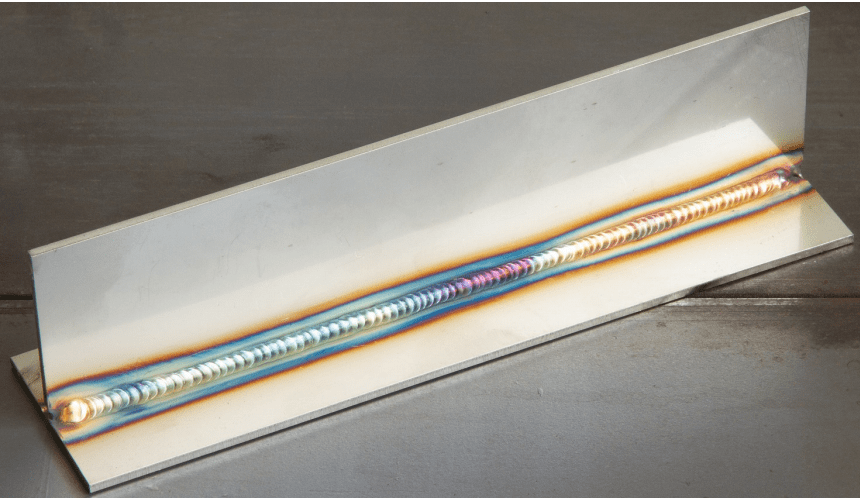
I. TIG Welding Equipment Selection and Setup
Choosing the right equipment ensures good TIG performance:
Welding Machine: Select a TIG welder based on material and thickness. For steel and stainless, a DC-output TIG welder suffices. For aluminum (or unknown materials), use an AC/DC TIG welder to cover both AC and DC modes. Ensure the machine can deliver enough amperage for the metal thickness (e.g. ~1 amp per 0.025″ of steel thickness). Check your workshop’s power (110V vs 230V, single vs three-phase) to match the welder’s requirements.
Torch and Accessories: Use the appropriate TIG torch (air-cooled or water-cooled). Larger-diameter tungsten and high current (>250 A) may require a water-cooled torch. Ensure the torch has a straight switch or fingertip control if you plan to start/stop the arc from the torch.
Shielding Gas: Argon is the standard TIG gas. For thick aluminum or special alloys, consider argon-helium blends (helium increases heat and cleaning but can make striking the arc harder). For stainless steel, small amounts of hydrogen or oxygen (1–5%) in argon can improve fluidity and penetration. Always verify gas purity and set flow to ~15–20 SCFH (7–10 L/min) as a starting point.
Filler Rods: Choose filler rods that match the base metal chemistry. Common choices: ER70S-2/3 for carbon steel, ER308/316 for stainless, ER5356/4043 for aluminum. For strength-critical or exotic alloys, consult supplier data (e.g. ER5356 for 5xxx series Al). Use rod diameters roughly 1/16″–1/8″ for thin sheets, larger for thick joints.
Safety Gear: Always wear welding helmet with appropriate shade, gloves, flame-resistant jacket, and safety boots. TIG welding emits no slag, but intense UV/IR radiation and metal vapor still require full PPE. Ensure good ventilation to remove fumes.
Setup Checklist: Follow these steps before welding:
Connect Torch: Insert the torch into the machine, attach gas hose and regulator.
Remote/Foot Pedal: Plug in foot pedal (or fingertip control). Test that it varies the current smoothly.
Work Clamp: Connect the ground clamp to the machine and clamp it to clean metal near the weld.
Polarity Selection: Set the machine polarity: DCEN for steel, AC for aluminum.
Tungsten Prep: Grind the tungsten to a sharp point (for DC) or slight ball (for AC) using a dedicated grinder.
Insert Tungsten: Slide tungsten into the torch collet, leaving ~3–5 mm exposed. Tighten the collet. The stick-out affects arc shape: short (3–5 mm) for precise control, longer (6–8 mm) for more reach.
Gas Purge: Open gas cylinder valve; purge the hoses (crack valve until argon flows). Set the flowmeter to 15–20 SCFH initially. Check for leaks (soapy water can detect leaks).
Set Power: Verify the weld setting (AC/DC, amperage) matches the joint requirements and metal thickness. Some TIG machines have pre-flow/post-flow timers—set post-flow (usually 10-15 seconds) to shield the weld while it cools.
With the equipment and machine configured, you’re ready to weld.
II. TIG Welding Tungsten Electrode and Filler Rod Selection
Choosing and preparing the correct tungsten and filler material is crucial:
Tungsten Type: Common tungsten electrodes include: 2% ceriated (gray), 2% lanthanated (blue), pure (green), and 2% zirconia (brown).
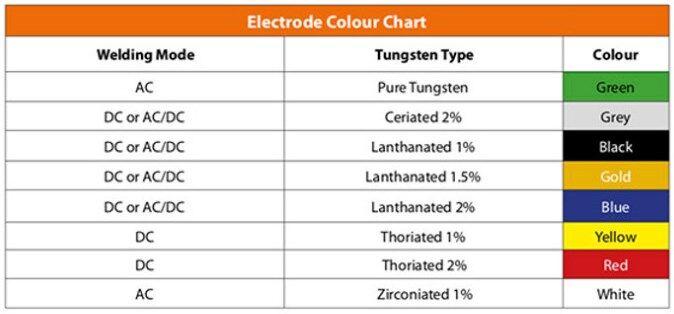
Ceriated (2% CeO₂, gray): Versatile; works on AC or DC. Good arc stability and long life. Suitable for most steel and aluminum work.
Lanthanated (2% La₂O₃, blue): Excellent for DC (carbon steel, stainless). Provides sharp arc at medium currents.
Pure (green): Traditionally for AC on older transformers. Modern inverter welders sometimes have difficulty starting with pure tungsten.
Zirconiated (ZrO₂, brown): Designed for AC welding of aluminum/magnesium. It maintains a balled tip for stable AC arcs.
Thoriated (red, ~2% ThO₂): Used historically for DC steel welding due to longevity and arc stability. However, thoriated tungsten is radioactive (and banned in parts of Europe). We avoid it here due to safety/regulatory reasons.
Tungsten Diameter: Match electrode diameter to current. As a rule of thumb, about 1 amp per 0.001″ of thickness (for steel). For example, 3/32″ tungsten (≈2.4 mm) is often good up to ~200A. If you exceed a tungsten’s amp rating, it will overheat and “ball” or burn back.
Tungsten Grind: Use a dedicated fine-grit wheel. Grind lengthwise (not sideways) to avoid pits. For DC welding grind a sharp point 2-3× the diameter length. For AC welding, create a small rounded ball (use the welder to form it by touching it to a clean aluminum surface briefly).
Filler Rods: Select rods matching the base metal’s composition and strength. For general steel work, ER70S-2/6 series (mild steel) rods are typical. For stainless, use rods of the same grade (e.g., ER316L for 316 SS). For aluminum, pick the appropriate alloy rod (e.g., ER5356 for 5xxx series, ER4043 for 4xxx series). Use filler rod length (~1 foot) manageable by hand.
Rod Diameter: A good rule is to use a filler slightly smaller in diameter than the material thickness. For beginner work, 1/16″–1/8″ (1.6–3.2 mm) rods are versatile for up to ~1/4″ plate. Thicker joints may use 3/32″ to 1/8″.
III. TIG Welding Torch Handling and Welding Technique
Proper torch angle, arc length, and hand technique dramatically impact weld quality:
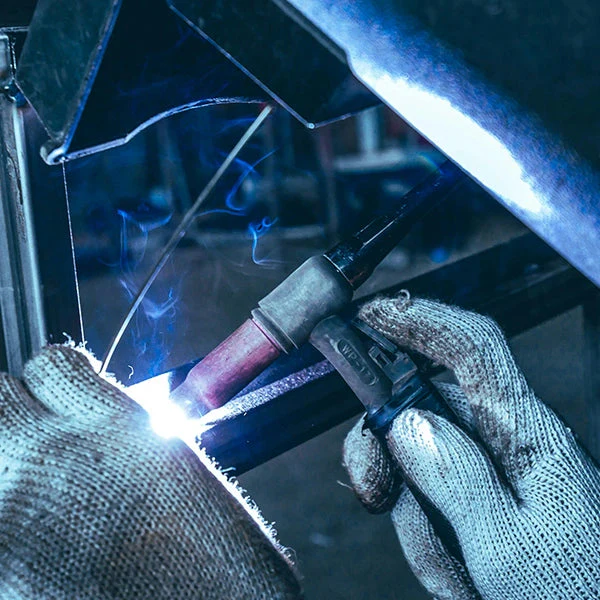
Torch Angle: Hold the torch at about a 70–80° angle relative to the work surface, slanted slightly backward (~15–20°) in the travel direction. This “dragging” or push angle helps the gas shield cover the puddle and lets you see the puddle and filler rod placement. Too flat (low) an angle will smear the puddle and spoil coverage; too vertical reduces visibility.
Arc Length: Keep a short arc length (~1/16–1/8″ or 1–3 mm). Too long an arc causes excessive heat and oxide formation on aluminum; too short risks contaminating/burning the tungsten. Consistency is key: maintain a constant gap as you weld, so the puddle stays steady in size.
Filler Rod Technique: Use your free hand to feed filler wire into the leading edge of the molten pool at a slight downward angle (~15°). Rest the rod on the welding table or finger-roll it between index and middle fingers, allowing precise control. Dip the rod gently into the leading front of the puddle – not directly into the arc – to avoid tungsten contamination. Feed the rod steadily with small "dabbing" motions, matching the puddle growth rate. A uniform bead width (~1/4″ or 6 mm) is a good target.
Foot Pedal Control: Practice using the foot pedal to vary amperage in real-time. Beginners should “feel” how the puddle responds: start at low current, then press the pedal to see the puddle grow. Keep the puddle width consistent to avoid shrinking (incomplete fusion) or growing (burnthrough). Good welds result from steady pedal control where current increases and decreases smoothly.
Travel Speed: Maintain a consistent torch travel speed. Too fast and the weld will be thin (lack fusion); too slow and you will burn through or create excess reinforcement. Adjust speed so molten metal pools just enough to wet both sides of the joint. For practice, tack-weld at different speeds and inspect bead shapes.
Joint Techniques: For common joints:
Butt/fillet welds: On a flat (butt) joint, torch work angle (side-to-side) is ~90°. On a perpendicular fillet, tilt ~45° toward the root so the arc equally penetrates both pieces.
Weave patterns: Beginners often start with simple “push” (straight) beads. Once steady, a small side-to-side weave can help fill wide joints. But avoid large oscillations until skilled.
Position welding: TIG can be done flat, horizontal, vertical, or overhead. Vertical up welds require slower travel and smaller welds to prevent dripping. Overhead welds need fast travel and careful droplet control.
Arc Starting and Stopping:
Starting: Use high-frequency (HF) start if available, or “lift-arc” (scratch start) at low current. HF ionizes the gap for a clean start. Ensure no part of the torch is touching metal when HF is fired.
Stopping: Don’t shut off current abruptly; end the weld gradually. Slowly reduce pedal pressure or use the machine’s downslope feature to taper the amperage. Continue shielding gas flow after the arc stops (post-flow) for a few seconds to protect the hot weld from oxidation. This prevents weld craters and cracks at the end.
IV. TIG Welding Shielding Gas Flow and Coverage
Effective shielding is essential in TIG:
Gas Type: Use pure argon for most TIG work. Argon is inert and protects the hot metal. For specialized cases, consider argon/helium blends (more penetration on thick aluminum) or argon/hydrogen (for faster, hotter welds on stainless). Avoid any reactive gases (CO₂) in TIG shielding.
Gas Flow Rate: Begin around 15–20 SCFH (7–10 L/min) for a #8 or #10 ceramic cup on carbon steel. Adjust up or down depending on cup size and ambient conditions. A larger cup (#10) might need 20–25 SCFH; a small cup (#6) only 10–15 SCFH. Too low flow causes porosity; too high causes turbulence sucking air in.
Check Coverage: Always ensure a smooth, steady gas plume over the weld zone. Inspect the torch components: gas lens or collet body and diffuser. Leaks or blockages in the torch, hose, or fittings will compromise coverage. Use soapy water to test all gas connections for bubbles. Replace faulty hoses or O-rings.
Use of Gas Lens: For critical welds (deep penetration or sensitive alloys), a gas lens is recommended. A gas lens nozzle produces laminar (even) argon flow, greatly improving protection. It is especially useful on sheet metal, complex welds, or materials that oxidize easily (e.g. titanium). However, be aware a gas lens can trap contaminants if welding dirty metal; always clean the gas lens before use.
Avoid Drafts: Ensure the welding area is free from drafts. Even slight breezes can blow away shielding gas. For outdoor or shop use, position welding curtains or grind shields to block drafts.
V. Common Defects and Troubleshooting
Even experienced TIG welders encounter problems. Below is a table of common defects with likely causes and fixes. Use this as a quick reference when diagnosing weld issues:
| Defect | Possible Cause | Solution |
| Porosity (tiny holes) | Surface contamination (oil, rust, paint); poor gas flow | Clean base metal and filler; increase argon flow; check for leaks. Use proper gas lens if needed. |
| Cracking (hot/cold) | Excessive heat input; rapid cooling; joint stress | Lower current or weave more to reduce heat; use proper root gap; consider preheat; slow down travel at weld end. |
| Incomplete Fusion | Low amperage or too fast travel | Increase welding current; slow torch travel; ensure joint fit-up is tight; clean joint edges. |
| Burn-Through | High amperage or too slow travel on thin metal | Reduce amperage; increase travel speed; ensure proper filler thickness for gap. |
| Tungsten Drag | Electrode touching weld pool | Maintain 1/16″–1/8″ arc length at all times; retrain hand steadiness; reground any contaminated tungsten. |
| Weld Bead Irregular | Uneven travel or filler feed | Practice steady travel and filler motion; maintain consistent angle; use weld clock or markers. |
| Spatter (rare in TIG) | Usually tungsten splatter from arc instability | Check tungsten prep; ensure arc starts cleanly; adjust HF or start mode. |
| Contaminants Inclusion | Dirt or rust trapped in weld; improper filler | Clean all surfaces thoroughly; remove any flux; use proper filler; maintain steady heat. |
| Undercut (edge pits) | Excessive heat on edges | Reduce amperage; slightly accelerate travel; check torch angle to avoid overheating joint edges. |
| Excess Convexity | Too slow travel or too much filler | Increase travel speed; reduce filler or filler angle; use proper heat control. |
VI. Safety Best Practices
TIG welding demands attention to safety:
Personal Protection: Always wear a welding helmet with the correct shade for TIG (usually shade 10–13) to protect eyes from intense UV/IR rays. Wear leather gloves and flame-resistant long-sleeve clothing to cover all skin. Use safety boots to protect feet from hot metal. TIG arcs have no slag to shield UV, so even quick tacks require full face protection and appropriate coveralls.
Ventilation: TIG generates fumes (especially when welding stainless steel or aluminum). Ensure a well-ventilated workspace. Use a fume extractor or open windows/fans to keep smoke away from breathing zone. Avoid welding in confined spaces without exhaust ventilation.
Work Area Setup: Clear flammable materials (oil, solvents, rags) from the welding area. Do not weld on damp surfaces. Secure gas cylinders upright with chains or straps. Check that cables and hoses are in good condition with no frays or leaks.
Grounding and Cables: Confirm the work clamp makes solid metal-to-metal contact on clean workpiece. Ensure torch and cable insulation are intact. Avoid draping cables across walkways to prevent tripping.
UV & Light: Never look at the arc without proper eye protection. UV burns are serious even for brief exposure. By OSHA and ANSI standards, use gear rated for TIG welding arc light.
Emergency Preparedness: Keep a fire extinguisher nearby. Welding can produce sparks or melt-through on thin metal, so be ready for any fire hazard.
VII. Beginner's 5-Point Checklist
Safety Gear & Setup: Don PPE (helmet, gloves, jacket) and ensure ventilation. Verify equipment is on stable surface and gas cylinders are secured.
Clean Workpiece: Remove all rust, paint, oil, or coatings. Use a dedicated wire brush or grinder—different brushes for steel, stainless, and aluminum to avoid contamination.
Machine Settings: Double-check polarity (AC for aluminum, DCEN for steels) and amperage for material thickness. Set gas flow to ~15–20 SCFH and purging is done. Install correctly ground tungsten.
Torch & Filler Ready: Grind tungsten at least 2× its diameter in length. Position torch at a 15–20° push angle relative to weld direction. Hold filler rod at ~15° horizontally. Practice holding torch 1/8″–1/4″ above surface.
Practice Before Welding: Start with scrap metal. Strike the arc, observe the puddle, and maintain a steady pedal/torch motion. Aim for a consistent, smooth weld bead about 1/4″ wide before tackling important work.
Conclusion
In conclusion, mastering TIG welding for aluminum requires careful attention to technique, equipment, and settings. Proper preparation, using the right filler material, and maintaining consistent heat control are crucial for achieving strong, clean welds. With the right tools and practices, even complex aluminum welding projects can be tackled with confidence.
If you want to buy Megmeet TIG welding machine, you can contact us by clicking: https://www.megmeet-welding.com/en/contacts, If you want to learn more welding tips, you can collect Megmeet News Center Page or follow our LinkedIn page.

Related articles
1. Pulse TIG welding: Process, Automation and Control
2. Why and How to Spot Weld With TIG Welder?
3. Robotic TIG Welding Improves Speed, Quality, and Efficiency
4. Guide to Optimal TIG Welding Setup
5. TIG Welding with DC vs. AC Current