Structural welding is the backbone of modern steel construction. It is the process of joining load-bearing steel members so they can safely carry static loads, dynamic forces, vibration, wind, impact, and long-term service stresses in buildings, bridges, platforms, heavy equipment, and other critical structures. In practice, structural welding is not just about making metal stick together; it is about producing repeatable, code-compliant welds that meet engineering requirements and inspection standards.
Because structural welds are part of the load path, the wrong process, poor fit-up, weak inspection, or inadequate safety controls can create serious performance and compliance problems. That is why structural welding is governed by established standards, especially the AWS structural welding code for steel construction, and why quality control, welder qualification, and safety procedures matter from the first cut to the final inspection.
I. What Is Structural Welding?
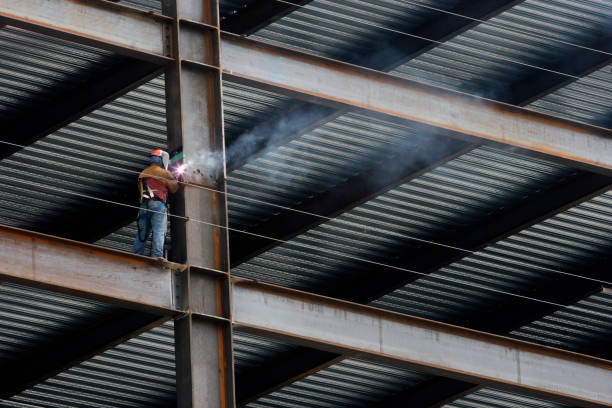
Structural welding refers to welding work performed on frameworks and assemblies that must safely support load. That includes beams, columns, braces, base plates, moment connections, column splices, bridge components, stair systems, industrial frames, and similar steel assemblies. These welds are part of the structure itself, so they must meet design intent, code requirements, and inspection criteria.
A useful way to think about structural welding is this: the weld is not decorative or incidental. It is functional. It must transmit force through the joint without unacceptable discontinuities, distortion, or weakening. That is why structural welding is commonly tied to written procedures, qualified welders, and code-based inspection rather than informal “good enough” shop practice.
II. Why Structural Welding Matters?
Structural steel is used because it offers high strength, efficient fabrication, and predictable performance. Welding makes it possible to connect members into complex systems that can be shipped, assembled, erected, and maintained efficiently. In the shop, welding supports speed and repeatability; in the field, it allows final assembly where bolting alone may not be sufficient or practical.
The quality of a structural weld directly affects rework, schedule, and cost. A jobsite filled with corrective grinding, repair welding, and inspection delays is usually a sign that the process selection, preparation, or procedure control was weak. High-quality structural welding reduces rework and helps projects stay on schedule and within budget.
III. Common Structural Welding Processes
Different structural jobs call for different processes. The “best” process depends on whether the work is happening in the field or in a shop, whether the joint is out of position or flat, how much deposition is needed, and how much cleanup is acceptable after welding. Industry guidance consistently separates field welding from shop welding for exactly these reasons.
1) Shielded Metal Arc Welding (SMAW)
SMAW, often called stick welding, remains one of the most common processes for field structural work. Its main advantage is portability. It is useful outdoors, tolerates difficult access, and does not require shielding gas, which makes it practical when wind and location make gas-shielded processes less reliable. The tradeoff is lower productivity because electrodes must be replaced frequently.
2) Self-Shielded Flux-Cored Arc Welding (FCAW-S)
FCAW-S is another strong choice for outdoor structural work. It offers higher productivity than stick welding in many field applications, especially when a welder is staying in one place long enough to deposit a significant amount of weld metal. It is often selected when portability is still important but arc-on time and deposition rate matter more than electrode changeovers.
3) Gas-Shielded Flux-Cored Arc Welding (FCAW-G)
FCAW-G is widely used in structural fabrication shops because it is productive, forgiving, and well suited to all-position work. It also performs well on steel with mill scale and can support high deposition rates. The downside is slag production, which adds cleanup time between passes and after welding.
4) Gas Metal Arc Welding (GMAW / MIG)
GMAW is common in shop environments where wind is not an issue and where clean welds with minimal post-weld cleanup are valuable. Since it does not generate slag, it can reduce grinding and chipping time. However, compared with FCAW-G it is generally less forgiving and less effective on dirty base metal or in difficult out-of-position work. Metal-cored wire can improve some of those limitations by offering a broader operating window and better tolerance to less-than-perfect base material.
5) Submerged Arc Welding (SAW)
SAW is used when structural shop work demands very high productivity over long, continuous welds. It is especially useful for heavy, repeatable welds such as those associated with large beams or multi-pass structural sections. The process requires more capital investment, but the return can be strong when a job has substantial arc time and can benefit from fast deposition rates.
IV. Structural Welding in the Field vs. the Shop
The first question in structural welding is often not “Which process is strongest?” but “Where is the weld being made?” Field conditions and shop conditions are fundamentally different. Wind, access, movement, setup time, and cleanup expectations all influence process choice and productivity.
| Factor | Field Welding | Shop Welding | Why It Matters |
|---|
| Environment | Wind, weather, and access constraints | Controlled indoor conditions | Wind can interfere with shielding gas, so outdoor work often favors processes that do not rely on external shielding gas. |
| Common processes | SMAW and FCAW-S | FCAW-G, GMAW, and SAW | Process selection follows portability, productivity, and shielding needs. |
| Productivity | Often limited by movement and repositioning | Higher due to better setup and repeatability | Shop work can prioritize arc time and deposition rate. |
| Cleanup | Usually minimized for mobility | Can be more extensive because parts stay in one place | Slag, grinding, and chipping reduce throughput in the shop. |
| Typical goal | Make reliable welds in difficult conditions | Maximize throughput and consistency | Different environments reward different process choices. |
In the field, welders often choose stick welding for portability or FCAW-S for greater deposition efficiency. In the shop, FCAW-G, GMAW, and SAW are often preferred because the environment is more controlled and productivity can be pushed higher. That distinction is central to structural fabrication strategy.
V. Structural Joint Types and Weld Types
Structural welding is usually built around a limited number of joint geometries and weld types. The most common joint types across welding practice include butt, lap, tee, corner, and edge joints, and those joint types are selected based on how the members transfer load and how the assembly is designed.
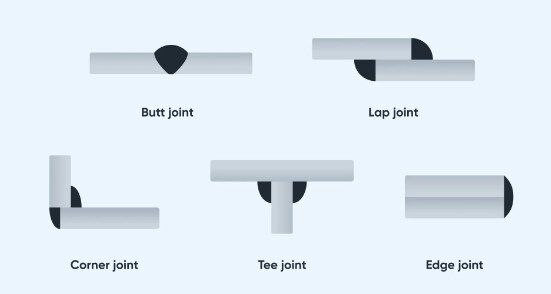
In structural steel work, fillet welds are extremely common, especially in T-joints, lap joints, and corner joints. They are fast to produce and often used on connections such as shear tabs, cover plates, bracing connections, and column bases. Groove welds are used where higher strength or complete joint penetration is required, such as moment connections, column splices, and hollow structural section connections.
A practical distinction matters here: fillet welds are often faster and simpler, while groove welds demand more preparation, more skill, and sometimes additional verification. Complete joint penetration groove welds are especially important when the design calls for the weld to transfer load through the full thickness of the joint.
VI. How Structural Welding Is Controlled by Codes?
Structural welding does not happen by improvisation. It is controlled by codes and specifications that define what is acceptable, how the work is qualified, and how it is inspected. The AWS structural welding code for steel construction covers welding requirements for welded structures made from commonly used carbon and low-alloy constructional steels.
That matters because structural welding is not only about bead appearance. It is about documented procedure, welder qualification, material compatibility, and conformance to the governing standard. AWS also notes that structural steel welders are typically qualified under AWS D1.1, while other types of welding work may follow different qualification paths.
Welders also need continuity to keep qualifications active. AWS guidance states that welders must remain qualified and maintain documented evidence of welding at least once every six months to keep continuity. In practice, that means structural welding teams need active records and an ongoing qualification mindset, not a one-time certificate on the wall.
VII. Procedure, Qualification, and Inspection
A strong structural welding program usually depends on three connected documents or controls: the welding procedure specification, procedure qualification support where required, and welder performance qualification. These controls establish what process is used, what parameters are permitted, and whether the welder is qualified to perform the work. AWS provides sample forms and qualification resources for structural welding documents, reinforcing how procedural the discipline is.
Inspection is equally important. AWS explains that the purpose of welding inspection is to determine whether a weldment meets the acceptance criteria of a specific code, standard, or other governing document. The inspector must understand welding processes, procedures, qualifications, materials, testing limitations, drawings, and reporting responsibilities.
Visual testing is one of the most important inspection tools in structural work. AWS’s visual testing training emphasizes lighting, magnification, flaw detection, weld inspection, and applicable codes. That makes visual inspection more than a quick glance; it is a disciplined quality-control step tied to code acceptance.
VIII. Safety Is Part of Structural Welding Quality
Safety is inseparable from structural welding quality because unsafe work conditions often create poor weld conditions too. AWS Z49.1 addresses safety and health in the welding environment, including ventilation, fire prevention, protection of personnel, and confined spaces. OSHA similarly requires mechanical ventilation for welding, cutting, and related processes to keep fumes and smoke within safe limits.
Fume control matters especially when welding on materials that can generate hazardous byproducts. OSHA states that employers must control exposure to hexavalent chromium under specific standards and has a PEL of 5 micrograms per cubic meter as an 8-hour time-weighted average. OSHA also notes that exposure can occur through inhalation of dusts, mists, or fumes containing Cr(VI).
For structural welders, that means PPE, ventilation, housekeeping, and fire prevention are not optional extras. They are core production controls. If a welding area is poorly ventilated, cluttered, or exposed to unnecessary fumes, the result is not just a safety problem; it also tends to be a quality problem.
IX. What Makes a Good Structural Weld?
A good structural weld starts long before arc initiation. The joint must be prepared properly, fit-up must be correct, the procedure must match the material and position, and the welder must know what the code expects. In other words, structural quality is built through preparation and control as much as through technique.
Good structural welds also balance penetration, fusion, bead profile, and minimal rework. The goal is not to make a weld that merely looks robust. The goal is to produce a weld that meets design intent and inspection requirements while staying efficient enough for practical fabrication and erection.
The best shops and crews usually share a few habits: they follow the procedure, use the right process for the environment, verify fit-up before striking an arc, and treat inspection as part of production rather than an afterthought. That mindset is what separates repeatable structural fabrication from one-off repair work.
X. Common Structural Welding Challenges
Structural welding often runs into the same recurring problems: wrong process selection for the environment, poor access to the joint, inconsistent fit-up, too much cleanup time, and weak communication between fabrication and inspection. Many of these issues are predictable, which means they can be prevented with better planning.
One frequent challenge is choosing a process that looks efficient on paper but does not suit the actual jobsite. A gas-shielded process in windy field conditions, for example, can create avoidable instability, while a slower but more portable process may be the better practical choice. Structural welding is always a tradeoff between productivity, access, and process reliability.
Another challenge is over-reliance on post-weld repair. Excessive grinding, chipping, and rework often mean the root cause was upstream: poor joint prep, wrong parameters, or inadequate training. In structural welding, quality problems compound quickly because large assemblies magnify small mistakes.
XI. Best Practices for Structural Welding Success
Start with the environment. If the job is outdoors and portable, choose a process that tolerates field conditions. If the work is in a shop and throughput is the priority, choose a process that gives the best balance of deposition rate, cleanup, and operator control. That single decision can have a major impact on productivity.
Next, match the weld type to the connection. Fillet welds are common and efficient, but groove welds are necessary when the structure requires deeper penetration or higher-strength connections. Do not overuse a heavy weld where a fillet weld is sufficient, and do not under-design a critical joint that needs complete joint penetration.
Then lock in procedure discipline. Use the right welding procedure, keep welder qualifications current, and make inspection part of the workflow. AWS guidance on structural welding qualification and inspection exists for a reason: structural work is only as dependable as its documentation and execution.
Finally, do not separate safety from productivity. Good ventilation, fume control, and fire prevention keep crews working longer, cleaner, and more consistently. Welding is more efficient when people can work safely and the workplace supports good technique.
XII. Structural Welding in Modern Construction
Structural welding remains essential in buildings, bridges, industrial plants, transportation systems, and heavy fabrication because it allows steel to be assembled into large, load-bearing systems that can be manufactured, transported, and erected efficiently. That role is not shrinking; if anything, it is becoming more important as projects demand tighter schedules and more dependable quality control.
The most successful structural welding operations are usually the ones that combine process knowledge, code awareness, and disciplined execution. They understand when to use stick, flux-cored, MIG, or submerged arc methods; they know the difference between fillet and groove weld applications; and they build quality and safety into every step.
Conclusion
Structural welding is the discipline that turns steel members into safe, serviceable, load-bearing systems. It depends on the right process, the right joint design, the right procedure, and the right inspection approach. It also depends on the right environment, because field welding and shop welding call for different priorities and different tradeoffs.
If there is one lesson that defines structural welding, it is this: strength alone is not enough. The weld must be strong, consistent, code-compliant, and safe to produce. When fabrication teams treat structural welding as a controlled process rather than a simple joining task, they reduce rework, improve productivity, and build structures that perform as intended.
Related articles
1. Common Welding Methods for Steel Structures Welding
2. Efficient Welding Technologies and Innovative Welding Solutions For Automotive Industry
3. How to Choose the Best Welding Equipment for Automotive Applications?
4. Expert Tips for Achieving Seamless Welds: A Guide for Welding Perfection
5. 10 Secrets to Reduce Welding Spatter