Weld distortion is often described as the "silent profit killer" in metal fabrication. Whether you are working on massive structural beams or intricate automotive components, the physical reality of heating and cooling metal introduces internal stresses that can warp, twist, or pull a workpiece out of tolerance.
When a project fails to meet dimensional requirements due to distortion, the costs accumulate rapidly: scrapped materials, hours of rework, compromised structural integrity, and delayed delivery schedules. Mastering weld distortion control is not just a technical skill—it is a critical business necessity for high-quality manufacturing.
This guide provides a deep dive into the types, causes, and prevention strategies of weld distortion, offering actionable insights for engineers and fabricators to achieve precision in every joint.
I. What is Weld Distortion?
At its core, weld distortion is the unintended displacement or deformation of a metal part caused by the heating and cooling cycles of the welding process.
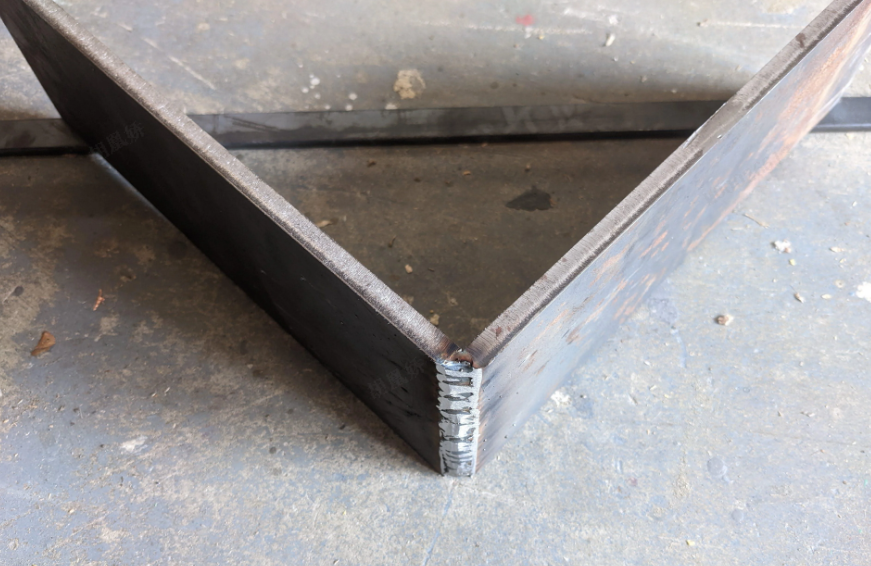
When you weld, the localized area under the arc reaches extreme temperatures, causing the metal to expand. However, the surrounding "cool" metal acts as a constraint, preventing the heated area from expanding freely. This creates internal compressive stress. As the weld pool solidifies and cools, the metal begins to contract. Because the metal was "upset" (deformed) during the heating phase, it cannot return to its original shape, leading to residual stresses that manifest as physical warping.
II. The Physics of Why Metal Warps
To implement effective weld distortion correction and prevention, one must understand the three primary forces at play:
Thermal Expansion and Contraction: Most metals expand when heated and contract when cooled.
Temperature Gradient: Welding involves intense heat in a very small area. The difference in temperature between the weld zone and the rest of the base metal is what creates the "fighting" forces within the plate.
Restraint: If a plate were heated uniformly in a vacuum, it would expand and shrink without distorting. In welding, the clamps, the fixture, and even the weight of the part itself act as restraints that force the metal to deform.
III. 5 Common Types of Weld Distortion
Understanding the types of weld distortion is the first step in diagnosing why a part is failing quality control. Distortion typically occurs in several distinct patterns:
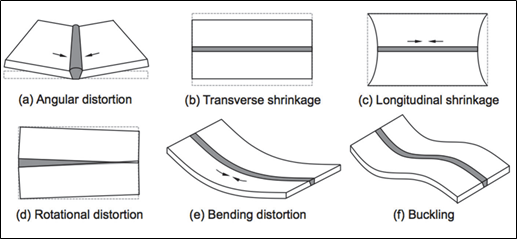
1. Longitudinal Shrinkage
This occurs along the length of the weld bead. As the weld metal cools, it pulls the base metal toward the center of the weld line, shortening the overall length of the component. This is particularly problematic in long, thin-walled sections or beams.
2. Transverse Shrinkage
Transverse shrinkage happens across the width of the weld. The weld bead pulls the two base plates together. This is the most common cause of parts ending up "too narrow" or joints closing up during a long pass.
3. Angular Distortion
When a V-groove or fillet weld is made, there is more weld metal at the top of the joint than at the bottom. As the larger volume of metal at the top shrinks, it pulls the plates upward, creating an angle. This is frequently seen in T-joints and lap joints.
4. Bowing and Cambering
If a weld is placed away from the "neutral axis" (the center of gravity of the part's cross-section), the shrinkage will pull the entire part into a curve. This is common in the fabrication of I-beams or long rectangular frames where welding is only performed on one side.
5. Buckling and Twisting
In thin materials, the internal stresses are often greater than the structural stiffness of the plate. This results in "oil-canning" or buckling, where the plate waves up and down. Twisting occurs when multiple different stresses interact, common in complex 3D assemblies.
IV. Factors That Influence Distortion Severity
Not every weld distorts equally. Several variables dictate how much a part will move:
Material Properties: Metals with high thermal expansion coefficients (like Stainless Steel or Aluminum) distort much more than Carbon Steel. Conversely, metals with low thermal conductivity trap heat in a localized area, increasing the temperature gradient.
Heat Input: Generally, the more heat you put into a joint, the greater the distortion. High-amperage, slow-travel-speed welding is a recipe for warping.
Joint Design: Over-welding is a major culprit. If a 6mm fillet weld is sufficient for the design, making an 8mm weld adds 70% more weld metal—and significantly more shrinkage force—without adding functional strength.
Welding Sequence: The order in which beads are deposited determines how stresses balance each other out.
V. How to Prevent Weld Distortion: Pre-Welding Strategies
The most cost-effective way to manage distortion is to stop it before the arc is ever struck. How to prevent weld distortion starts at the drafting table and the fit-up station.
1) Optimize Joint Design
Minimize Weld Volume: Use the smallest weld size required for the structural load.
Use Double-V Grooves: By welding from both sides of a plate, the shrinkage forces cancel each other out, preventing angular distortion.
Balance the Welding: Place welds symmetrically around the neutral axis of the component.
2) Accurate Fit-Up and Tacking
A loose fit-up requires more weld metal to fill the gap, which increases heat input and shrinkage.
Presetting: If you know a joint will pull 3 degrees, preset the parts at an opposite 3-degree angle so that the distortion pulls them into the perfect final position.
Strong Tacking: Use frequent, high-quality tack welds. Inconsistent tacks can break during the main welding pass, leading to sudden and unpredictable warping.
3) Use of Fixtures and Jigs
Fixturing holds the parts in a rigid position, forcing the metal to resist the shrinkage forces. While this doesn't eliminate internal stress (it actually increases residual stress), it keeps the part within dimensional tolerances. Copper or water-cooled chill bars can also be used to "sink" the heat away from the base metal, reducing the size of the heat-affected zone (HAZ).
VI. Effective Weld Distortion Control During Welding
Once welding begins, the operator's technique and the sequence of passes become the primary tools for weld distortion control.
1. The Backstep Technique
Instead of welding in one continuous direction from left to right, the backstep technique involves welding in short segments from right to left, while the overall progression moves left to right. This allows the heat to dissipate more evenly and prevents the buildup of longitudinal stress.
2. Skip Welding
Similar to backstepping, skip welding involves welding a short section, skipping a section, and welding another. You then return to fill in the gaps once the first sections have cooled. This keeps the overall temperature of the workpiece lower.
3. Planned Welding Sequence
In large assemblies, always weld from the center outward. If you are welding a large frame, have two welders work simultaneously on opposite sides to balance the heat and shrinkage. This "symmetrical welding" is one of the most effective ways to prevent bowing.
4. Increase Travel Speed
Using advanced welding processes that allow for higher travel speeds reduces the total heat input per inch. Modern pulse-spray transfer or specialized waveforms can achieve deep penetration with less overall heat, significantly lowering distortion levels.
VII. Weld Distortion Correction: Fixing Warped Parts
Even with the best planning, some distortion is inevitable in complex fabrications. When a part is out of spec, weld distortion correction techniques must be applied.
1. Mechanical Straightening
For minor distortion, hydraulic presses, jacks, or even manual hammering can be used to force the metal back into alignment. However, this can introduce cold-work stresses and is often not suitable for high-strength or brittle materials.
2. Thermal (Flame) Straightening
This is a highly skilled process where heat is applied to specific areas of the distorted part to create "controlled distortion" in the opposite direction.
Spot Heating: Used to remove small bulges in thin plates.
Line Heating: Used to correct angular distortion or bowing in beams.
Wedge/Vee Heating: A triangular area is heated on a bent member. As the wide part of the triangle cools and shrinks, it pulls the member straight.
Caution: Thermal straightening must be done carefully. Overheating can change the metallurgical properties of the steel, potentially making it brittle or reducing its load-bearing capacity.
VIII. Advanced Technology and Automation
Modern manufacturing is increasingly turning to technology to solve the "weld distortion" problem.
Robotic Welding: Robots provide 100% consistency in travel speed and heat input, making distortion highly predictable and easier to counteract through presetting.
Digital Power Sources: Modern inverters offer "Low Heat Input" modes. By precisely controlling the arc and the droplet transfer, these machines can reduce the heat-affected zone by up to 30% compared to traditional machines.
Simulation Software: High-end engineering firms now use Finite Element Analysis (FEA) to simulate the welding process before it happens. This allows engineers to see exactly how a part will warp and design the fixturing and sequences accordingly.
IX. Summary Checklist for Distortion Management
| Stage | Action Item | Goal |
| Design | Use intermittent welds or smaller fillets. | Reduce total weld volume. |
| Preparation | Preset parts or use rigid fixturing. | Counterbalance expected movement. |
| Fit-up | Ensure tight gaps and robust tacking. | Minimize filler metal and heat. |
| Execution | Use backstep or skip welding sequences. | Distribute heat evenly. |
| Execution | Employ high-speed, low-heat processes. | Minimize the heat-affected zone. |
| Correction | Use flame or mechanical straightening. | Bring parts back into tolerance. |
Conclusion
Weld distortion is an inherent challenge in metalworking, but it is not an unsolvable one. By understanding the thermal dynamics of the process and identifying the specific types of weld distortion affecting your work, you can move from reactive fixing to proactive prevention.
Implementing a robust weld distortion control strategy—combining smart joint design, disciplined welding sequences, and modern technology—will result in cleaner fabrications, lower costs, and a significantly higher standard of quality. Whether you are a solo fabricator or a marketing engineer explaining these concepts to a global audience, the key takeaway remains: control the heat, and you control the outcome.
Related articles:
1. Common Defects and Faults in Robotic Welding: Causes and Solutions
2. 9 Common Copper Pipe Welding Problems and Prevention
3. Laser Welding Aluminum Guide: Machines, Problems, and Settings
4. Aluminum Alloy Welding Common Problems and Solutions
5. Common Faults and Solutions of Gas Shielded Welding Machine