In the high-stakes world of industrial fabrication, the integrity of a single joint can support the weight of an entire skyscraper or the dynamic load of a suspension bridge. When dealing with heavy steel structures—where plate thicknesses often exceed 1/2 inch (12.7mm)—the "standard" welding approach isn't enough. You need deeper penetration, higher deposition rates, and the technology to handle hours of continuous arc-on time.
While traditional Stick (SMAW) welding was once the backbone of the construction site, modern MIG welding (Gas Metal Arc Welding, or GMAW) has evolved into the preferred solution for large-scale steel projects. This shift is driven by the need for speed without sacrificing the metallurgical strength required by strict building codes like AWS D1.1.
This guide explores the advanced techniques, physics, and industrial solutions that ensure strong, durable joints in heavy steel construction.
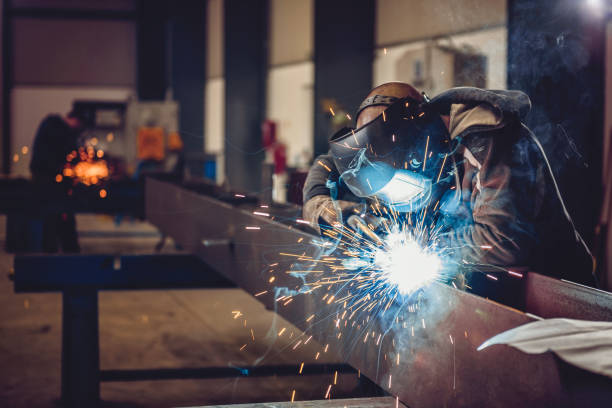
I. Why MIG Welding is the Go-To for Heavy Construction
The primary metric for success in heavy fabrication is the deposition rate—essentially, how many pounds of metal you can fused into a joint per hour. MIG welding dominates this category because of its continuous wire feed, which eliminates the downtime spent swapping electrodes in Stick welding.
Key Advantages for Large-Scale Heavy Steel Structure Projects:
Production Speed: MIG is significantly faster than TIG or Stick, allowing projects to stay on schedule.
High Efficiency: With automated and semi-automated options, labor intensity is reduced, which is critical during the skilled welder shortage currently affecting the industry.
Consistency: Unlike manual processes that rely heavily on operator "rhythm," modern MIG systems provide a stable arc that ensures uniform bead profiles over long runs.
Deep Penetration Capability: By utilizing specific transfer modes and travel directions, MIG can achieve the "complete joint penetration" required for load-bearing columns.
II. The Physics of Strength: Push vs. Pull Techniques
One of the most critical decisions an industrial welder makes is the travel direction of the torch. This isn't just about ergonomics; it fundamentally changes the physics of the arc and the resulting weld forming.
1. The Pull (Drag) Technique: The Industrial Standard for Depth
In the pull technique—also known as the drag or backhand technique—the welding gun is pointed back at the weld puddle and dragged away from the completed bead.
How it Works: The torch is inclined at an angle of 5 to 15 degrees toward the direction of travel. By dragging the arc, you focus the intense heat directly into the base metal at the bottom of the joint.
The Result: Narrower, taller beads with significantly deeper penetration.
Best Use Case: For heavy steel structures where structural integrity is the primary concern, pulling is the mandatory approach to ensure the weld "digs" into the root of thick plates.
2. The Push Technique: For Cleanliness and Coverage
The push technique (forehand welding) involves pointing the gun ahead of the weld puddle, moving in the direction of the joint.
How it Works: The shielding gas and arc force are directed toward the "cold" metal ahead of the pool.
The Result: A flatter, wider bead with shallower penetration.
Best Use Case: Use this for "capping" passes (the final visible layer) where aesthetics and a smooth blend into the parent metal are required, or when welding thinner ancillary steel components like handrails.
Comparison of Bead Morphology
| Feature | Pull (Drag/Backhand) | Push (Forehand) |
| Penetration Depth | Deep and aggressive | Shallow to moderate |
| Bead Shape | Narrow and tall | Flat and wide |
| Spatter Level | Slightly lower | Slightly higher |
| Visibility | Excellent view of the arc/joint | Focused on the weld puddle |
| Primary Use | Thick structural plates | Thin materials and capping |
III. Technical Mastery: Setting Up for Success on Thick Plates
Welding a 1-inch (25mm) thick structural column is fundamentally different from welding a 1/8-inch frame. You must move from "Short-Circuit" transfer to "Spray Transfer" to achieve the required fusion.
1. The 1-Amp Rule
A reliable industry "Golden Rule" for a starting point is: You need approximately 1 amp of output for every 0.001 inch of material thickness.
2. Spray Transfer Mode
For heavy steel structures, "Short-Circuit" (the buzzing sound) is insufficient—it often leads to "cold lapping" where the wire melts but doesn't fuse with the plate. Instead, industrial welders use Spray Transfer.
By increasing the voltage (typically 26V+) and using a shielding gas with at least 80% Argon, the metal "sprays" across the arc in tiny droplets. This provides the extreme heat needed to penetrate thick slabs of structural steel.
3. Choosing the Right Wire and Gas
ER70S-6 Solid Wire: The industrial gold standard for mild steel. It contains deoxidizers that allow you to weld through light mill scale or rust commonly found on construction sites.
ER80S-D2: Used for high-strength low-alloy (HSLA) steels where higher tensile strength is required.
C25 Shielding Gas (75% Argon / 25% CO2): Offers the best balance between deep penetration and a stable, low-spatter arc.
Pure CO2: Sometimes used for the deepest possible penetration on very thick steel, though it results in significantly more spatter.
IV. Managing Industrial Challenges: Distortion and Joint Access
The more heat you put into a heavy steel beam, the more it wants to move. Managing this physical reality is what separates an expert fabricator from a beginner.
1. Joint Preparation (Beveling)
You cannot achieve full penetration on thick plates by simply butting them together. For steel thicker than 3/16", the edges must be ground into a V-groove or Double-V configuration. This allows the arc to reach the "root face" and ensures a homogenous bond through the entire thickness of the plate.
2. Multi-Pass Strategy
Never try to fill a deep structural joint in a single pass.
Root Pass: The first bead at the very bottom. This is usually "dragged" for maximum depth.
Fill Passes: Multiple layers stacked to build volume.
Cap Pass: The final layer, often "pushed" for a smoother, flatter finish that blends into the surface.
3. Fighting Warping and Distortion
Uneven heating causes heavy steel to warp. To prevent this, fabricators use Skip Welding (welding small sections at a time and moving around) or Back-Stepping (welding small sections in the opposite direction of the overall progression).
V. Troubleshooting Structural Defects
Even with the best equipment, heavy-duty welding is prone to specific defects that can fail industrial inspections (like UT or Radiographic testing).
| Problem | Potential Technique Cause | Recommended Technical Adjustment |
| Cold Lap (Lack of Fusion) | Travel speed too fast; Pushing on thick metal | Switch to Pull; Slow down; Increase Voltage |
| Porosity (Pinholes) | Windy conditions; Too steep an angle | Use Push for better gas coverage; check for drafts |
| Undercut (Grooves at edges) | Voltage too high; Arc length too long | Lower Voltage; Tighten arc; use a slight weaving motion |
| Slag Inclusions | Pushing Flux-Cored wire | Always Pull slag-producing wires (If there's slag, you must drag) |
VI. FAQs of MIG Welding Solutions for Heavy Steel Structures
Q1. Is MIG welding as strong as Stick welding for heavy structures?
Yes. When performed correctly according to a qualified Welding Procedure Specification (WPS), a MIG weld is just as strong, if not stronger, than Stick. Because MIG is a continuous process, it has fewer "re-starts" (where a stick electrode is changed), which are the most common points for internal defects to form.
Q2. Can I MIG weld structural steel outdoors?
Standard MIG (solid wire with shielding gas) is sensitive to wind. For outdoor work where wind might blow away your gas shield, fabricators often switch to Flux-Cored Arc Welding (FCAW). This uses a tubular wire that creates its own shield, making it wind-resistant while maintaining the high speed of a wire-fed process.
Q3. What is the maximum thickness MIG can weld?
With a high-amperage industrial machine (like Megmeet’s 500A or 630A series), there is virtually no limit to the thickness, provided you use proper joint preparation (beveling) and a multi-pass strategy.
Q4. Why is preheating necessary for some heavy steel?
Preheating the metal to 150°F–400°F before welding slows down the cooling rate. This prevents the steel from becoming brittle and cracking, which is a major risk in high-strength steels used in heavy machinery and construction.
Strategic Conclusions for Large-Scale Fabrication
The shift toward advanced MIG solutions is no longer a luxury for heavy steel fabricators—it is a necessity for staying competitive and ensuring public safety. By mastering the travel direction, optimizing transfer modes, and leveraging digital inverter stability, companies can produce structures that are built to last for generations.
For industrial-grade equipment designed to withstand the harshest construction environments while delivering superior arc performance, explore Megmeet steel structures industry welding solutions. These digital power sources are redefining what is possible in heavy-duty structural fabrication.
Related articles:
1. How to Weld Stainless Steel: Tips and Tricks
2. Easy-To-Use Welding Machines: Simplicity Forged in Steel and Sparks
3. Common Welding Methods for Steel Structures Welding
4. Making Stainless Steel Welds Post-weld Cleaning Easy and Cost-Efficient
5. How to Weld Stainless Steel with GTAW, GMAW or SMAW Method