How to Weld Vertical: A Practical Guide to Strong, Clean Vertical Welds
In the hierarchy of welding skills, vertical welding stands as a significant milestone. While flat and horizontal welding allow the operator to work with gravity, vertical welding forces you to fight it. Every drop of molten metal wants to succumb to the earth’s pull, threatening to sag, drip, or fall out of the joint entirely.
Learning how to weld vertical is not just about technical proficiency; it is about understanding the physics of the molten pool. Whether you are working on structural steel, pipe, or heavy machinery, mastering tips for vertical welding will elevate your capability from a shop-floor hobbyist to a high-demand professional.
This comprehensive guide explores the techniques, settings, and secrets behind successful vertical welding (3G and 3F positions) across Stick, MIG, and TIG processes.
I. Understanding the Physics: Gravity vs. Surface Tension
Before you strike an arc, you must understand your opponent. In vertical welding, two forces are at play: gravity and surface tension.
Gravity: Pulls the molten puddle downward. If the puddle becomes too large or too fluid, it will "curtain" or sag, leading to a defect known as "grapes" or overlap.
Surface Tension: The force that holds the molten metal to the base material. The goal of vertical welding is to manage the heat so that surface tension wins the battle against gravity.
To achieve this, we use the "Shelf" Technique. Each "step" of the weld acts as a physical ledge or shelf for the next drop of molten metal to rest upon.
II. Vertical Up vs. Vertical Down: Which One Should You Use?
One of the first steps in learning how to weld vertical is choosing the direction of travel. This decision is usually dictated by the thickness of the material and the structural requirements of the job.
1) Vertical Up (Progressing Upward)
Vertical up is the standard for structural welding and heavy-duty fabrication.
Best For: Materials thicker than 1/4 inch (6.4 mm).
Why: It provides deep penetration and a stronger bond because the arc is always digging into the base metal while the puddle follows.
Difficulty: High. Requires precise heat management to prevent the puddle from sagging.
2) Vertical Down (Progressing Downward)
Vertical down is often used for thin sheet metal, pipe root passes, or non-structural repairs.
Best For: Thin materials (less than 3/16 inch) or high-speed production where penetration is less critical.
Why: It is much faster and produces less heat input, preventing burn-through on thin sheets.
Difficulty: Moderate. The primary challenge is staying ahead of the slag so it doesn't get trapped in the weld.
III. How to Weld Vertical with Stick (SMAW)?
Stick welding is perhaps the most challenging process for vertical work due to the presence of slag.
1) Electrode Selection:
Fast-Freeze (e.g., 6010, 6011): These rods are excellent for vertical down root passes because the puddle solidifies almost instantly.
Low-Hydrogen (e.g., 7018): The industry standard for vertical up. It produces high-strength, ductile welds but requires a steady hand to maintain the "shelf."
2) Machine Settings
For vertical up, you generally want to lower your amperage by 10% to 15% compared to what you would use for a flat weld. This keeps the puddle smaller and more manageable.
3) The Technique: The "Z-Weave" and "Triangle"
The Z-Weave: Move the electrode in a "Z" pattern. Pause at the sides (to fill the edges and prevent undercut) and move quickly across the center (to avoid building up too much heat).
The Triangle: Ideal for heavy fillet welds. Move the rod up into the root, then down to the left side, then across to the right, forming a triangle. This ensures deep root penetration.
IV. Tips for Vertical Welding with MIG (GMAW)
MIG welding is widely used for vertical applications because of its speed and ease of use, but it is prone to a defect called "cold lap" if not executed correctly.
1) Short-Circuit vs. Pulse:
Short-Circuit Transfer: Most common for vertical MIG. It uses lower heat and a smaller puddle, making it easier to fight gravity.
Pulse MIG: An advanced technique where the machine "pulses" the current, allowing the puddle to cool slightly between drops. This is perfect for vertical up on aluminum or thick steel.
2) Torch Angle:
Keep a push angle (pointing slightly upward) of about 5° to 15° for vertical up. This allows the arc force to help hold the puddle in place.
3) The Technique:
For vertical up MIG, avoid a straight stringer bead. Use a tight "U" or "Z" weave. Pro Tip: Never linger in the middle of the weld. The middle will naturally stay hot; you must focus your time on the edges to ensure the weld "ties in" to the base metal without leaving a groove (undercut).
V. Masterclass: TIG Welding (GTAW) in the Vertical Position
TIG welding offers the most control but requires the most coordination.
Amperage Control: Use a foot pedal or torch slider. You will need more heat to start the puddle on the vertical plate, but as the heat builds up in the metal, you must slowly back off the amperage to keep the puddle from sagging.
Filler Rod Placement: Always add the filler rod to the top of the puddle. Gravity will naturally pull the molten filler down into the pool.
Tungsten Focus: Use a sharp tungsten to keep the arc cone narrow. A wide arc will spread heat too far, making the entire joint unstable.
VI. Critical Tips For Vertical Welding: Common Pitfalls
Even experienced welders struggle with vertical positions. Here are the most common issues and how to solve them:
1) Avoiding Undercut:
Undercut is a groove melted into the base metal that isn't filled by the weld.
The Fix: Pause at the sides of your weave. Count "one-one-thousand" at the edge before moving across. This allows the filler metal to fill the "hole" created by the arc.
2) Preventing Slag Inclusions:
This happens when molten slag gets trapped underneath the weld metal.
The Fix: In vertical down welding, keep your arc on the leading edge of the puddle. If the slag starts to run ahead of the arc, increase your travel speed or adjust your torch angle.
3) Managing Body Positioning:
You cannot weld what you cannot see.
The Fix: Get comfortable. Prop your arm against the workpiece or a stand. If you are shaky, your weave will be inconsistent, leading to sagging.
VII. Comparison Table: Vertical Up vs. Vertical Down
Feature
Vertical Up (3G/3F)
Vertical Down
Penetration
Deep
Shallow
Speed
Slow
Fast
Material Thickness
Thick (>6 mm)
Thin (<5 mm)
Heat Input
High
Low
Structural Integrity
High (Code Compliant)
Lower (Non-structural)
VIII. Safety and Preparation
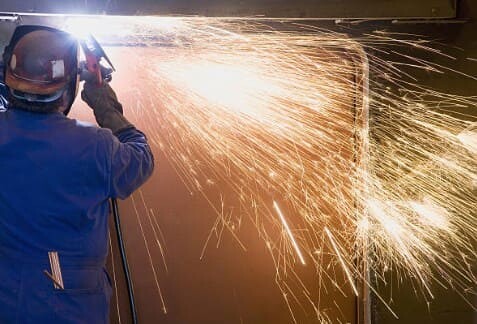
Vertical welding often results in more "sparks" falling directly on the operator.
PPE: Wear a leather apron, high-quality welding jacket, and a cap under your helmet. Ensure your boots are tucked under your pants so sparks don't fall inside.
Fit-up: For vertical joints, a consistent gap is vital. If the gap varies, your heat management will be impossible to maintain.
Conclusion
Learning how to weld vertical is a journey of muscle memory. The most important of all tips for vertical welding is to watch the puddle, not the arc. If you see the puddle getting too round and "bulbous," you are too hot—move faster or turn down the amps. If the puddle isn't "wetting out" to the edges, you are moving too fast.
Mastering the vertical shelf will open up a world of structural and industrial opportunities. It is the definitive test of a welder's control over their environment.