Pipeline welding plays a critical role in a wide range of industries — petroleum, natural gas, chemical, power generation, shipbuilding, and more. The process demands more than simply “joining pipes”: welds must remain leak-proof under high pressure, resist corrosion, tolerate temperature and mechanical stresses, and meet stringent regulatory and safety standards. In practice, that makes pipeline welding one of the most demanding welding disciplines.
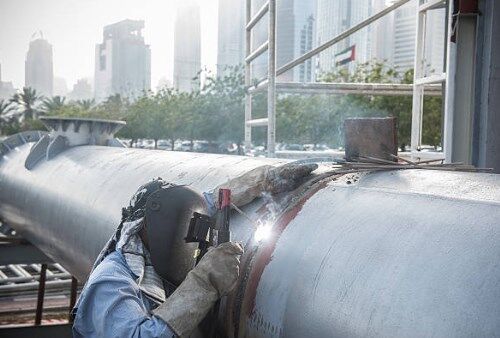
In this article we expand on the key methods, challenges, and best practices — including considerations for in-service repairs. Whether you are specifying welding procedures, procuring equipment, or supervising pipeline construction / maintenance, this guide offers a clear, up-to-date overview.
I. What Is Pipeline Welding — and How It Differs from Typical Pipe Welding?
“Pipe welding” and “pipeline welding” are often used interchangeably — but there are important distinctions in context, operating environment, and engineering demands.
Pipe welding: usually refers to joining or fabricating pipes in a shop, plant, or construction setting under controlled conditions (e.g. for process piping, structural piping, small- to medium-diameter systems). Fit-up is generally easier to control; environment, cleanliness, and welding parameters can be carefully regulated.
Pipeline welding: typically involves large-diameter, long-distance pipelines used for transporting oil, gas, water or other fluids — often buried, exposed to field conditions, spanning many kilometers, and subject to regulatory and safety requirements. Because of these factors, pipeline welding demands stricter controls over fit-up, welding parameters, material compatibility, inspection and documentation.
In other words: pipeline welding extends beyond mere metal joining — it’s critical infrastructure work, where environment, safety, and long-term reliability matter.
II. Why Pipeline Welding Is Especially Challenging?
Compared with general fabrication welding, pipeline welding carries extra burdens. Several factors make it technically demanding:
Diverse materials, specs, and conditions — Pipelines vary widely in diameter, wall thickness, material (carbon steel, low-alloy, stainless, etc.), operating pressure, and the transported medium (gas, oil, chemicals, water). Each combination influences how the weld must be performed.
High-quality and safety requirements — Weld seams must guarantee mechanical strength, ensure sealing under internal pressure, and resist failure for decades. This often demands strict adherence to procedures, careful testing and inspection, and certified workmanship.
Logistics and labor constraints — Frequent changes in pipeline specs or varying customer demands often force production line adjustments. Meanwhile, the skilled labor pool is tight; qualified pipeline welders are in high demand, which makes recruitment difficult and labor costs high.
Field conditions and harsh environments — Pipelines are often built or maintained in remote, rugged terrain, extreme weather, or confined spaces. Equipment must handle transport, rough conditions, and continuous long-hour operation.
Inspection & rework burden — Because of safety requirements, every weld may need non-destructive testing (e.g. ultrasonic or radiographic), leak and pressure testing. Weld defects (lack of fusion, porosity, slag inclusion, cracking, undercut, burn-through, etc.) can lead to expensive rework or risk of pipeline failure.
All these factors mean pipeline welding is not only a technical challenge, but also a logistical and economic challenge — requiring careful planning, capable equipment, and experienced personnel.
III. Common Pipeline Welding Methods — Pros & Cons
Depending on the pipeline material, wall thickness, and job requirements (new construction, repair, maintenance, in-service welding), different welding methods may be used. Below is an overview of common techniques, with typical advantages and limitations.
| Welding Method | Typical Use Cases | Advantages | Common Limitations / Risks |
|---|
| Manual Arc Welding (SMAW / “stick”) | Small-to-medium pipelines; remote sites; where simple equipment is favored | Simple equipment; flexible; adaptable to many locations | Lower productivity; quality less consistent; higher risk of defects (slag inclusion, porosity, undercut, hydrogen-induced cracking) |
| Gas-shielded welding (GMAW, GTAW/TIG, MIG/MAG) | Pipelines needing high-quality welds, controlled heat input, better aesthetics | Higher weld quality; better fusion and sealing; less deformation; cleaner welds | Requires more complex equipment; sensitive to environmental conditions; higher equipment cost and shielding-gas logistics |
| Submerged Arc Welding (SAW) / Automatic Welding | Large-diameter pipelines, long weld seams, automated or production-line welding | High deposition rates; consistent weld quality; efficient for repetitive welds | Equipment complexity; requires stable power and wire feed systems; less flexible in remote/outdoor or small-batch jobs |
| Special Methods (e.g. Plasma Arc Welding for thick walls) | Thick-wall pipelines, high energy density needs, critical joints | High energy concentration; effective for thick materials | Expensive equipment; requires skilled operators; sensitivity to parameter control |
In many real-world pipeline projects, contractors combine methods — perhaps using gas-shielded welding or SAW for main-line construction, and manual arc welding for tie-ins or small-diameter branches.
IV. Pipeline Maintenance and In-Service Repairs: Extra Complexity
One of the biggest technical challenges in pipeline welding lies in in-service welding or repair — i.e. working on pipelines that are in operation, carrying pressurized oil, gas or other fluids. This is common when corrosion, wall-thinning, or defects occur on existing pipelines.
Here are core issues and recommended practices for in-service welding:
1) Heat sink effect & rapid cooling:
When a pipeline still contains fluid (oil, gas, or product), that medium acts as a heat sink — it absorbs welding heat, cooling the weld puddle much faster than welding an empty pipe or new build. That rapid cooling can lead to poor fusion, incomplete penetration, or hard microstructures (heat-affected zone brittleness), increasing risk of cracking or weld defects.
2) Risk of burn-through and leaks:
Because the pipe wall is already under pressure, and possibly thinned by corrosion or wear, welding can risk burn-through. If the pipe wall is too thin, or welding parameters are not carefully controlled, welding may penetrate or overheat the wall — causing leakage or pipeline failure.
3) Testing and weld parameters must be adjusted carefully:
Given the altered thermal behaviour and increased risk, welding procedures for in-service repair often require different parameters: higher amperage, controlled heat input, interpass temperature control, and special pre- and post-weld inspection. In some cases, “butter passes” are used — adding weld material incrementally to build up pipe wall thickness before final weld, to avoid burn-through and improve structural integrity.
4) Alternative repair methods: weld-deposition repair or repair sleeves:
For wall-thinning due to corrosion or pitting, repair may involve adding weld metal via deposition (rather than replacing the pipe) or installing a full-encirclement sleeve and welding it on. These methods avoid complete pipe replacement, which can be costly and logistically difficult — especially when the pipeline is in service.
Weld-deposition repair is often more economical, does not require new materials beyond consumables, and can address wall loss in bends or fittings where sleeves cannot be installed.
However, weld-deposition repair presents its own limitations — including metallurgical integrity, post-weld strength, and ensuring long-term durability — so procedure qualification, inspection, and testing are critical.
V. Pipeline Maintenance and In-Service Repairs: Extra Complexity
Given the demands of pipeline welding — variable field conditions, long work hours, tight schedules, varied job types (new construction, maintenance, in-service repair) — the welding equipment used must meet high standards. A well-designed welding machine for pipeline projects should deliver the following:
Durability and reliability under harsh conditions — able to withstand transport, rough terrain, temperature extremes, humidity, and long continuous hours without failure.
Consistent performance — stable arc control, repeatable weld quality across many joints, minimizing downtime and rework.
Flexibility for different welding methods — from manual arc (for remote tie-ins), gas-shielded welding, to automated or semi-automatic processes when higher productivity needed.
Ease of maintenance, low downtime — often pipeline sites lack nearby service facilities; machines should be easy to service, with accessible components and straightforward maintenance schedules.
Compatibility with varied materials and requirements — ability to handle carbon steel, low-alloy steels, potentially stainless steels; suitable for thick-wall and thin-wall pipes; capable of producing welds that meet pressure and quality standards under varying conditions.
In sum, the equipment must be robust, versatile, and dependable; failure is not an option given the safety and cost stakes.
The pipeline rack platform is a fixed offshore platform supported by the pipeline rack driven into the seabed, mainly used for offshore drilling, oil production, and transportation activities. In the manufacturing of pipeline racks, the weld seam at the truss saddle is one of the most difficult welding nodes, requiring high-altitude operations, low accuracy, poor alignment, and limited positioning. It requires the use of welding rods for the root, gas-shielded flux-cored welding wire for filling, multi-layer multi-pass welding, and a large filling volume.
Shenzhen Chiwan Shengbaowang Engineering Co., Ltd. (CSE) used the Megmeet Artsen CM500C fully digital industrial heavy-duty CO2/MAG/MMA intelligent inverter welding machine in the offshore pipeline rack manufacturing project. The series of welding machines has the following characteristics:
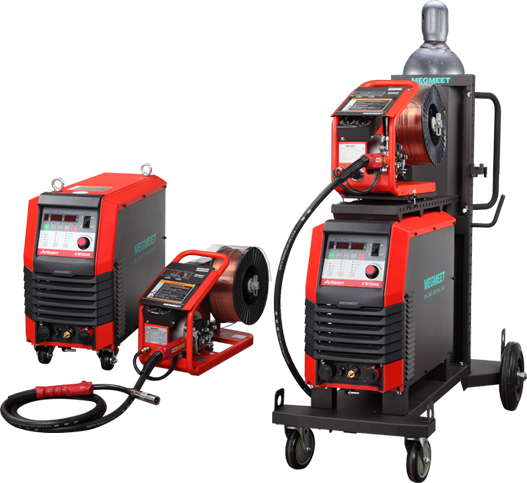
Adopting carrier technology eliminates control lines, greatly improving overall reliability and ensuring efficient production. It can achieve remote welding of 100 meters with stable and reliable parameters.
Supports special flux-cored welding wire (E71T-1C), vertical upward straight pulling welding function, relative oscillation welding, greatly reducing the heat input to the weld seam. Suitable for vertical upward welding of ultra-large container ships and other thick plates.
It has a 100% load continuous rate at 500A, with a high wire feeding speed and high deposition rate of 24 meters per minute. It can adapt to long-term stable welding with large currents.
The wire feeder and PCBA have excellent protection design, making them more suitable for working in environments such as vibration, collision, humidity, and salt spray.
It has short-circuit overcurrent and open-circuit protection functions of electromagnetic valves, realizing automatic protection.
Through comparison, the Megmeet Artsen CM500C series welding machine has better welding effects for pipeline welding, mainly manifested in:
Stable and reliable welding with high current over long distances, the welding parameters displayed by the wire feeder greatly improve welding quality, reducing rework rates by 15%.
One welding machine meets the requirements of on-site manual operation and gas shielded welding process switching, increasing equipment utilization by 30%.
The failure rate of the welding machine has dropped significantly, and the number of welding machine repairs has decreased by 50%.
Deep welding penetration, multi-layer, and multi-groove welding can reduce the risk of non-fusion and ensure the welding quality.
VII. Key Best Practices & Recommendations
Based on industry experience and documented repair-welding guidance, several best practices emerge for pipeline welding — especially for in-service or maintenance welding:
1) Adjust welding parameters according to pipe conditions:
For in-service welding, expect faster heat dissipation due to fluid inside pipe; consider increasing amperage (sometimes 40–50% higher than for empty pipe) to ensure good fusion.
Use “butter passes” when wall thickness is reduced — build up material first, then perform final weld to avoid burn-through or weak spots.
2) Strict pre-weld inspection and fit-up controls:
Proper beveling, alignment, root gap, and cleaning is essential. Uneven edges, poor alignment or contamination significantly raise the risk of defects (lack of fusion, porosity, slag inclusion).
Maintain root opening, bevel angles, and fit-up tolerances precisely. This ensures deep fusion and structural integrity.
3) Appropriate welding method selection:
For remote or small-diameter pipelines — manual arc welding remains practical due to simple equipment needs.
For long runs or high-volume pipelines — gas-shielded or automatic methods improve productivity and weld quality.
For thick-wall, high-spec pipelines — advanced or automated welding (SAW, gas-shielded, possibly mechanized) may be justified.
4) Appropriate welding method selection:
Use nondestructive testing (ultrasonic, radiography, magnetics) to verify weld integrity.
For in-service repairs: conduct pressure tests, leak tests, hydro tests — because welds may have hidden defects, or micro-structural changes due to rapid cooling.
Keep detailed records: weld procedure specification (WPS), welder qualifications, material certifications, inspection reports.
5) Invest in reliable, well-designed welding equipment:
Given the demanding environment and need for reliability, welding machines should be designed with ruggedness, ease of maintenance, and flexibility in mind.
Digital controls, consistent arc stability, and ability to support multiple welding processes (manual arc, gas-shielded, auto) are big pluses.
6) Training, qualification and skilled workforce:
Pipeline welding — especially field welding and in-service repair — requires highly skilled welders. Given the shrinking pool of experienced pipeliners, investing in training and qualification is critical.
Continuous re-certification, procedure qualification, and on-site supervision help ensure quality and safety.
Conclusion
Pipeline welding — whether for new construction, maintenance, or in-service repair — demands a high level of technical skill, precise execution, and robust equipment. The complex interaction of variables — materials, wall thickness, operating pressure, fluid inside the pipe, environmental conditions — requires careful planning, welding procedure specification, competent welders, and rigorous inspection procedures.
For organizations specifying or carrying out pipeline welding, investing in high-quality, durable welding equipment and maintaining a well-trained workforce is essential. Likewise, strict adherence to welding parameters, fit-up, inspection, and post-weld testing helps ensure long-term pipeline safety and reliability.
In short: pipeline welding is not just about putting metal together — it’s about building trust in a system that will carry fluids under pressure for decades.
Related articles:
1. 15 Tips for Welding Aluminum in Shipbuilding Industry
2. Megmeet Supporting the 9th China Welding Technology Development Forum of Shipbuilding and Marine Engineering
3. Megmeet Welding Solution — Ship-building Industry
4. Side Panel of Shipping Container Welding - Using Artsen II PM500F Welder
5. Aluminum Alloy Boat Welding - Using Dex PM3000S Welding Machine