Working with thin sheet metal is often described by welders as "performing surgery with a sledgehammer." If you’ve ever tried to join two pieces of 22-gauge steel only to watch the metal vanish into a gaping hole, you know the frustration. Whether you are restoring a classic car, building custom ductwork, or fabricating delicate artistic pieces, the stakes are high and the margins for error are microscopic.
When it comes to thin gauge materials, the debate usually boils down to two heavyweights: MIG (Metal Inert Gas) and TIG (Tungsten Inert Gas) welding. But which one is truly the best? In this guide, we will break down the techniques, equipment setups, and "pro secrets" to help you master thin sheet metal without the headache of warping or burn-through.
I. Why Is Thin Sheet Metal So Difficult to Weld?
Before we dive into the MIG vs TIG comparison, we need to understand the enemy: Heat.
Thin metal (generally defined as 1/8 inch or thinner, down to 24-gauge) has very little mass. This means it cannot soak up and dissipate heat like a thick plate of structural steel. When you apply an arc to thin metal, the temperature rises almost instantly. If that heat isn’t managed, two things happen:
Burn-Through: The metal reaches its melting point and simply falls away, leaving a hole where a bead should be.
Distortion and Warping: Metal expands when heated and contracts when cooled. Because thin sheet is flexible, this uneven expansion causes the metal to "oil can," wave, or twist out of shape.
II. Is MIG Welding Better for Thin Sheet Metal?
MIG welding is often the first choice for home hobbyists and high-volume industrial shops because of its speed and ease of use. But is it right for the delicate stuff?
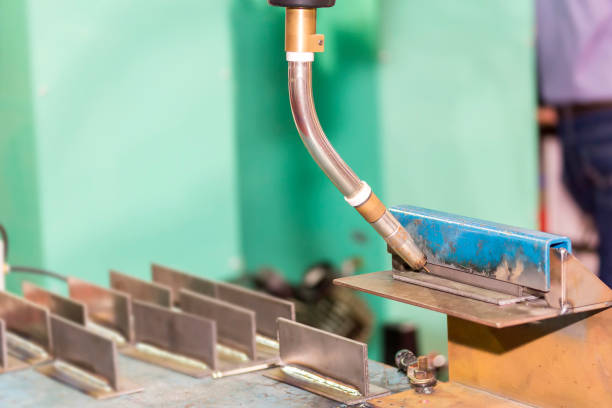
1) The Mechanics of MIG on Thin Gauges
In MIG welding, a wire electrode is fed through a gun, creating an arc that melts both the wire and the base metal. For thin sheets, the biggest challenge with MIG is that the wire is constantly feeding into the puddle. If your wire speed is too high, you’re adding too much material; if your voltage is too high, you’re blowing holes.
2) Pros of MIG for Thin Metal
Speed: You can move much faster than TIG, which actually helps minimize the time heat is applied to a single spot.
Learning Curve: It’s far easier to maintain a steady hand when the machine is doing the "feeding" for you.
Gap Bridging: If your fit-up isn't perfect, MIG is much more forgiving at filling small gaps.
3) Cons of MIG for Thin Metal
Heat Control: It is harder to "fine-tune" the heat mid-weld compared to a TIG foot pedal.
Spatter: Thin metal often requires low-voltage "short-circuit" transfer, which can be messy and require more cleanup.
III. Is TIG Welding the "Holy Grail" for Precision?
If MIG is a paintbrush, TIG is a needle. It is widely considered the superior process for ultra-thin materials, but it demands a higher level of skill.
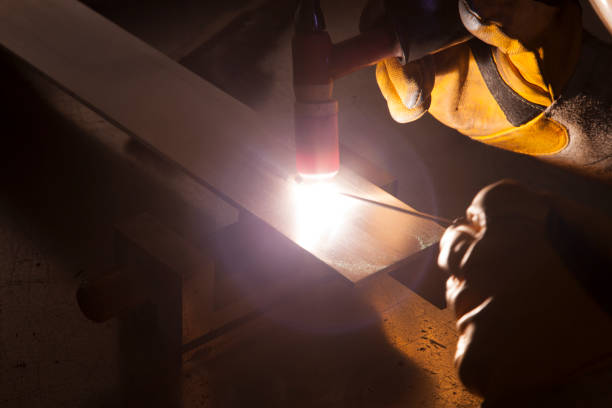
1) The Mechanics of TIG on Thin Gauges
TIG uses a non-consumable tungsten electrode to create the arc. You hold the torch in one hand and manually feed a filler rod with the other. This separation of heat source and filler material is the secret to TIG’s success on thin metal.
2) Pros of TIG for Thin Metal
Ultimate Heat Control: Using a foot pedal, you can back off the amperage the moment you see the metal getting too hot.
Aesthetics: TIG produces those famous "stacked dimes" beads that require almost no grinding or finishing.
Low Amperage Stability: High-quality TIG welders can maintain a stable arc as low as 5 amps, allowing you to weld metal as thin as a razor blade.
3) Cons of TIG for Thin Metal
Slowness: The slow travel speed means heat has more time to "soak" into the surrounding metal, which can actually increase warping if you aren't careful.
Difficulty: It requires excellent hand-eye-foot coordination.
IV. MIG vs TIG: Head-to-Head Comparison
| Feature | MIG Welding | TIG Welding |
| Primary Advantage | Speed and Efficiency | Precision and Control |
| Ease of Use | High (Beginner-friendly) | Low (Steep learning curve) |
| Heat Control | Limited (Set on machine) | Excellent (Foot pedal control) |
| Weld Appearance | Functional, some spatter | Aesthetic, "Stacked Dimes" |
| Best For | Auto body panels, long seams | Jewelry, tubing, stainless steel |
| Minimum Thickness | ~24 Gauge (with care) | ~30 Gauge (with precision) |
V. How Do You Prevent Burn-Through and Distortion?
Regardless of the machine you choose, the technique is what separates a professional weld from a piece of scrap metal. Here are the best techniques to keep your sheet metal flat and hole-free.
1. The "Stitch Welding" Technique
Instead of running one long, continuous bead, use stitch welding (also called skip welding). Lay a 1/2-inch bead at the beginning of the seam, move to the middle for another 1/2-inch, then to the end. This allows the heat to dissipate across the entire panel rather than concentrating in one area.
2. Use a Backing Bar (Heat Sink)
This is a game-changer. Place a thick piece of copper or aluminum behind the joint you are welding. Since these metals conduct heat much faster than steel, they act as a "heat sink," sucking the excess thermal energy away from the thin sheet. Bonus: Weld spatter won't stick to copper!
3. Perfect Your Fit-Up
With thick plate, you can "fill" a gap. With thin sheet metal, a gap is a death sentence. If there is a space between your workpieces, the arc will instantly melt the edges back rather than joining them. Ensure your pieces are touching tightly across the entire joint.
4. Wire and Tungsten Selection
For MIG: Use the thinnest wire possible, usually .023 inch (0.6mm). This requires less energy to melt, which keeps the overall heat input low.
For TIG: Use a small diameter tungsten, such as 1/16 inch, and grind it to a sharp, long point to keep the arc focused and stable at low amperages.
V. Which Shielding Gas Should You Use?
For thin sheet metal, the gas mixture is more than just a shield; it’s a cooling mechanism.
MIG Standard: A mix of 75% Argon and 25% CO2 (C25) is the industry standard for mild steel. It provides a stable arc with manageable heat.
MIG Pro Tip: If you are struggling with burn-through, some welders switch to a 90% Argon / 10% CO2 mix to reduce the "hot" characteristic of the CO2.
TIG Standard: 100% Pure Argon is almost always used. It provides the cleanest arc and prevents contamination that could lead to weak, brittle welds on thin gauges.
VI. FAQs: Common Thin Metal Welding Questions
Q1. Can I weld 22-gauge steel with a flux-core welder?
It is possible, but extremely difficult. Flux-core (gasless) welding is generally a "hotter" process and produces significantly more spatter. If you must use it, use very short "burst" tacks and allow the metal to cool completely between hits.
Q2. What is the best travel angle for thin metal?
For MIG, use a push angle (leaning the torch away from the direction of travel) of about 10-15 degrees. This results in a flatter bead and less penetration, which is exactly what you want on thin stuff.
Q3. How do I fix a burn-through hole?
Conclusion
When choosing between MIG and TIG for thin sheet metal, consider your end goal. If you are doing floor pans in a truck where the weld will be covered by carpet, MIG welding is the most efficient way to get the job done. However, if you are working on a visible exterior panel or a high-end stainless project, TIG welding is worth the extra time and effort.
To achieve industrial-grade results in MIG applications, the quality of your power source matters. Modern technology has introduced "Synergic" and "Pulsed" modes that take the guesswork out of thin metal settings. For those looking for a reliable, high-performance solution, Megmeet MIG welding machine offers advanced arc control specifically designed to handle thin materials with minimal distortion and a remarkably stable arc. By pairing the right technique with a professional-grade machine, you can turn the "nightmare" of thin sheet metal into your most impressive work yet.
Related articles:
1. Mastering Shielding Gas in TIG Welding: A Guide to Better Welds
2. TIG Welding Technique Principle, Applications and Considerations
3. A Guide to Heavy Industrial TIG Welding Tools & Equipment
4. How To Setup A TIG Welding Machine For the First Use?
5. Mastering TIG Welding Polarity: PRO Tips for Perfect Welds