In the modern engineering landscape, the ability to join two different types of metal—known as Dissimilar Metal Welding (DMW)—is a critical skill. Whether it is joining stainless steel to carbon steel in a power plant, or aluminum to copper in battery manufacturing, the goal is often to combine the unique properties of two materials. One might provide corrosion resistance, while the other offers structural strength or cost-efficiency.
However, welding dissimilar metals is significantly more complex than joining the same alloys. It involves navigating conflicting melting points, differing thermal expansion rates, and the risk of creating brittle chemical compounds.
This guide provides an in-depth exploration of the metallurgy, technical challenges, and practical steps required to master the art of joining dissimilar materials.
I. The Metallurgy of Dissimilar Metal Welding
To understand how to weld different metals, we must first look at what happens at the atomic level. When two metals are melted together, they form a new alloy in the "fusion zone." If these metals are not compatible, the resulting joint can be weak, brittle, or prone to immediate cracking.
1. Solubility and Intermetallic Compounds
For a weld to be successful, the two metals must be soluble in each other in the liquid state. If they are not, they will separate like oil and water. Even if they are soluble, they may form intermetallic compounds—brittle phases that act like glass within the weld. For example, when welding aluminum to steel, a thick layer of iron-aluminum intermetallics forms, which is so brittle that the weld will often snap under the slightest stress.
2. Differing Melting Points
If Metal A melts at 600°C and Metal B melts at 1,500°C, by the time Metal B begins to liquefy, Metal A may have already vaporized or turned into a "runny" mess that is impossible to control. This temperature gap requires specialized heat management or the use of non-fusion joining processes.
3. Coefficient of Thermal Expansion (CTE)
Metals expand when heated and contract when cooled. If one metal contracts much faster than the other during the cooling phase of a weld, it creates massive internal stress. This often leads to "hot cracking" or the weld pulling away from one of the base materials.
II. Key Challenges in Dissimilar Metal Joining
Beyond the basic metallurgy, several secondary factors can compromise the longevity and safety of a dissimilar joint.
1. Galvanic Corrosion (The Battery Effect)
When two different metals are in contact in a moist environment, they create a natural battery. The more "noble" metal will pull electrons from the "less noble" metal, causing the latter to corrode at an accelerated rate. For instance, if you weld stainless steel to carbon steel and expose it to saltwater, the carbon steel will rust away rapidly at the weld interface.
2. Carbon Migration
In high-temperature applications (like steam pipes), carbon atoms have a tendency to move from high-carbon steel into lower-carbon alloys (like stainless steel). This leaves a "soft zone" in the carbon steel that is prone to fatigue failure and a "sensitized" zone in the stainless steel that loses its corrosion resistance.
III. Essential Processes for Joining Dissimilar Metals
The choice of welding process is often dictated by how much the metals differ in their physical properties.
1. Fusion Welding (MIG, TIG, and Stick)
Fusion welding is the most common method but also the most difficult for dissimilar tasks. It involves melting both base metals and a filler rod together. Success in fusion welding depends heavily on dilution control—managing how much of each base metal enters the weld pool.
2. Solid-State Welding (Friction Stir Welding)
Friction Stir Welding (FSW) is a "cold" process compared to arc welding. It uses a rotating tool to "stir" the metals together without melting them. Because the metals stay in a plastic state rather than a liquid state, the formation of brittle intermetallic compounds is significantly reduced. This is often the preferred method for the "impossible" joint: Aluminum to Steel.
3. Brazing and Soldering
If the melting points are too far apart, brazing is an excellent alternative. In brazing, only the filler metal melts; the base metals remain solid. Since the base metals don't melt, there is no dilution, and the risk of brittle intermetallics is minimized.
IV. Navigating the Schaeffler Diagram
For professionals welding stainless steels to other alloys, the Schaeffler Diagram is an essential tool. It allows welders to predict the "phase" (microstructure) of the resulting weld based on the "Nickel Equivalent" and "Chromium Equivalent" of the materials.
By plotting the base metals and the filler metal on this chart, a technician can select a filler rod that ensures the final weld contains a small amount of delta ferrite. Ferrite acts as a "buffer" that prevents hot cracking in stainless steel joints.
V. Common Dissimilar Metal Combinations
1) Carbon Steel to Stainless Steel
This is the most frequent dissimilar joint in the industry. The primary goal is to prevent the stainless steel from being "diluted" by the carbon steel, which would cause it to lose its corrosion resistance.
2) Copper to Stainless Steel
Copper has a very high thermal conductivity, meaning it sucks heat away from the weld zone instantly.
3) Aluminum to Steel
As mentioned, these metals do not naturally like each other.
The Technique: Direct fusion welding is generally impossible for structural loads. Instead, engineers use "Transition Inserts." These are pre-bonded strips (made by explosion welding) that are half aluminum and half steel. You weld the aluminum side of the insert to your aluminum part and the steel side to your steel part.
VI. Step-by-Step Guide for a Successful Dissimilar Weld
Identify the Alloys: You cannot guess. You must know the exact grade of both metals to choose the correct filler.
Clean the Surfaces: Dissimilar welds are hypersensitive to contamination. Remove all oils, oxides, and coatings.
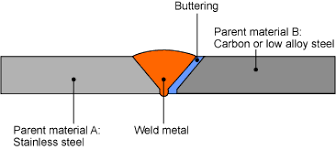
Select the Buffer Layer (Buttering): If the metals are highly incompatible, you can "butter" the face of one metal with a layer of filler metal that is compatible with the second metal.
Control the Heat Input: Use a "low-heat" process if possible. High heat increases dilution and intermetallic formation.
Post-Weld Cooling: Cool the joint slowly to manage the stress caused by differing thermal expansion rates.
VII. Dissimilar Metal Compatibility Matrix
| Metal A | Metal B | Compatibility | Recommended Filler/Process |
| Carbon Steel | Stainless Steel | Excellent | 309L Filler Rod |
| Carbon Steel | Copper | Good | Silicon Bronze / Brazing |
| Stainless Steel | Nickel Alloys | Excellent | Inconel-type Filler |
| Aluminum | Copper | Moderate | Friction Stir / Specialized Brazing |
| Aluminum | Steel | Poor | Transition Inserts / Explosion Welding |
VIII. FAQs of Dissimilar Metal Welding
Q1. Can I use a standard 308L rod to weld stainless to carbon steel?
It is not recommended. 308L does not have enough alloy content to handle the dilution from the carbon steel. This can result in a brittle weld that is prone to cracking. 309L is the industry standard for this joint.
Q2. What is "Buttering" in welding?
Buttering is the process of depositing a layer of filler metal onto the face of one of the base metals before the actual joint is made. This "buffer" layer makes the final weld more compatible and helps manage chemical migration.
Q3. Why did my dissimilar weld crack immediately upon cooling?
This is likely due to the difference in the Coefficient of Thermal Expansion. One metal shrank faster than the other, creating enough internal tension to tear the weld apart. Increasing the preheat or using a more ductile filler metal can help.
Q4. Is it possible to MIG weld copper to steel?
Yes, using a Silicon Bronze wire. This is technically a "braze-welding" process because the steel doesn't fully melt, but the Silicon Bronze bonds to it effectively.
Conclusion: The Key to DMW is Control
Welding dissimilar metals is an exercise in compromise. You are rarely seeking a "perfect" metallurgical match; instead, you are seeking a joint that is "fit for purpose." By understanding the thermal properties of your materials, utilizing tools like the Schaeffler Diagram, and controlling your heat input, you can create joints that leverage the best of both worlds.
In the future of manufacturing—where lightweighting and high-performance alloys are the norms—mastering dissimilar metal joining is no longer an optional skill; it is a foundational necessity for any advanced fabrication facility.
Related articles:
1. What Filler Metal to Use in Welding Dissimilar Metals?
2. An Introduction to Laser Welding for Dissimilar Metals
3. How To Prep Metal For Welding: A Complete Guide
4. 9 Tips for Welding Thin Gauge Sheet Metal
5. Tips for Welding Sheet Metal With MIG or TIG