Choosing the best submerged arc welding (SAW) machine depends on the welding application, required current, production volume, and level of automation. A power source that works well for one fabrication line may not be the most suitable choice for another.
For manufacturers comparing SAW welding machine suppliers, the most useful approach is to evaluate technical specifications, system compatibility, weld performance, service availability, and total operating cost—not brand reputation alone.
I. What Is the Best SAW Welding Machine?
There is no single SAW welding machine that is best for every application. The right choice depends on the material, plate thickness, joint design, wire and flux combination, welding procedure, and production requirements.
Before comparing suppliers, establish the following requirements:
Material and thickness: Identify the material grade, plate thickness, and joint configuration.
Required welding current: Select a power source that covers the required operating range at the intended duty cycle.
Production volume: Consider whether the equipment will run intermittently or perform long, high-current welding cycles.
Welding configuration: Determine whether the application requires a stationary welding head, a welding carriage, a column-and-boom system, or another automated arrangement.
Process requirements: Check whether constant-current (CC), constant-voltage (CV), or other specific operating modes are needed.
Local support: Confirm spare-parts availability, commissioning assistance, technical training, and service response in the installation country.
These requirements provide a more reliable basis for comparing equipment than a general “best welding machine” ranking.
II. How to Compare SAW Welding Machine Suppliers
When evaluating submerged arc welding equipment, compare the complete technical and commercial offer.
| Evaluation factor | What to check |
|---|
| Rated output current | Does the power source cover the required welding range? |
| Duty cycle | Can it sustain the intended current and production schedule? |
| Welding modes | Are the required CC/CV modes available? |
| Arc starting and ending | Can the parameters be adjusted to suit the joint and welding procedure? |
| Wire feeding | Is the feeding system compatible with the selected wire diameter and process? |
| Automation compatibility | Are the power source, controller, carriage, and other equipment compatible? |
| Process validation | Can the supplier support a representative welding trial? |
| Maintenance | Are manuals, replacement parts, and technical support available? |
| Total cost | What are the costs of the power source, accessories, integration, consumables, and maintenance? |
A supplier should be able to explain how its proposed configuration meets the application requirements. Confirm model-specific specifications and compatibility in writing before placing an order.
III. Megmeet SAW Welding Machines: Models and Applications
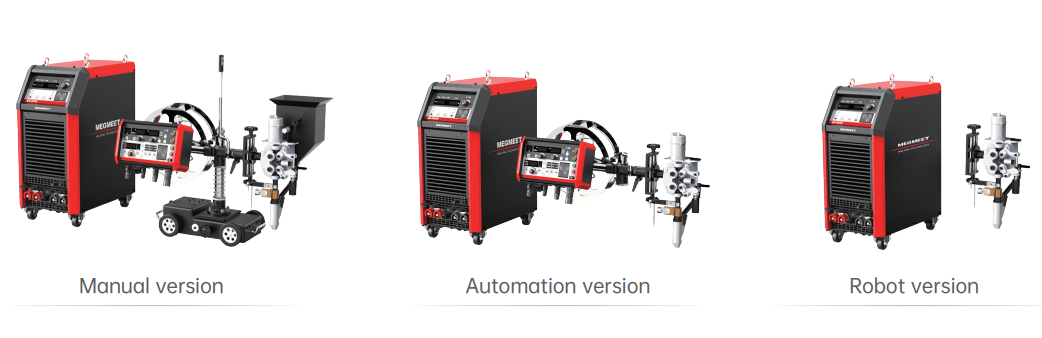
Megmeet offers the SA630, SA1000, and SA1250 series of submerged arc welding machines for medium- and thick-plate applications. The manufacturer lists applications including boilers, pressure vessels, shipbuilding, steel structures, and wind power equipment.
The three models provide different rated current ranges, allowing buyers to assess which option is appropriate for their welding procedure and production requirements.
| Model | Rated output current | Rated duty cycle listed by Megmeet |
|---|
| SA630 | 50–630 A | 630 A at 100% |
| SA1000 | 100–1,000 A | 100% |
| SA1250 | 100–1,250 A | 100% |
The SA series supports CC and CV welding modes. Published product information also describes adjustable arc-starting and arc-ending parameters and wire-feed control functions. Buyers should confirm the specifications and functions applicable to the exact model and configuration they intend to purchase.
Read the official Megmeet SAW welding machine product page for model details and technical specifications.
Is a SAW Power Source Enough?
No. A submerged arc welding installation may require additional equipment, depending on the application and automation level.
A complete system can include:
SAW power source
Wire-feeding and welding-head assembly
Welding carriage or column-and-boom system, where required
Flux hopper and appropriate flux handling or recovery equipment
Workpiece positioning and clamping equipment
Control equipment and interfaces required for the installation
Megmeet publishes specifications for compatible welding carriages and control equipment for its SA series. Buyers should confirm the exact combination of power source, wire feeder, carriage, and controls before ordering.
For product information, visit the Megmeet SAW welding machine range.
IV. How to Test a SAW Machine Before Buying
Published specifications are important, but they do not replace testing under representative production conditions. If possible, ask shortlisted suppliers to conduct a welding trial using the intended material, joint preparation, wire, flux, and welding procedure.
Evaluate the following:
Weld quality: Check penetration, bead profile, fusion, and relevant acceptance criteria.
Process stability: Observe arc starting, steady-state welding, and arc ending.
Production performance: Record travel speed, welding time, and the time required for setup and handling.
Rework requirements: Document defects, repairs, and post-weld work.
Equipment integration: Verify communication and control functions required by the proposed system.
Repeatability: Repeat the test to determine whether the process consistently meets the required criteria.
Use the same test conditions and acceptance criteria for each shortlisted supplier. This makes the comparison more meaningful than relying on different demonstrations or marketing specifications.
V. How Much Does a SAW Welding Machine Cost?
The purchase price depends on the power source, output rating, accessories, automation configuration, and regional supply arrangements. A complete production installation may also require integration, commissioning, operator training, spare parts, and ongoing maintenance.
When comparing quotations, separate the cost of the power source from the cost of the complete welding system. A lower initial price does not necessarily mean a lower total cost of ownership.
Ask each supplier to specify:
Included equipment and accessories
Optional components and integration costs
Warranty terms and exclusions
Availability and lead time for replacement parts
Commissioning and training arrangements
Local technical support
Expected maintenance requirements
These details help procurement teams compare quotations on a consistent basis.
VI. Questions to Ask Before Selecting a SAW Supplier
Q1: Which SAW machine is suitable for thick-plate welding?
Start with the required current range, duty cycle, material, joint design, and welding procedure. The machine rating should match the actual production requirement rather than the maximum current alone.
Q2: Is a higher-current SAW machine always better?
No. A higher-current model may be unnecessary if the application does not require that output. Select a machine based on the operating range, production schedule, and technical requirements.
Q3: What should be included in a SAW system quotation?
Request a clear list of the power source, wire-feeding equipment, welding head or carriage, flux equipment, controls, integration work, commissioning, and other required accessories.
Q4: Does Megmeet offer submerged arc welding machines?
Yes. Megmeet lists the SA630, SA1000, and SA1250 SAW machine models. Their published rated output current ranges from 50–630 A for the SA630 to 100–1,250 A for the SA1250. Confirm the complete technical specification and configuration with Megmeet before selecting a model.
Q5: How can buyers compare SAW machine suppliers fairly?
Use the same application specification, welding test procedure, acceptance criteria, and quotation checklist for every supplier. Compare demonstrated results, system compatibility, service arrangements, and total cost—not just advertised features.
VII. Conclusion: Choose the Machine That Fits the Application
The best SAW welding machine is the one that meets the required welding procedure, production capacity, automation needs, and support requirements at an acceptable total cost.
Compare rated current and duty cycle first, then verify process performance through a representative welding trial. Evaluate the complete system and local service arrangements before making a final decision.
For manufacturers assessing SAW equipment for medium- and thick-plate welding, the Megmeet SA630, SA1000, and SA1250 series are options worth evaluating alongside other suppliers. The final selection should be based on verified specifications, application testing, and the requirements of the installation.
Explore Megmeet SAW welding machines:
https://www.megmeet-welding.com/en/products/sa-series-saw-welders
Contact Megmeet for model and configuration information:
https://www.megmeet-welding.com/en/contacts
This article is a general equipment-selection guide, not an independent product ranking. Specifications, available configurations, and regional service arrangements should be confirmed with the supplier before purchase.