In the world of metal fabrication, few technologies are as fundamental as arc welding. From the skeletal frames of skyscrapers and the hulls of massive container ships to the delicate sensors in medical devices, arc welding is the invisible force holding the modern world together. As manufacturing moves toward 2026, the demand for high-efficiency, high-integrity joining methods has never been greater.
Understanding the various types of arc welding is not just for students or hobbyists; it is a critical requirement for engineers, project managers, and procurement specialists who need to balance speed, cost, and structural performance. This guide provides an in-depth analysis of the different types of arc welding, their underlying physics, and how to select the right process for your specific application.
I. The Physics of the Arc: How It Works
At its core, arc welding is a fusion process that uses an electric arc to create heat. This arc is essentially a continuous plasma discharge between an electrode and the base material. The temperatures generated in the arc can exceed 6,000°C, which is more than enough to melt most industrial metals instantly.
The basic circuit consists of a power source, two cables (work and electrode), an electrode holder (or torch), and the workpiece itself. When the electrode touches the workpiece and is then slightly withdrawn, the air gap becomes ionized, allowing current to flow through the plasma arc.
To calculate the heat input ($Q$) during these processes, engineers often use the following formula:
 caculiation formula.png "heat input (Q) caculiation formula.png")
Where:
II. Categorizing Arc Welding: Consumable vs. Non-Consumable
The easiest way to organize the types of arc welding is by the nature of the electrode used.
Consumable Electrode Processes: The electrode itself melts and becomes part of the weld pool (the "filler" metal). Examples include SMAW, GMAW, and FCAW.
Non-Consumable Electrode Processes: The electrode (usually Tungsten) does not melt. If filler metal is needed, it is added separately. The primary example is GTAW (TIG).
III.Analysis on Different Types of Arc Welding
1. Shielded Metal Arc Welding (SMAW) – "Stick Welding"
Often referred to as the "old reliable" of the industry, SMAW is the most widely used among the different types of arc welding for outdoor and structural work.
 or Shielded Metal Arc Welding (SMAW) - how it works.png "Stick welding, also known as Manual Metal Arc (MMA) or Shielded Metal Arc Welding (SMAW) - how it works")
1) How it Works
SMAW uses a fixed-length metal rod coated in a chemical flux. As the arc burns, the flux melts to create a gaseous shield and a layer of slag that protects the molten puddle from atmospheric contamination (oxygen and nitrogen).
2) Pros and Cons
Pros: Highly portable, requires no external gas tanks, and can be used in windy outdoor environments or on rusty/dirty metal.
Cons: Low productivity due to the need to stop and replace electrodes frequently; requires manual "slag chipping" after each pass.
Common Applications: Construction, pipeline repair, and farm maintenance.
2. Gas Metal Arc Welding (GMAW) – "MIG/MAG Welding"
MIG (Metal Inert Gas) or MAG (Metal Active Gas) welding is the most popular industrial process due to its high speed and ease of automation.
 welding - how it works.png "MIG (Metal Inert Gas) welding - how it works")
1) How it Works
A continuous solid wire electrode is fed through a welding gun. A shielding gas (usually Argon, CO2, or a mix) is delivered through the same gun to protect the weld pool.
2) Pros and Cons
Pros: High deposition rates, long continuous welds, and a very short learning curve for operators.
Cons: Requires bulky gas tanks; sensitive to wind (which blows away the shielding gas); requires very clean base metal.
Common Applications: Automotive manufacturing, sheet metal fabrication, and robotics.
3. Flux-Cored Arc Welding (FCAW)
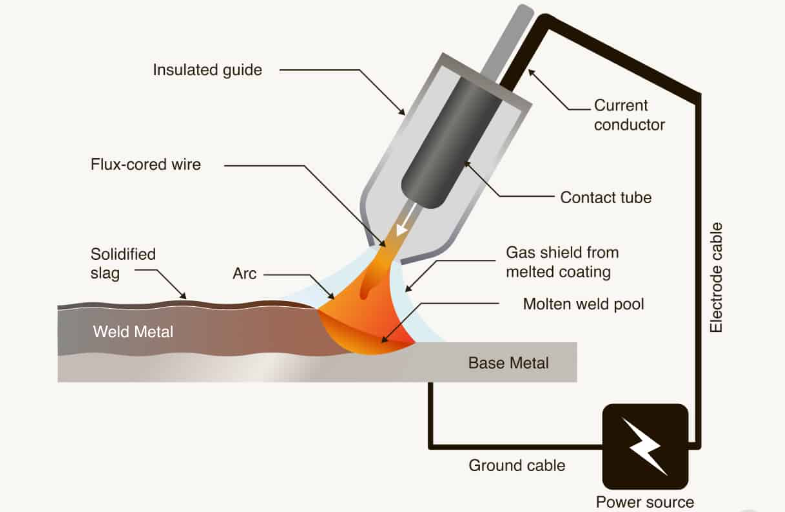
Think of FCAW as a hybrid between Stick and MIG. It was developed to combine the high productivity of MIG with the portability and "toughness" of Stick.
1) How it Works
Instead of a solid wire, FCAW uses a tubular wire filled with flux.
Self-Shielded (FCAW-S): The flux inside the wire provides all the protection (no gas tank needed).
Gas-Shielded (FCAW-G): An external gas is used in addition to the internal flux for higher-quality welds.
2) Pros and Cons
Pros: Deep penetration and very high speed. Excellent for thick plates and outdoor structural steel.
Cons: Produces significant smoke and fumes; requires slag removal.
Common Applications: Shipbuilding, heavy equipment repair, and structural steel erection.
4. Gas Tungsten Arc Welding (GTAW) – "TIG Welding"
When precision and aesthetics are the priority, TIG is the undisputed king of the types of arc welding.

1) How it Works
A non-consumable tungsten electrode creates the arc. The welder manually dabs a filler rod into the puddle with their other hand. This provides the operator with independent control over the heat (via a foot pedal) and the amount of filler metal.
2) Pros and Cons
Pros: The cleanest, most beautiful welds. No sparks, no smoke, and no slag. Ideal for very thin materials and exotic alloys.
Cons: The slowest process; requires the highest level of operator skill; equipment is more expensive.
Common Applications: Aerospace, medical devices, high-end bicycle frames, and nuclear power piping.
5. Submerged Arc Welding (SAW)
For massive industrial projects, SAW is the workhorse that stays "under the radar"—literally.
1) How it Works
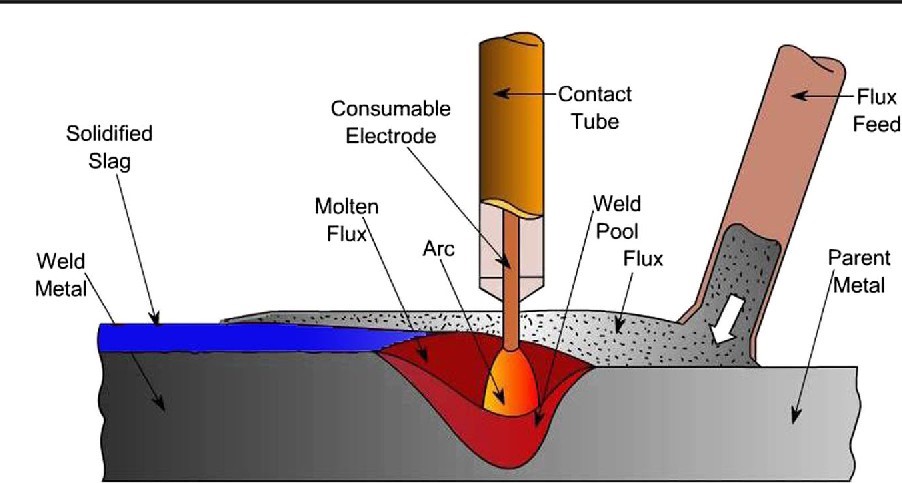
The arc is struck beneath a thick layer of granular flux. The arc is not visible to the operator, which eliminates the need for a welding helmet and prevents "arc flash" in the shop.
2) Pros and Cons
Pros: Incredible deposition rates (up to 10x faster than MIG). Deep penetration and high-quality mechanical properties.
Cons: Limited to flat or horizontal positions; requires a flux recovery system; only used for long, straight seams on thick material.
Common Applications: Pressure vessels, bridge girders, and large diameter pipe manufacturing.
6. Plasma Arc Welding (PAW)
Often confused with TIG, PAW is a more advanced version used for extreme precision and high-speed automated lines.
1) How it Works
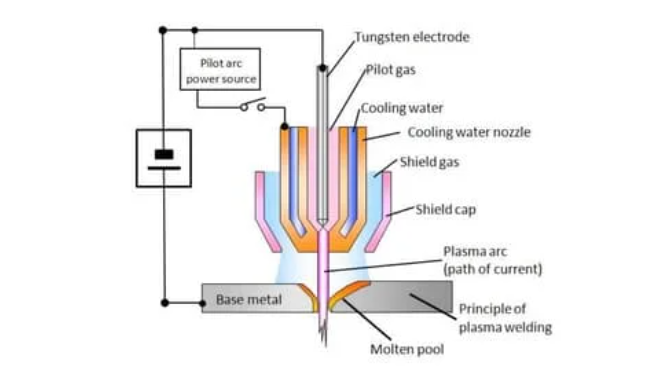
The electrode is recessed within the torch body. The gas is forced through a tiny nozzle, constricting the arc into a needle-like shape. This increases the energy density significantly compared to standard TIG.
2) Pros and Cons
Pros: Higher welding speeds than TIG and a much more stable arc at very low amperages. Excellent for "keyhole" welding in thick materials.
Cons: Very expensive equipment and complex torch maintenance.
Common Applications: Electronics, precision instrumentation, and jet engine components.
IV. Comparison of the Different Types of Arc Welding
| Process | Portability | Skill Level | Speed | Material Thickness | Best For |
| SMAW (Stick) | Excellent | Moderate | Slow | Medium to Heavy | Outdoors/Construction |
| GMAW (MIG) | Poor | Low | Fast | Thin to Medium | Production/Auto |
| FCAW (Flux) | Good | Moderate | Very Fast | Heavy | Shipbuilding/Heavy Iron |
| GTAW (TIG) | Poor | High | Very Slow | Thin/Exotic | Aerospace/Precision |
| SAW (Sub) | None | Moderate | Fastest | Very Heavy | Large Pipes/Girders |
V. How to Choose Among the Different Types of Arc Welding
Selecting the right process is a strategic decision. Consider the following "Big Four" factors:
Material Type: Aluminum usually demands TIG or MIG. Heavy carbon steel is best suited for Flux-Core or Sub-Arc.
Environment: If you are on a windy construction site, MIG is a nightmare. Stick or self-shielded Flux-Core are the only viable options.
Volume: For 1,000 identical parts, MIG or SAW (automated) is the only way to remain profitable. For a one-off custom titanium exhaust, TIG is the only choice.
Appearance vs. Strength: If the weld will be visible on a luxury product, TIG is required. If the weld is buried inside a bridge girder, the high-deposition strength of SAW is preferred.
VI. Safety in Arc Welding
Regardless of the types of arc welding you use, safety is non-negotiable. The arc produces:
UV and IR Radiation: Can cause permanent eye damage ("arc eye") and skin burns.
Toxic Fumes: Especially when welding galvanized steel or using flux-heavy processes like FCAW.
Electrical Shock: High-amperage current requires properly grounded equipment and dry environments.
Conclusion
The landscape of the different types of arc welding is changing. We are seeing the rise of Cobots (collaborative robots) that allow human welders to program complex MIG or TIG paths in minutes. Furthermore, digital "inverter" power sources now allow for hyper-precise waveforms, reducing spatter and heat input to levels previously thought impossible.
As we look toward the future of global manufacturing, the "arc" remains the central pillar of fabrication. Mastering these processes ensures that our structures remain safe, our vehicles remain light, and our technology continues to advance.
Related articles:
1. Manual Arc Welding (MMA) vs. Robotic Welding: A Comprehensive Guide
2. Complete Basics of Gas Shielded Arc Welding
3. What is Hybrid Laser-Arc Welding and How Does It Work?
4. Arc Welding Tools and Equipment List
5. How to Select and Use an Arc Welding Power Source?