In the world of fabrication, repair, and manufacturing, the ability to join two pieces of metal together is a foundational skill. However, not all joints are created equal. Depending on the materials you are using, the strength required, and the thermal sensitivity of your project, you will likely find yourself choosing between three primary methods: welding, brazing, and soldering.
While these processes all achieve the same high-level goal—fusing components into a single unit—the physics, temperatures, and metallurgical results differ significantly. Choosing the wrong method can lead to joint failure, material warping, or even the destruction of sensitive components.
This comprehensive guide breaks down the nuances of welding vs. brazing vs. soldering, helping you identify the right technique for your next project.
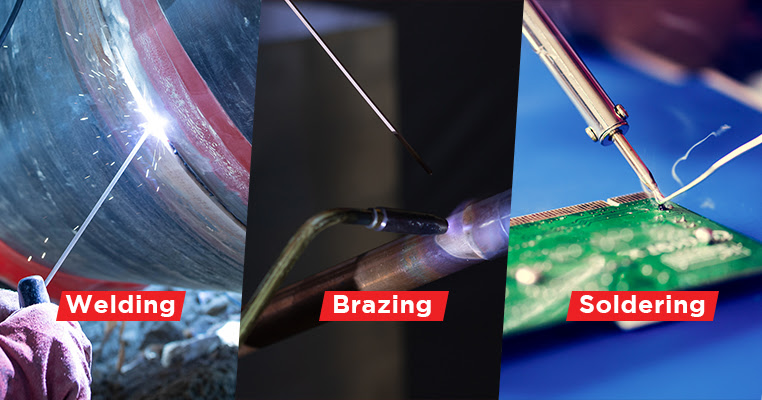
I. What is Welding? The Power of Fusion
Welding is the most robust metal-joining process. Unlike the other two methods, welding relies on fusion. In a true weld, the base metals (the pieces being joined) are melted along with a filler material to create a single, homogenous pool of molten metal. When this pool cools, the two pieces become one.
1) How Welding Works?
Welding involves an intense, localized heat source—usually an electric arc or a gas flame—that reaches temperatures high enough to melt the base metal. Because the base metal itself melts, the resulting joint is often as strong as, or even stronger than, the original material.
2) Common Welding Processes
Arc Welding: Uses an electric power supply to create an arc between an electrode and the base material.
Gas Metal Arc Welding (GMAW): Uses a continuous wire feed and a shielding gas.
Gas Tungsten Arc Welding (GTAW): Known for precision, it uses a non-consumable tungsten electrode.
3) Key Characteristics of Welding
Highest Temperature: Requires temperatures exceeding the melting point of the base metals, often reaching 3000°C or higher in the arc.
Structural Strength: Ideal for heavy-duty applications like bridge construction, automotive frames, and pressure vessels.
Metallurgical Change: The heat-affected zone (HAZ) undergoes a permanent change in grain structure, which can sometimes lead to brittleness if not managed correctly.
II. What is Brazing? The Strength of Capillary Action
If welding is about "melting together," brazing is about "gluing together" with high-strength liquid metal. In brazing, the base metals are heated but never melted. Instead, a filler metal with a lower melting point is flowed into the joint.
1) How Brazing Works?
Brazing relies on a phenomenon called capillary action. When two closely fitted base metals are heated to the correct temperature, the molten filler metal is drawn into the tiny gap between them, regardless of the orientation of the joint.
To be classified as brazing, the process must occur at temperatures above 450°C (840°F), but below the melting point of the base metals.
2) Why Choose Brazing?
Dissimilar Metals: Brazing is excellent for joining metals that cannot be easily welded together, such as copper to steel.
Reduced Distortion: Because the base metals don't melt, there is significantly less warping and internal stress compared to welding.
Cleanliness: Brazed joints are often very neat and require minimal post-weld finishing.
III. What is Soldering? Precision and Conductivity?
Soldering is technically a "cousin" to brazing, but it operates at much lower temperatures. It is the go-to method for electronics, jewelry making, and residential plumbing.
1) How Soldering Works?
Like brazing, soldering uses a filler metal (solder) and capillary action. However, soldering takes place at temperatures below 450°C (840°F).
Historically, solders were lead-based, but modern health standards have shifted the industry toward lead-free alloys, typically consisting of tin, silver, and copper.
2) Soft Soldering vs. Hard Soldering
Soft Soldering: Used primarily in electronics. It uses the lowest temperatures and provides the least mechanical strength but excellent electrical conductivity.
Hard (Silver) Soldering: Technically a form of brazing, this uses higher temperatures and silver-bearing fillers to create stronger joints in jewelry or high-pressure copper piping.
3) Key Characteristics of Soldering
Thermal Safety: Low heat prevents damage to sensitive electronic components or delicate decorative items.
Reversibility: Solder joints can easily be "de-soldered" by reheating the joint, making it ideal for repairs.
Lower Strength: Solder joints are not intended for high-load structural applications.
IV. Welding vs. Brazing vs. Soldering: Key Differences at a Glance
For quick decision-making, it helps to compare the three methods across several critical factors.
1) Temperature Thresholds
The most objective way to distinguish these methods is by the heat involved:
2) Strength of the Joint
Welding: The strongest. The joint is a continuous piece of metal.
Brazing: Medium-high strength. While not as strong as a weld, it is often sufficient for high-pressure systems like HVAC lines.
Soldering: Lowest strength. Primarily used for connection and containment rather than load-bearing.
3) Impact on the Base Metal
Welding: Causes significant changes to the base metal's properties. High risk of distortion.
Brazing/Soldering: Minimal impact on the base metal. The parts retain their original shape and metallurgical integrity.
| Feature | Welding | Brazing | Soldering |
| Base Metal Melts? | Yes | No | No |
| Heat Source | High Intensity (Arc/Flame) | Medium (Torch/Induction) | Medium (Torch/Induction) |
| Primary Bond | Fusion | Capillary Action | Capillary Action |
| Joint Clearance | Not critical | Very tight (0.001 - 0.005") | Tight |
| Skill Level | High | Medium | Low to Medium |
V. Factors to Consider When Choosing Your Method
To select the right process, ask yourself the following four questions:
A. How thick is the material?
Welding is generally preferred for thick sections of metal (e.g., 1/4 inch and up) because it provides the depth of penetration needed for stability. Brazing and soldering are better suited for thin-walled tubing or sheet metal where high heat would cause "burn-through."
B. Are the metals the same?
If you are joining steel to steel, welding is usually the most efficient. If you are joining brass to stainless steel or copper to galvanized steel, brazing is almost always the superior choice because it avoids the complex metallurgical "clashes" that occur during fusion.
C. Does it need to conduct electricity?
While all metal joints conduct electricity to some degree, soldering is specifically engineered for this. In electronics, the goal is a low-resistance path, and the low heat of soldering ensures that the circuit board traces don't delaminate.
D. What are the aesthetics of the finished product?
If the joint will be visible—such as in high-end furniture or jewelry—brazing and soldering offer a much cleaner appearance. Welding often produces "beads" or "spatter" that require grinding and polishing to hide.
VI. The Role of Flux in Brazing and Soldering
You cannot discuss brazing or soldering without mentioning flux. Unlike welding, where shielding gas is often used to protect the molten pool, brazing and soldering use a chemical cleaning agent called flux.
The Purpose of Flux:
Oxide Removal: It chemically dissolves the oxide layer that forms on metal when heated.
Prevents Oxidation: It acts as a barrier, preventing new oxides from forming during the heating process.
Wetting: It promotes "wetting," which is the ability of the liquid filler metal to spread across the surface of the base metal.
Without flux, the filler metal will simply bead up like water on a waxed car, failing to enter the joint.
Conclusion: Which One Do You Need?
The "welding vs. brazing vs. soldering" debate isn't about which process is better, but which is appropriate for the task at hand.
Choose Welding when you need maximum strength, are working with heavy materials, and want a permanent, fused structure.
Choose Brazing when you need a strong, leak-proof joint between dissimilar metals or thin sections where distortion must be minimized.
Choose Soldering for electrical connections, delicate repairs, or plumbing where ease of use and thermal safety are the priorities.
By understanding the melting points, the mechanics of capillary action versus fusion, and the specific needs of your materials, you can ensure that every joint you create is built to last.
Related articles:
1. Spot Welding vs. TIG Welding vs. MIG Welding: Differences & How to Choose?
2. Arc Welding vs. Laser Welding: The Key Differences
3. Cold Metal Transfer (CMT) Welding VS. Retract Droplet Transfer (RDT) Welding
4. Bad Welding vs Good Welding: How to Tell the Difference?
5. Laser Welding Vs. Arc (TIG) Welding