In the world of metal fabrication, few things are as universally frustrating as welding spatter. Whether you are a seasoned professional in an industrial setting or a weekend hobbyist in a home garage, those tiny, stubborn droplets of molten metal that fuse themselves to your workpiece and equipment can turn a quick job into a grueling cleanup session.
Beyond the aesthetic annoyance, welding spatter represents a loss of filler material, potential structural issues, and a significant drain on productivity. Understanding the science behind why it happens and how to prevent it is the key to producing clean, professional welds every time.
In this comprehensive guide, we will explore the definition of welding spatter, its primary causes, and the industry-proven techniques used to minimize it.
I. What is Welding Spatter?
Welding spatter consists of small particles of molten metal that are expelled from the welding arc during the fusion process. These droplets are projected away from the weld pool and typically land on the base metal, the welding nozzle, or the surrounding workspace. Because they are molten upon contact, they often fuse to the surface, requiring mechanical removal through chipping, grinding, or sanding.
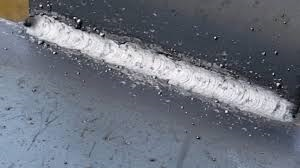
1) Spatter vs. Splatter: What’s the Difference?
While the terms are often used interchangeably in casual conversation, "spatter" is the correct technical term used within the welding industry and by organizations like the American Welding Society (AWS). "Splatter" is more commonly associated with liquids like paint or water. However, regardless of what you call it, the result is the same: a messy weld that requires extra work.
2) Why is Spatter a Problem?
Post-Weld Cleanup: Removing spatter is labor-intensive and increases the total time spent on a project.
Visual Quality: For projects where aesthetics matter—such as automotive bodywork or architectural steel—spatter creates an unprofessional, "dirty" appearance.
Equipment Damage: Spatter can build up inside the welding nozzle (shroud) and on the contact tip, obstructing gas flow and causing wire-feeding issues.
Coating Failure: If spatter isn't properly removed before painting or powder coating, the coating will eventually flake off those raised bumps, leading to premature corrosion.
II. The Primary Causes of Welding Spatter
Spatter is rarely the result of a single factor. Usually, it is a combination of machine settings, material preparation, and environmental conditions. Here are the most common culprits:
1. Surface Contamination
One of the most frequent causes of excessive spatter is welding on "dirty" metal. Any substance that isn't the base metal itself will react violently to the intense heat of the arc.
Rust and Scale: Iron oxide does not conduct electricity as well as clean steel and causes arc instability.
Oil and Grease: Residual oils from the manufacturing process vaporize and expand rapidly, popping like grease in a frying pan.
Zinc Coatings: Welding on galvanized steel is notorious for spatter because the zinc boils at a lower temperature than the steel melts, creating gas pockets that explode out of the puddle.
2. Incorrect Machine Settings
Welding is a delicate balance between voltage (heat) and wire feed speed (material). If this balance is off, the arc will not be stable.
Wire Speed Too High: If the wire is feeding faster than the arc can melt it, the wire "stubs" into the weld pool, causing a violent short circuit that flings metal everywhere.
Voltage Too Low: Low voltage results in a cold arc that struggles to maintain a consistent molten pool, leading to globular transfer rather than a smooth spray.
3. Improper Shielding Gas
The gas used to protect the weld from the atmosphere plays a huge role in how the metal transfers from the wire to the joint.
Pure CO2: While cost-effective, 100% CO2 gas often results in a "globular" transfer. This means the molten metal forms large, irregular drops that tend to pop and scatter.
Gas Flow Issues: If the gas flow is too low (due to wind or a clogged nozzle), the arc becomes unprotected, causing "turbulence" and spatter.
4. Electrode Angle and Arc Length
The way you hold the torch matters.
Too Much Angle: If the torch is held at an extreme angle (beyond 15 degrees from vertical), the force of the arc can blow the molten metal out of the puddle.
Long Arcing: In Stick welding or TIG, holding the electrode too far from the workpiece creates an unstable arc that is easily disturbed.
III. How to Avoid Welding Spatter: Best Practices
Prevention is always more efficient than cleanup. By following these steps, you can significantly reduce, or even eliminate, spatter in your welding projects.
Step 1: Prioritize Metal Preparation
You cannot produce a clean weld on dirty metal. Use a wire brush, an angle grinder, or a chemical degreaser to ensure the weld zone is clear of rust, paint, and oil. For the best results, grind the surface until you see shiny, bare metal.
Step 2: Optimize Your Settings
A "tuned" machine is a quiet machine. When a MIG welder is set correctly, it should produce a consistent "sizzle" sound, similar to bacon frying.
Fine-Tune the Wire Speed: If you feel the torch pushing back against your hand, your wire speed is likely too high. Decrease it slightly until the arc is smooth.
Check the Polarity: Ensure your machine is set to the correct polarity for the wire you are using. Solid wire with gas typically requires DCEP (Direct Current Electrode Positive), while flux-cored wire often requires DCEN.
Step 3: Choose the Right Shielding Gas
If your application allows for it, switching from pure CO2 to an Argon/CO2 mix (typically 75% Argon and 25% CO2) is the single most effective way to reduce spatter. Argon creates a much smoother arc and allows for "spray transfer," where the metal moves across the arc in a fine mist rather than large, unstable drops.
Step 4: Use Anti-Spatter Solutions
For industrial applications or complex geometries where cleanup is difficult, anti-spatter products are a lifesaver.
Nozzle Gel: Dipping your welding nozzle into a jar of specialized gel prevents spatter from sticking to the contact tip and shroud.
Anti-Spatter Spray: Spraying a water-based or solvent-based solution onto the base metal around the weld joint creates a temporary barrier. Any spatter that lands on the spray will not fuse and can be easily brushed away with a glove or a cloth after the weld cools.
Step 5: Maintain Your Equipment
A worn-out contact tip or a kinked liner can cause "chatter" in the wire feed. This inconsistency leads to a flickering arc, which is a major source of spatter. Replace your consumables regularly and ensure your ground clamp is attached to clean, bare metal to maintain a strong electrical circuit.
IV. Advanced Techniques: Waveform Control and Constant Feed
In modern industrial welding, technology has evolved to tackle spatter at the source. Many high-end power sources now feature Waveform Control Technology. These machines use high-speed electronics to monitor the arc thousands of times per second.
When the machine senses a short circuit (the moment spatter is usually created), it instantly reduces the current to prevent a violent "explosion" of the droplet. This results in an incredibly smooth weld with virtually zero spatter, even when using 100% CO2 gas.
V. Dealing with Spatter After the Weld
Even with the best preparation, a small amount of spatter can occur. When it does, use the following tools for removal:
Chipping Hammer: For heavy spatter on thick structural steel.
Wire Brush: Good for removing light, "dusty" spatter.
Scraper or Chisel: A sharp cold chisel can pop off individual stubborn beads.
Flap Discs: For a perfectly smooth, paint-ready finish, a 60 or 80-grit flap disc on an angle grinder is the most efficient tool.
VI. Summary Checklist for Spatter-Free Welding
| Factor | Action for Less Spatter |
| Material | Grind to bare, shiny metal; remove all oils. |
| Gas | Use an Argon/CO2 mix instead of 100% CO2. |
| Settings | Balance voltage and wire speed until you hear a steady sizzle. |
| Technique | Maintain a consistent arc length and a 10-15 degree torch angle. |
| Protection | Use anti-spatter spray on the workpiece and gel on the nozzle. |
| Grounding | Ensure the ground clamp is on clean metal for a stable arc. |
Conclusion
Welding spatter is often viewed as an unavoidable part of the process, but in reality, it is usually a symptom of a specific technical issue. By taking the time to properly clean your materials, dial in your machine settings, and choose the correct shielding gas, you can transform your welding experience.
Reducing spatter doesn't just make your welds look better—it saves money on consumables, reduces the physical toll of grinding, and allows you to focus on the art of fusion rather than the chore of cleanup. Keep your metal clean, your arc steady, and your settings balanced, and you will find that a spatter-free weld is well within your reach.
Related articles:
1. Causes and Solutions for Slag Spatter in Dual-shield Welding
2. 10 Secrets to Reduce Welding Spatter
3. How to Reduce the Occurrence of Welding Cracks?
4. Reducing Energy Consumption During Welding - how it’s done?
5. Welding and Sustainability: How to Balance these Two?