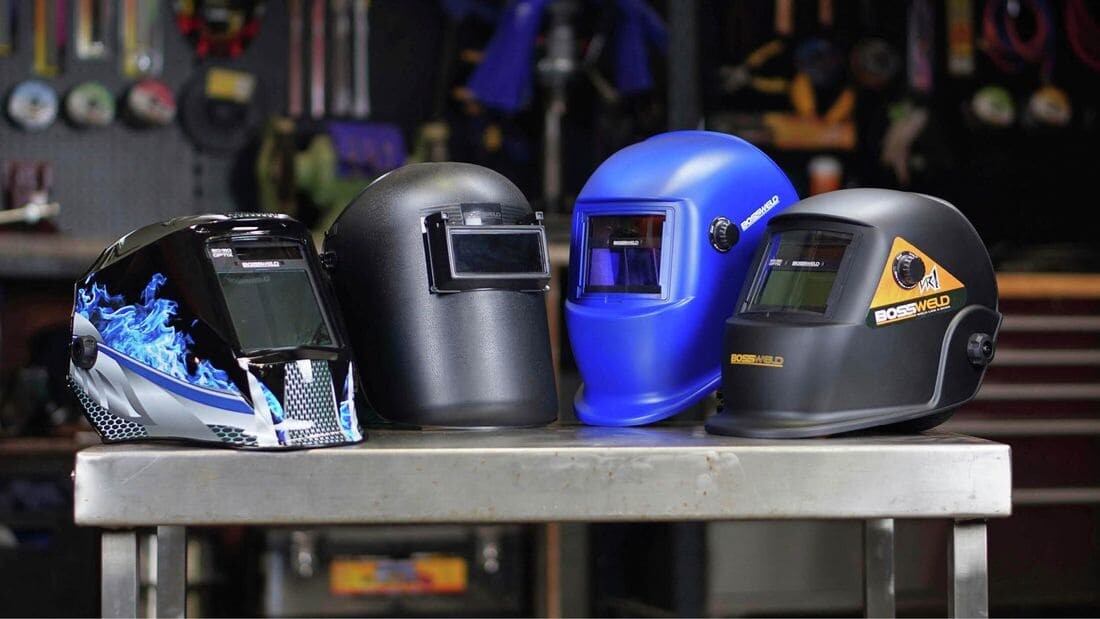
A welding helmets is more than just a visor. It’s your first line of defence against intense light, harmful radiation, and flying spatter. Choosing the right helmet means balancing protection, comfort, visibility and adaptability to your work. In this article you’ll find clear guidance on what to look for, how to compare features, and how to pick a helmet that fits your style and application.
I. Why the right helmet matters?
Welding produces an intense arc, ultraviolet (UV) and infrared (IR) radiation, flying sparks, hot metal fragments and sometimes grinding or cutting operations. A helmet that does not properly protect you can lead to eye strain, “arc eye”, burns on your face/neck and reduced visibility of the weld region.
At the same time, a helmet that is heavy, poorly fitted or visually limiting will fatigue you, reduce your precision, and may even discourage you from wearing it consistently.
Therefore: protection + comfort + visibility = better welding.
II. Key features to evaluate a Right Welding Helmet
Below are the major aspects you should compare when choosing a welding helmet.
1. Safety standard compliance
Make sure the helmet meets recognized safety standards. For example:
In the US, look for ANSI Z87.1 (or equivalent) certification.
In Europe, auto-darkening helmets are governed by EN 379, which gives ratings such as 1/1/1/1 or 1/1/1/2 for optical clarity.
Meeting these standards ensures the lens filters dangerous UV/IR radiation and offers reliable protection even before the arc triggers darkening.
2. Fixed shade vs auto-darkening
Fixed (passive) shade helmets have a dark tinted lens all the time (for example shade #10) and don’t change when the arc strikes. They’re simpler and lighter.
Auto-darkening helmets (ADF) use sensors to detect the welding arc and switch the lens from a light state to a dark state (shade you select) almost instantly. This means you can see through the helmet before striking the arc, reducing guesswork and fatigue.
If your work involves frequent short welds, tack welding, grinding or switching tasks, auto-darkening is generally the better option.
3. Shade range
The shade number refers to how dark the lens becomes when welding. Higher welding currents or intense arcs require darker shades. Typical guidelines:
For MIG, stick welding: shades around DIN 10-12 (or equivalent) are common.
For TIG or lower amps maybe shade DIN 8-10.
When the helmet offers a variable shade range, you can adjust the darkness depending on process, material, amperage and ambient light. That flexibility improves comfort and accuracy.
4. Optical clarity & viewing area
Optical clarity ratings such as 1/1/1/1 (EN standard) indicate how clear, undistorted and consistent the view through the lens is. Higher clarity equals better visibility and less eye fatigue.
Viewing area refers to the size of the window you look through. A larger viewing area gives you a broader view of your workpiece and surroundings. For example, beginners may prefer a larger area.
Balance is key: bigger viewing area often adds weight; clarity is more important than size alone.
5. Sensor count, switch speed & sensitivity
For auto-darkening helmets:
Number of arc sensors: More sensors (3 or 4) increase reliability especially when welding in awkward positions or when sensors may be blocked.
Switch speed / reaction time: The faster the lens switches from light to dark, the less exposure your eyes get to the arc.
Sensitivity / delay controls: Allows you to adjust how easily the lens triggers and how long it stays dark after the weld ends—important for processes like TIG or grinding.
6. Weight, fit & comfort
If you wear your helmet for hours every day, weight and fit matter a lot. A heavy helmet strains your neck and increases fatigue. Good adjustable headgear, proper coverage of the head/neck, and comfortable padding all improve your experience. It’s worth putting a helmet on and walking around to see how it feels.
7. Additional features / usability
Grind mode: Lets you switch the lens to a lighter shade or non-arc state so you can grind without removing the helmet.
Coverage/protection: Does the helmet cover your ears, neck and top of head? Some tasks require more coverage.
Battery or solar power: For auto-darkening, check how it is powered and how long it lasts.
Replaceable lenses/cover plates: The outer covering often gets scratched; easy replacement means less downtime.
Comfort extras: Sweatbands, helmet balance, low profile, compatibility with respirators or hard hats if needed.
III. Step-by-step selection checklist
Here’s a practical checklist you can run through when choosing your helmet:
1)Identify your welding tasks
What processes do you use (MIG, TIG, stick, plasma, grinding)?
What current/amperage ranges do you work at?
Do you frequently switch between tasks or materials?
Do you wear a respirator or work in confined/bright conditions?
2)Decide on lens type
If you do occasional hobby welding, a fixed-shade helmet may suffice.
If you weld full time, switch tasks often, or value visibility and ease, pick auto-darkening with a good range.
3)Check the shade range
If you do grinding as well, ensure a suitable grind/light mode.
4)Inspect optical clarity & viewing area
Look for clarity ratings like 1/1/1/1 or 1/1/1/2 if you want top-level visibility.
Choose a viewing area size suited to your work: wide for larger assemblies, narrower for precision work.
5)Sensor, reaction time and controls
6)Try it on for fit & comfort
Raise and lower your head; check if it stays stable.
Ensure the back, top and neck are covered if your work generates overhead spatter.
Note the weight on your head and if it feels balanced.
7)Evaluate extras & durability
See how easy it is to replace outer lenses and cover plates.
Check if the helmet has features such as grind mode, compatibility with respirator, good padding, good balance.
Consider the environment you work in (bright shop, outdoors, confined space) and how the helmet fits that.
8)Budget with future in mind
A quality helmet is an investment. Don’t pick purely by lowest cost—visibility, protection and comfort count.
Consider replacement parts cost (cover plates, batteries) and expected lifespan.
IV. Common mistakes to avoid
Choosing a helmet that fits poorly (slips, moves) which undermines protection and precision.
Ignoring climate or ambient light: auto-darkening helmets may struggle in bright sunlight or reflective environments if sensors are exposed.
Selecting a helmet with too limited shade range, forcing you to use an incorrect shade or change helmets for different tasks.
Failing to replace scratched or damaged lenses/plates, which reduces optical clarity and protection.
Ignoring comfort and ergonomics — even the best helmet will be a burden if it causes fatigue.
Conclusion
Choosing a good welding helmet means combining safety, visibility and comfort. Start with a helmet that meets the required safety standards, opt for auto-darkening if you weld regularly or switch tasks, ensure the shade range and optical clarity match your work, and pay attention to sensor quality, fit and comfort. Don’t compromise on what you will use every day simply to save a few dollars. A well-chosen helmet protects your eyes, improves your accuracy and makes your welding work more comfortable and consistent.
Related articles:
1. The Perils of Welding Without Adequate Protection
2. What protective gas should I use for laser welding?
3. Common Dangers of Welding and How to Avoid Them
4. How to Prevent and Control Fire Hazards in Welding Operations?
5. Welding Safety: Hazards, Tips, & Precautions